A pharmacy loyalty program is a rewards scheme that gives members points, perks or services for shopping with a pharmacy, built so that ordinary rewards apply to front of store purchases while prescriptions are handled under the stricter rules that govern medicines and health data. That split is what makes pharmacy different from every other retail category, and it is where most programs either get into legal trouble or leave retention on the table.
This guide covers what a pharmacy rewards program can and cannot incentivise in the US and the GCC, how to separate over the counter (OTC) and front of store spend from the dispensary, why refill reminders are the strongest retention mechanic a pharmacy has, and how to handle the health data a program inevitably touches. It is written for pharmacy chains, drugstores and health retailers evaluating a loyalty platform. It is not legal advice, so check every rule below with counsel in each market you operate in.
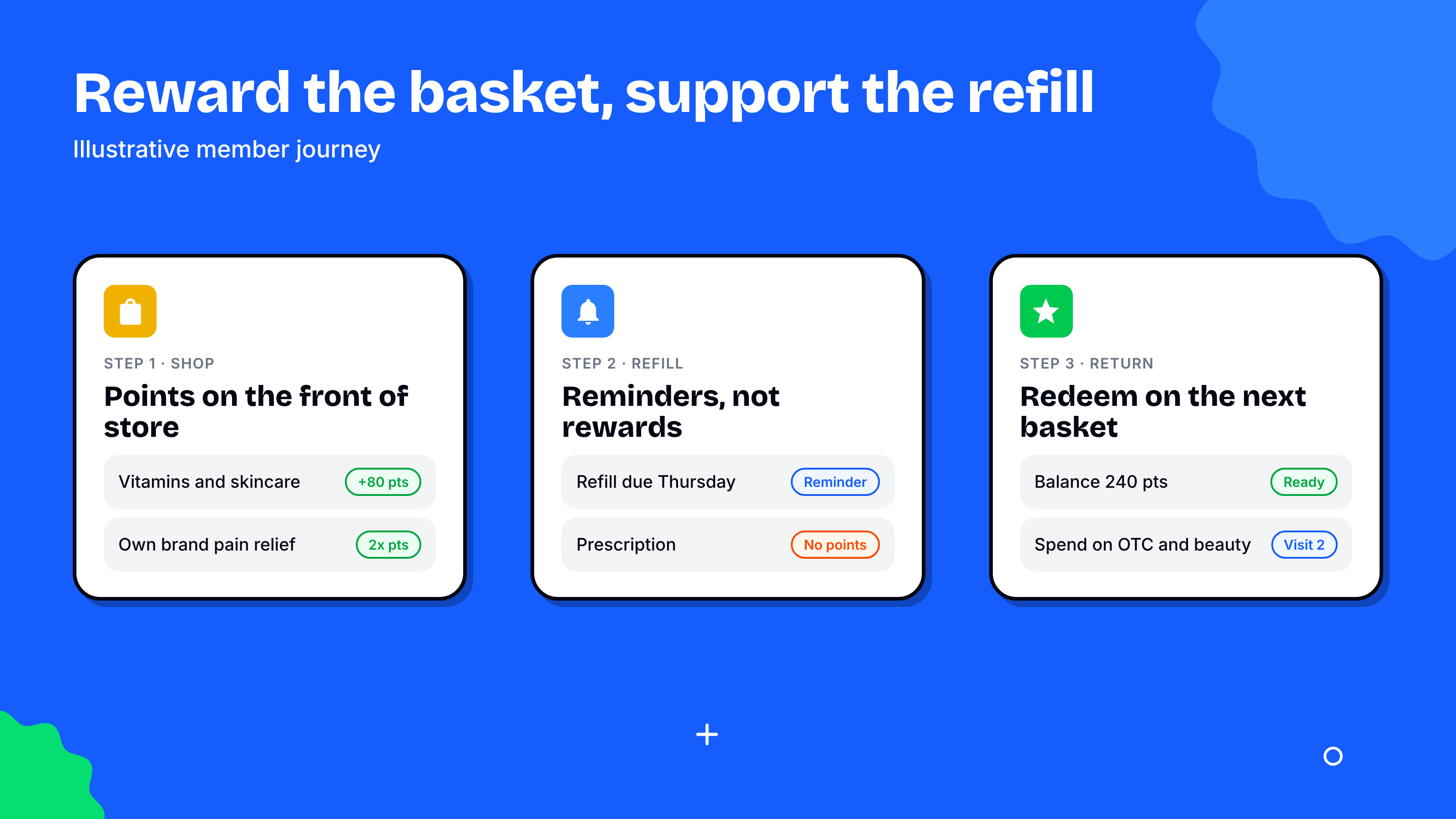
What is a pharmacy loyalty program?
A pharmacy loyalty program, often called a drugstore loyalty program, rewards repeat visits to a pharmacy chain or health retailer. Most combine a points currency on everyday health, beauty and household products with pharmacy services such as refill reminders, delivery and pharmacist access. To see how this fits the wider category, read our companion guide on retail loyalty software, which covers the features every multi store chain needs before it picks a platform.
Three formats dominate the market, and the largest chains run all three inside one app:
Members earn a currency on beauty, baby, household and OTC purchases. CVS ExtraCare pays 2% back in ExtraBucks Rewards on purchases after coupons.
A monthly fee buys delivery and discounts. ExtraCare Plus costs $5 a month and adds free same day delivery and 20% off CVS Health brand products.
Refill reminders, pickup alerts and chronic medication outreach. Saudi chain Nahdi sends refill reminders to chronic medication customers as part of its personalisation work.
The CVS details come from Fox Business's breakdown of ExtraCare, and the Nahdi details from Retail4Growth's report on the chain's data tools. The common thread is that none of the three formats pays points directly on a prescription without conditions.
Why pharmacy retention works differently
Pharmacy is the rare retail category where the most frequent purchase is also the one you are least free to reward. A patient on a chronic medication visits every month, the kind of frequency a fashion or electronics brand would pay heavily for, and that frequency is exactly what drives a strong repeat purchase rate. But in the US, rewarding a prescription paid for by a federal health care program can raise issues under the Anti-Kickback Statute and the beneficiary inducement rules, and several states restrict prescription rewards outright.
That is why CVS makes its pharmacy rewards unavailable in Arkansas, New Jersey and New York, caps them at $50 in ExtraBucks Rewards per calendar year, and only lets prescriptions earn credits once a member signs a privacy authorization. The upside of getting the design right is large, and so is the cost of patients drifting away from their medication:
The adherence figure is from the American Heart Association's medication adherence fact sheet, which also puts nonadherence at about 125,000 preventable deaths a year in the US. For a pharmacy, every patient who stops refilling is both a health outcome and a lost monthly visit, which is why retention here is closer to care than to marketing.
What can a pharmacy rewards program incentivise?
In most markets a pharmacy rewards program can freely reward front of store and OTC purchases, while anything tied to prescription drugs, especially prescriptions paid by government health programs, needs legal review and is often restricted or excluded. The table below shows how that plays out across the markets this guide covers.
| Purchase or action | Can it earn rewards? | What chains do |
|---|---|---|
| Front of store: beauty, baby, household | Yes, under ordinary retail rules | Standard points, multipliers, tiers and challenges |
| OTC medicines and supplements | Usually yes, subject to local rules on promoting medicines | Points, often with own brand multipliers |
| US prescriptions paid by federal programs | High risk under the Anti-Kickback Statute and beneficiary inducement rules | Excluded, or counted neutrally with no prescription specific reward |
| Other US prescriptions | Restricted by some states | CVS: unavailable in Arkansas, New Jersey and New York, capped at $50 a year |
| UK prescriptions | Excluded by major chains | Boots excludes prescriptions, selected dispensary items and pharmacy services from its 8 points per £1 Over 60s offer |
| GCC prescriptions | Set by each national health regulator | Keep points on the front of store unless local counsel approves otherwise |
| Refill reminders | Yes, as a service | Sent by app, SMS and email under the US refill reminder exception |
| Incentives to transfer a prescription | High risk | Avoid: regulators read them as steering patients between pharmacies |
The clearest US precedent is OIG Advisory Opinion 12-05. The regulator declined to act against a supermarket chain's rewards program in which pharmacy spend counted like any other purchase, because rewards could only be redeemed on gasoline, cost sharing was not waived, and there was no specific incentive to transfer prescriptions, as Mintz summarised in its analysis of the opinion. The Boots exclusions are listed on its Over 60s Rewards page. The pattern to copy is simple: treat prescriptions neutrally, let members redeem on items no government program pays for, and never pay people to switch pharmacies.
Pharmacy rules change by country, state and payer. Configure earn rules as category and region exclusions that your legal team can switch on or off without a release, and keep a written record of who approved each rule.
How to separate OTC and front of store from prescriptions
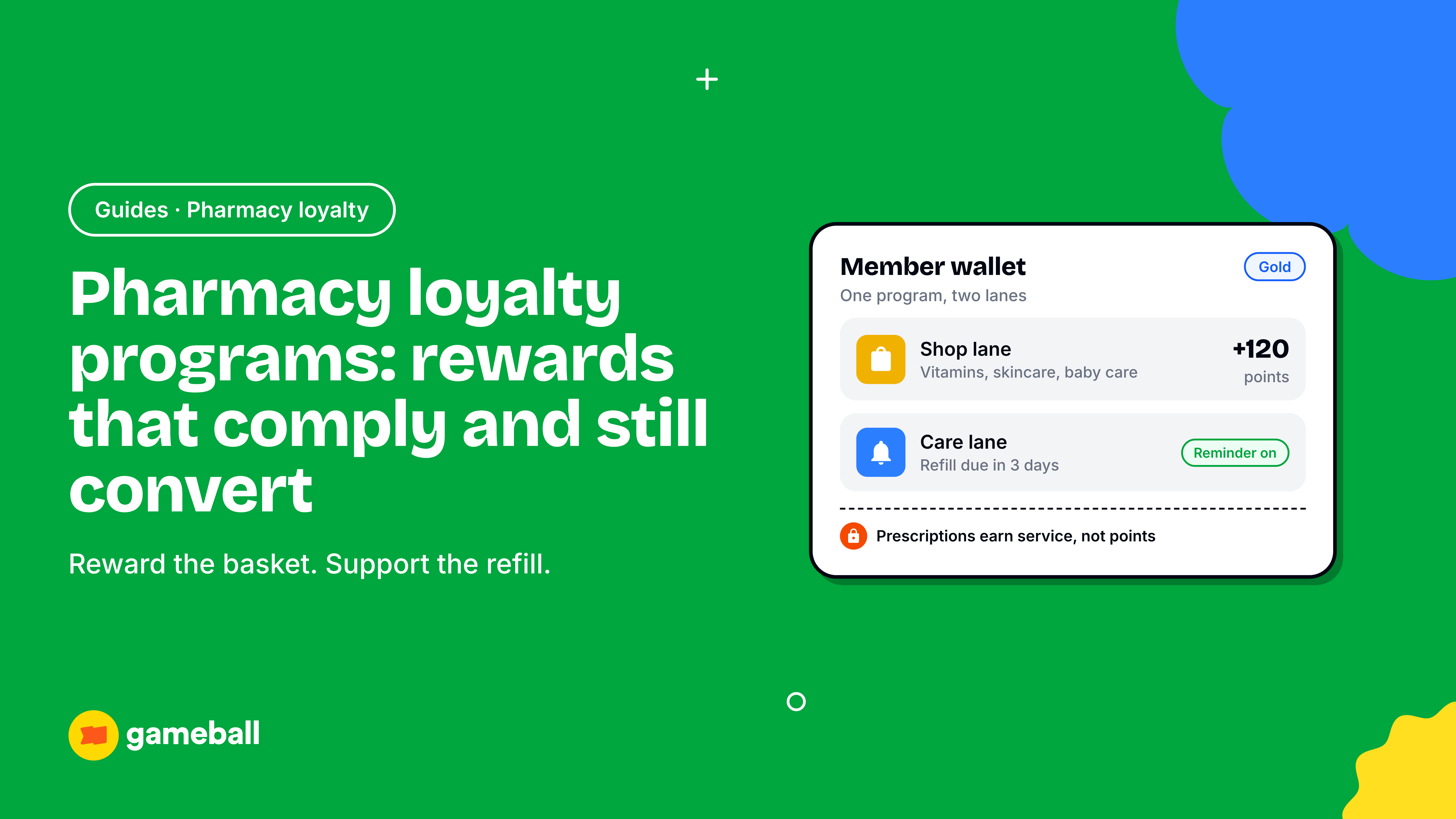
Run one program with two lanes. The shop lane covers everything a customer could buy in any retailer: skincare, vitamins, baby care, household items and, in most markets, OTC medicines. It runs on ordinary loyalty program mechanics such as points, own brand multipliers, tiered membership and challenges. The care lane covers the dispensary. It earns service rather than points: refill reminders, ready for pickup alerts, delivery and pharmacist time.
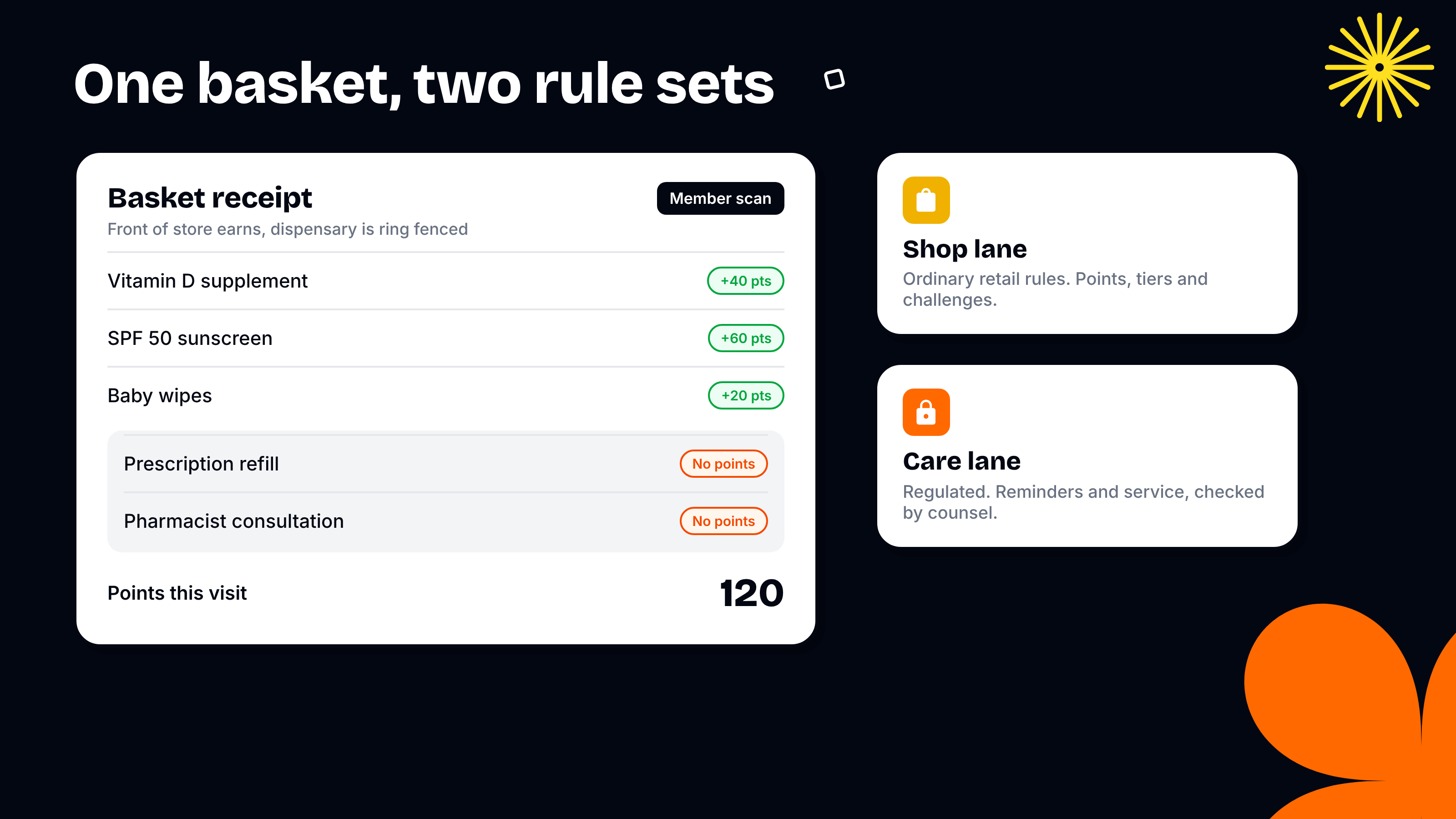
The difference between a program built this way and one that treats every line the same is the difference between a growth lever and a compliance project:
- Prescriptions earn points by default, so every state and payer rule becomes an exception
- Tier progress counts dispensary spend, which is hard to defend later
- Health data leaks into the marketing profile
- Legal reviews block launches
- Front of store runs on normal retail mechanics
- Prescriptions get reminders and service, not currency
- Tier progress and redemption use front of store spend only
- Exclusions change by market without a rebuild
In practice the split lives in the product catalogue. Tag every SKU at category level as prescription, OTC or front of store, exclude prescription items from earn rules and tier progress, and let points redeem only on front of store items. Our explainer on how points engines actually work covers the rule types this needs. Restricting redemption to the shop lane also tends to keep your loyalty redemption rate healthy, because members spend points on the products that carry margin.
Why refill reminders are the best retention mechanic in pharmacy
Refill reminders turn the dispensary's natural monthly rhythm into a reason to come back, and in the US they sit outside the HIPAA definition of marketing. According to HHS guidance on the refill reminder exception, refill reminders and other communications about a drug currently prescribed for the individual are carved out, provided any payment a pharmacy receives for sending them is reasonably related to the cost of making the communication.
The Healthcare Dive report on the study adds that 38% of the patients who refilled did so within two hours of the text. The retention logic for a pharmacy is that every refill visit is also a front of store visit. A member who comes in for a refill and sees a points balance in the app is primed to pick up the vitamins and skincare that do earn. Sequencing this well is a job for marketing automation with the care lane and the shop lane kept in separate audiences:
Send the reminder by app push and SMS. Keep it about the medication and the pickup, with no product offer attached.
Confirm the order is ready and show the member their shop lane points balance in the app, not in the prescription message.
Surface a front of store offer, such as double points on own brand vitamins, that earns under ordinary retail rules.
Credit the shop lane points and update tier progress using front of store spend only.
Send a follow up reminder and flag the patient to the pharmacist, so adherence is handled as care.
How to handle privacy in a pharmacy loyalty program
Treat anything that reveals a medication, condition or prescription as health data, keep it out of the marketing profile by default, and get explicit consent before using it for anything beyond the service it was collected for. The three markets most pharmacy chains in our audience operate in each set the bar differently:
| Market | Rule | What it means for loyalty |
|---|---|---|
| United States | HIPAA Privacy Rule | Refill reminders about a current prescription are not marketing. Communications outside that exception can count as marketing, which is why CVS asks members to sign a privacy authorization before prescriptions earn credits. |
| Saudi Arabia | Personal Data Protection Law, in force since 14 September 2023 | Health data is sensitive. Processing it needs explicit consent, legitimate interest cannot be relied on, and marketing needs consent with an easy opt out. |
| United Arab Emirates | Federal Law No. 2 of 2019 on ICT in health fields | Health data must be kept confidential, generally stored and processed inside the UAE, and not used for non health purposes without an exception such as written consent. |
The Saudi summary draws on Latham & Watkins' note on the PDPL and the UAE summary on Trowers & Hamlins' overview of the ICT health law. The practical answer is to treat the shop lane as your first party data engine and the care lane as a protected record:
- Prescription and condition data never enters marketing segments by default
- Explicit, separate consent is collected before any health data is used for offers
- Refill messages carry no third party product promotion
- Health data for UAE patients is stored and processed in the UAE unless an exemption applies
- Every member can see, export and withdraw consent from the app in two taps
Pharmacy loyalty program examples
Three programs show the two lane model working at scale, each shaped by its own market's rules. Gulf chains in particular lean on personalisation, which matches what we found on what makes Gulf shoppers come back:
2% back in ExtraBucks on purchases. Prescriptions and vaccines earn credits only after a privacy authorization: $2 for every four credits, capped at $50 a year, unavailable in Arkansas, New Jersey and New York.
Over 60s Rewards members earn 8 points per £1, but the offer excludes prescriptions, selected dispensary items and pharmacy services.
Loyalty penetration rose from 77% in 2022 to 80.5% in 2023. An AI personalisation project tailors promotions, suggests complementary products and sends refill reminders, adding US$60 million in incremental sales in 2023.
Health retail beyond the pharmacy counter follows the same pattern. DentaCarts, a dental supplies marketplace operating in Egypt, Saudi Arabia and Germany, raised its retention rate by over 130%, doubled purchase frequency and lifted average order value by 38% in one quarter after launching a rewards program with Gameball.
How to measure pharmacy retention
Measure the two lanes separately and then measure the link between them. On the shop lane, track member share of sales, visit frequency and redemption. On the care lane, track the share of refills collected on time and the number of active refill patients. The link is front of store spend per refill visit, which tells you whether the care lane is feeding the shop lane. Plotting members on both axes shows where to act, and our guide to customer churn rate covers how to calculate the at risk group:
They refill on time but rarely buy anything else. Surface shop lane offers at pickup.
Protect them with tiers, early access and own brand perks.
Lead with a care message, then a front of store welcome back offer.
They buy regularly but do not fill prescriptions with you. Promote services, never prescription rewards.
Segments like these are easiest to maintain when the loyalty platform and the analytics share one member record, which is what Gameball's analytics and intelligence is built for.
- A pharmacy loyalty program should reward the front of store basket and support the prescription with service, not points.
- In the US, prescription rewards touch the Anti-Kickback Statute, beneficiary inducement rules and state law, so the safest pattern is to count prescriptions neutrally and redeem on non reimbursable items.
- Refill reminders are permitted under HIPAA's refill reminder exception and are the strongest retention lever a pharmacy has.
- Treat prescription and condition data as health data: separate consent in Saudi Arabia, local storage and confidentiality in the UAE, a signed privacy authorization before prescriptions earn in the US.
- Measure the shop lane, the care lane and the link between them: front of store spend per refill visit.
How Gameball helps
Gameball gives pharmacy and health retail chains a loyalty engine with category and region exclusions, so prescriptions stay out of earn rules while the front of store runs on points, tiers and targeted promotions, all across stores, app and web through our retail and ecommerce integrations. Refill and pickup journeys run through marketing automation, results show up in analytics and intelligence, the platform is SOC 2, ISO 27001, GDPR and Saudi PDPL compliant as listed on our trust center, and you can book a demo or see pricing to scope a two lane program.
Related reads
- Grocery and Supermarket Loyalty Programs: Examples and How to Build One
- Coffee Shop Loyalty Programs: Setup Guide With Real Examples
- Retail Loyalty Software: The Features Every Chain Actually Needs
Frequently asked questions
What is a pharmacy loyalty program?
A pharmacy loyalty program is a rewards scheme run by a pharmacy chain or drugstore that gives members points, discounts or services for shopping there. Most programs reward front of store and OTC purchases with points, while prescriptions earn service such as refill reminders and delivery, because prescription rewards are regulated in many markets.
Can pharmacies give loyalty points on prescriptions?
Sometimes, but with conditions. In the US, rewards tied to prescriptions paid by federal health programs raise Anti-Kickback and beneficiary inducement risk, and some states restrict them. CVS, for example, requires a privacy authorization, caps pharmacy rewards at $50 a year and does not offer them in Arkansas, New Jersey or New York.
Is a refill reminder considered marketing under HIPAA?
No, as long as it concerns a drug currently prescribed for the patient. HHS carves refill reminders out of the HIPAA marketing definition, provided any payment the pharmacy receives for sending them is reasonably related to the cost of the communication. Messages that go beyond the current prescription can count as marketing, so review them with counsel.
What should a drugstore loyalty program reward?
A drugstore loyalty program should reward the front of store basket: beauty, baby care, household items, vitamins and, where local rules allow, OTC medicines. Own brand multipliers, tiers and challenges work well here. Prescriptions are better served with refill reminders, pickup alerts and delivery than with points or cash rewards.
How do pharmacy loyalty programs handle health data in Saudi Arabia and the UAE?
In Saudi Arabia the PDPL treats health data as sensitive, so processing it needs explicit consent and marketing needs consent with an easy opt out. In the UAE, Federal Law No. 2 of 2019 requires health data to stay confidential and generally inside the country, and limits its use for non health purposes.
How do you measure pharmacy retention?
Measure two lanes. For the shop lane, track member share of sales, visit frequency and points redemption. For the care lane, track refills collected on time and active refill patients. Then track front of store spend per refill visit, which shows whether prescription customers are also becoming loyal shoppers.


Ready to level up your game?
Create your first campaign and start seeing results in 30 days.
Ready to grow?
Get in touch with our sales team today.
The loyalty vendor checklist your CTO
will thank you for
Discover engineering challenges, essentials, and more from global brands.

Gameball Staff
Stay ahead on retention
Subscribe to our newsletter and get all the latest updates as we post.

Ready to level up your game?
Create your first campaign and start seeing results in 30 days.
Read related articles
Ready to level up your customer loyalty?
Level up your customer loyalty!