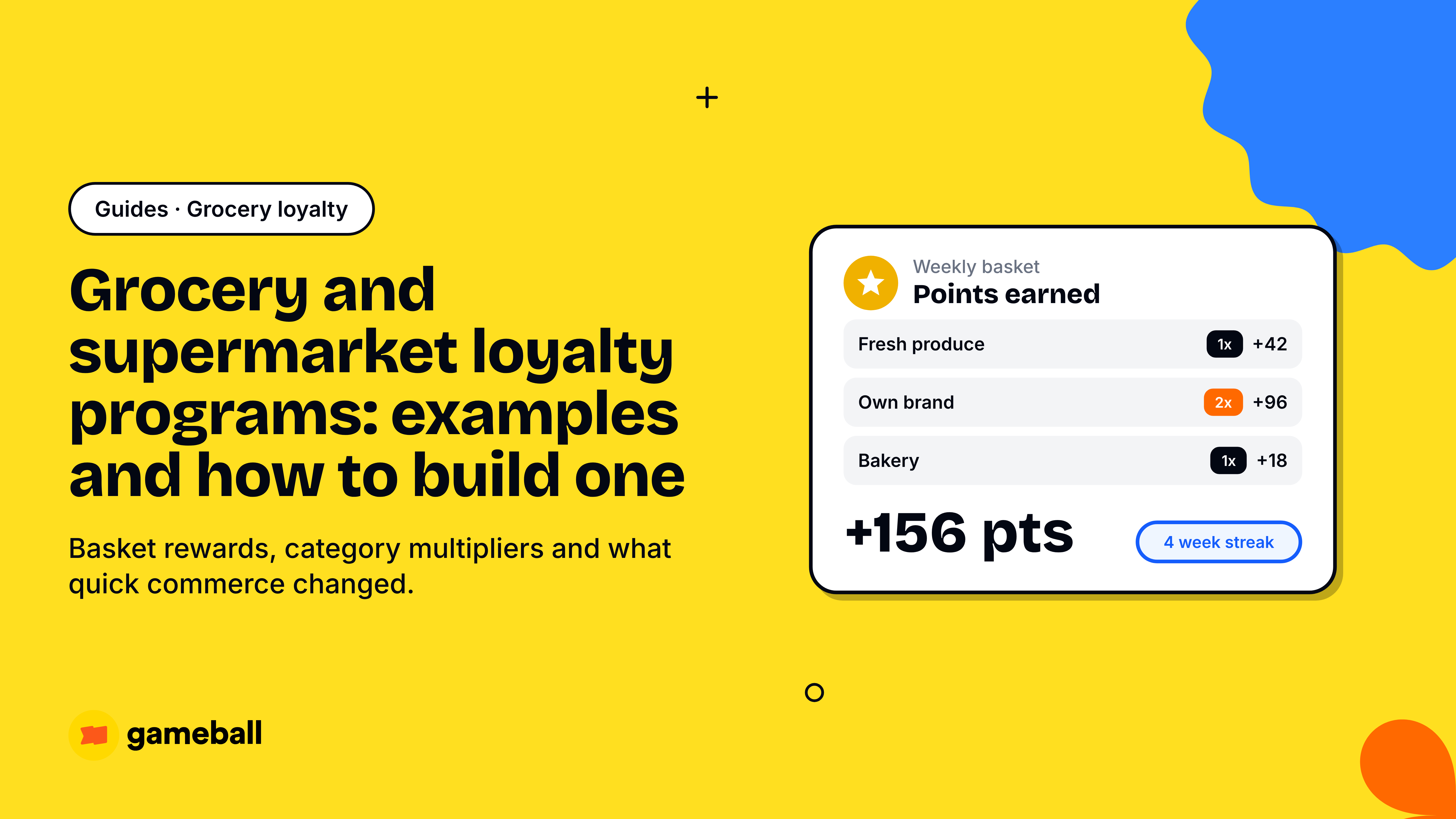
A grocery loyalty program is a rewards scheme that gives shoppers points, member prices or perks for buying their weekly groceries from one supermarket, store or delivery app, so that more of the household food budget lands with that grocer. It is one of the oldest loyalty formats in retail, and one of the hardest to get right, because grocery runs on thin margins and very frequent trips.
This guide covers how the big supermarket loyalty programs work, with seven real examples from the UK, the US and the Middle East, and then walks through how to build one: when to reward the basket and when to reward the visit, how to use category multipliers without giving away margin on fresh food, and how quick commerce apps changed what grocery shoppers in MENA now expect from a rewards program.
What is a grocery loyalty program?
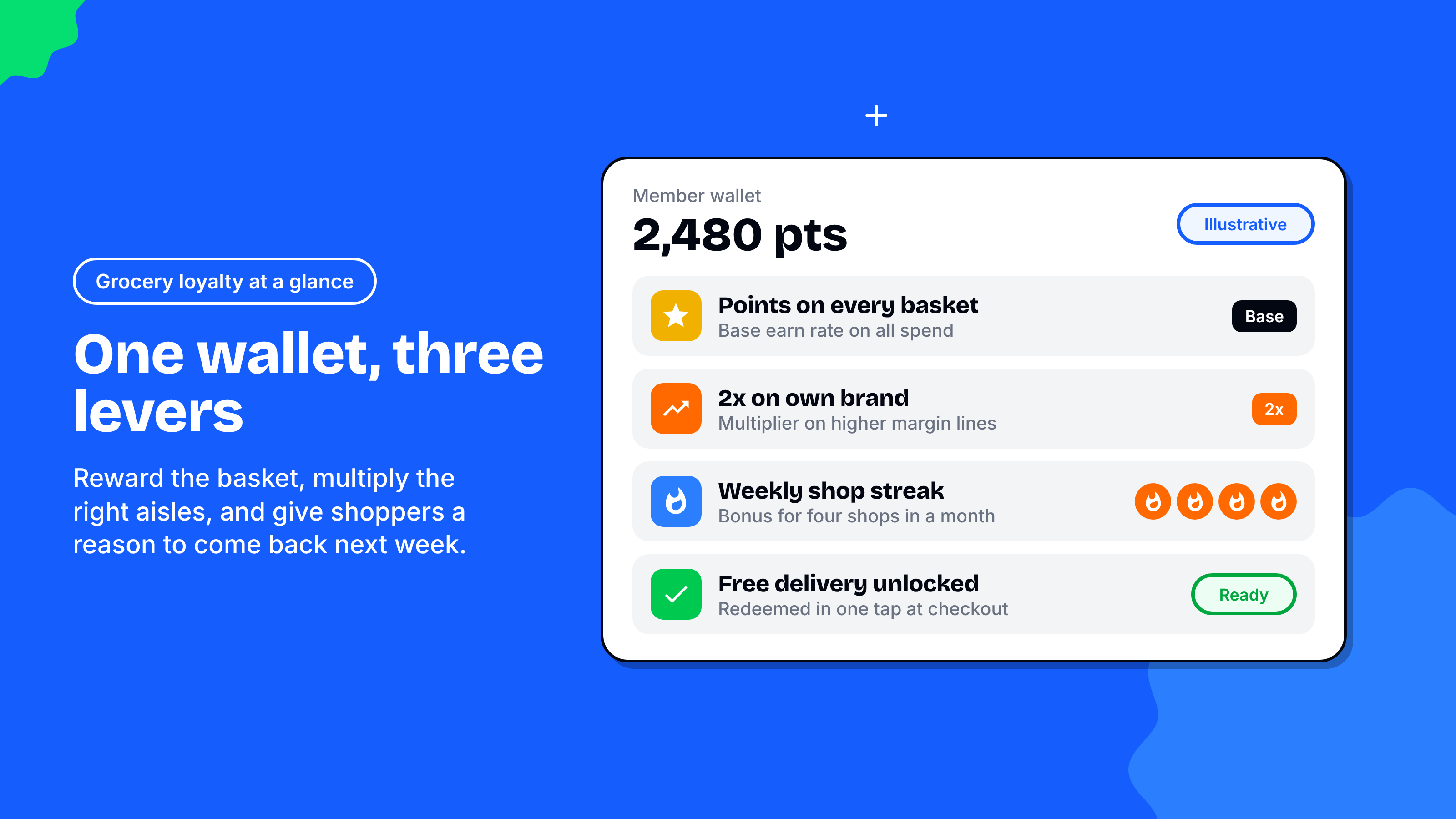
A grocery loyalty program is a membership that identifies a shopper at checkout, records what they buy and rewards them for concentrating their spend with one grocer. The reward can be points that convert into money off, lower shelf prices for members, free delivery, fuel discounts or a paid tier with extra benefits. To see how these formats fit together, read our companion guide on the eight types of loyalty programs, which maps every model side by side.
In grocery, four models cover almost every program you will meet:
Earn a fixed rate on every unit of spend, then redeem for money off. Tesco Clubcard and Lidl Plus work this way.
Members see a lower shelf price on selected lines. The reward is instant, so it changes behaviour at the shelf.
A yearly fee for free delivery and boosted earning, like Kroger Boost. Best for heavy online shoppers.
One currency across a group of brands, like SHARE across Carrefour and Majid Al Futtaim malls.
A modern grocery loyalty card is usually a phone number or an app barcode rather than a plastic card, and the points engine sits behind the till, the website and the app at the same time. If you want the mechanics of that engine, our guide on how points engines actually work goes deeper.
Why grocery loyalty programs matter
Grocery loyalty programs matter because the margin for error in grocery is tiny. US food retail net profit margins settled at 1.7% in FMI's 2025 Food Retailing report, so a program that gives away 1% of sales as rewards has to earn that back in extra visits, bigger baskets or cheaper marketing. Done well, it can: McKinsey research cited in its State of grocery retail MENA 2026 report found that loyalty programs can lift incremental revenue by 4 to 7% and cut marketing costs by 6 to 8%.
The catch is that almost everyone already has a grocery card, so membership alone wins nothing. Upside’s 2026 Escaping the Loyalty Plateau study found that 82% of US grocery shoppers belong to at least one program but only 59% use one regularly, and the average member now holds 3.4 grocery programs. Only about one member in ten is committed enough that incentives no longer change where they shop. For the other nine, the program still has to earn the next trip, which is why measuring repeat purchase rate matters more than counting sign-ups.
Grocery and supermarket loyalty program examples
The best supermarket loyalty programs each pick one lever and pull it hard. The table below compares seven, using each program's published terms or the source named in the notes.
| Program | Market | How members earn | What stands out |
|---|---|---|---|
| Tesco Clubcard | UK | 1 point per £1 in store and online; points worth 1p, or 2p with partners | Clubcard Prices give members lower shelf prices on selected lines |
| Sainsbury's Nectar | UK | At least 1 point per £1; each point worth 0.5p | Up to 10 personalised weekly offers in the app |
| Lidl Plus | UK and Europe | 1 point per £1 in store; 500 points for £5 off | Small rewards like a bakery item for 50 points keep redemption frequent |
| Kroger Boost | US | Double fuel points on grocery spend | Paid tier launched in 2021 at $59 or $99 a year for free delivery on $35 orders |
| SHARE (Carrefour) | UAE and GCC | 2.5 to 150 points per AED 100 across Majid Al Futtaim brands | Coalition currency spanning grocery, malls and entertainment, with three tiers |
| Breadfast | Egypt | Points on orders plus badges for first orders, anniversaries and new categories | 2x points campaigns steer shoppers to private label products |
| Mano | Nigeria and Angola | 1 point per 1,500 NGN on the entry level | Levels unlock on completed orders, not spend, and recalculate every quarter |
Sources: UK earn rates from Which? loyalty cards compared (September 2026); Kroger Boost from its 2021 launch announcement; SHARE from sharerewards.com; Breadfast and Mano from their Gameball case studies.
Two patterns stand out. The UK programs have shifted value from points to member prices, because a lower price on the shelf is felt today while points pay out later. The quick commerce programs, Breadfast and Mano, lean on challenges, levels and free delivery instead of cashback. We covered more regional programs in five grocery reward programs in MENA.
Basket-level vs visit-level rewards: which should a grocer use?
Basket-level rewards pay members for how much they spend, while visit-level rewards pay them for how often they come back, and most grocers need both. Points per pound or per riyal reward a bigger weekly shop, which suits large households and supermarkets with a strong average basket size. Visit rewards, such as a bonus for the fourth shop in a month or a weekly challenge, suit top-up trips and delivery apps where baskets are small but frequent.
- ✕Heavy households earn most, so light shoppers never see a reward
- ✕Encourages one big monthly shop rather than weekly visits
- ✕Easy for a rival to match with a higher earn rate
- ✓Base points on spend, plus a streak or weekly challenge
- ✓Small, frequent orders still move members toward a reward
- ✓Visit bonuses can be targeted at lapsing members only
The practical rule: set your base earn rate at basket level, keep it simple and stable, and use visit-level mechanics as time-boxed campaigns rather than permanent rules. That keeps the reward cost predictable while still giving you a lever when frequency drops. Gameball's gamification tools run streaks, challenges and badges on top of a points base without changing it.
How do category multipliers work in a supermarket?
A category multiplier gives members extra points on specific aisles or brands, for example 2x points on own brand products, so the grocer can steer spend toward the categories that pay it back. It is the most useful lever in grocery loyalty, and the easiest to misuse, because margins differ so much from one aisle to the next.
Fresh food is the clearest example. In a Bain survey of more than 2,500 Australian supermarket shoppers, buying fresh was the main reason for 65% of visits to their primary store, and fresh quality ranked equal to price in choosing where to shop. But Bain also found that shrinkage can run up to 10 times higher in fresh departments and labour costs three to seven times higher. Fresh brings shoppers in; it rarely carries the cost of a multiplier on its own.
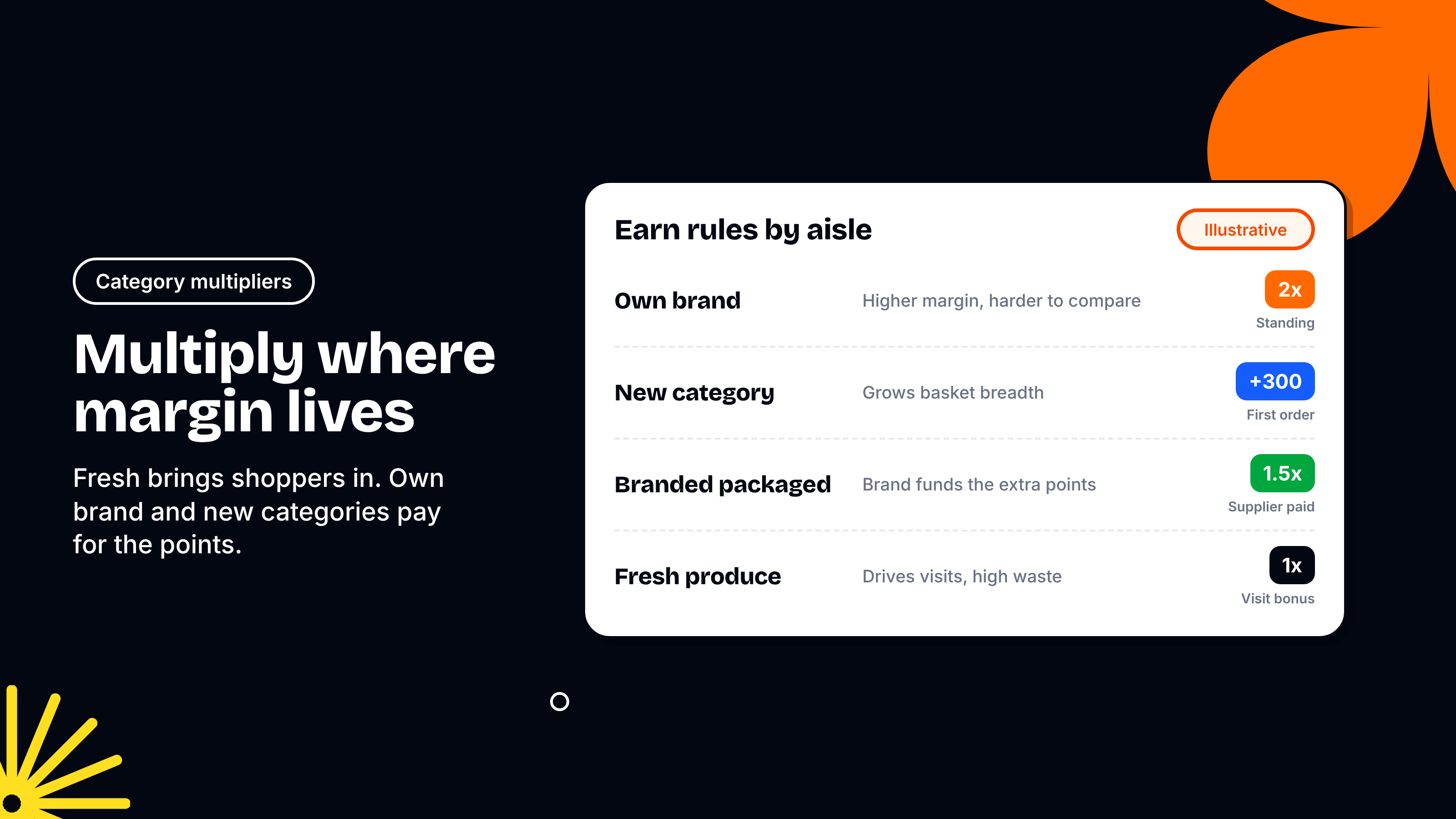
Higher margin and harder to compare. The best home for a standing 2x multiplier.
Drives visits and margin, but watch waste. Use short weekly bonuses.
Grows basket breadth. Reward the first purchase once, then stop.
The reason people come in. Keep it at the base rate and reward the visit instead.
Packaged branded goods sit in the middle: thin margins for the grocer, but brands will often fund bonus points to win shelf attention, which turns a cost into income. Private label is the other big opportunity. McKinsey found that more than 80% of MENA consumers rate private labels as equal or better than branded products, yet private label penetration is below 10% in four of the five markets it studied. A standing multiplier on own brand, like the 2x campaigns Breadfast runs, closes that gap without a price cut. Gameball's promotions engine sets these rules by category, product or segment.
How quick commerce changed grocery loyalty in MENA
Quick commerce changed grocery loyalty in MENA by moving the shop into an app, shrinking the basket and turning delivery itself into the reward that matters most. McKinsey reports that online grocery grew by more than 40% a year from 2019 to 2024 in four of the five MENA markets it tracks, with Qatar reaching an 11.4% e-grocery share. At the same time, price is the largest driver of shopper dissatisfaction, and only about a third of shoppers are satisfied with what they pay.
Discount grocery formats grew at a 20% CAGR from 2021 to 2024, against 1% for modern grocery overall, with 56% in the UAE and 11% in Saudi Arabia.
That combination, value-hungry shoppers with apps on their phones, reset expectations in four ways. Shoppers expect to see their balance and progress inside the app, not on a receipt. They expect to redeem in one tap at checkout, as Breadfast does with its Show Rewards button. They value free delivery more than a small discount, which is why both Breadfast and Mano put it in the reward catalogue. And they respond to progress mechanics: Mano unlocks its Gold level after 25 completed orders and Platinum after 40, which rewards frequency rather than spend. For the wider regional picture, see our guide to what makes Gulf shoppers come back.
Avoid cashback as your main reward in a low-margin app.
Breadfast deliberately avoids cashback and rewards members with free products, free shipping and coffee rewards instead. A free item costs you its cost price, while cashback costs you its full face value.
How to build a grocery loyalty program
To build a grocery loyalty program, start from your margin and your shopping pattern, not from a competitor's earn rate. These six steps work for a single supermarket, a chain or a delivery app.
- 1Measure the baseline
Pull average basket, trips per shopper per month, and gross margin by category before you design anything.
- 2Set a base earn rate you can afford
Price the reward as a share of sales, then check it against the margin in your lowest-margin categories.
- 3Choose basket and visit levers
Base points on spend, plus one visit mechanic such as a weekly shop streak or a quarterly level.
- 4Map category multipliers
Own brand and new categories first, supplier-funded points on branded lines, fresh at the base rate.
- 5Make redemption instant
One tap at checkout or a scan at the till, with small rewards that members can reach within a few trips.
- 6Measure the lift
Compare members against a holdout on visits, basket and margin, and adjust multipliers every quarter.
Redemption deserves special attention. Lidl Plus lets members redeem 50 points for a bakery item, which means a shopper can earn a reward within weeks rather than months. Small, reachable rewards keep your loyalty redemption rate healthy and stop points piling up as a liability. When you are ready to put numbers on the business case, our guide to calculating loyalty program ROI shows the method.
Common grocery loyalty mistakes to avoid
Most grocery programs that fail do so for the same few reasons, and all of them are visible before launch.
- ✕A flat high earn rate across every aisle, including thin-margin fresh
- ✕Rewards that take six months of shopping to reach
- ✕In-store and app balances that do not match
- ✓Multipliers mapped to margin, with own brand first
- ✓A holdout group so you can prove the lift to finance
The common thread is treating the program as a discount rather than a data and behaviour engine. If your store sells across many categories, our guide to retail loyalty software features lists what the platform needs to support.
- ✓A grocery loyalty program has to earn its cost on a margin of under 2%, so every reward needs a behaviour it pays for.
- ✓Use basket-level points as a stable base and visit-level challenges as targeted campaigns.
- ✓Put category multipliers on own brand and new categories; reward fresh with visit mechanics, not extra points.
- ✓In MENA quick commerce, in-app balances, one-tap redemption and free delivery matter more than cashback.
- ✓Start small and reachable on rewards, and prove the lift with a holdout group.
How Gameball helps
Gameball runs grocery and quick commerce programs like Breadfast and Mano, combining points and tiers, challenges and badges, referral rewards and category-level multipliers in one platform that works across your app, website and stores. Its analytics show the lift by segment and category, and the on-demand and delivery toolkit is built for high-frequency apps, so book a demo to see it running on a grocery catalogue, or compare plans.
Related reads
- Grocery Reward Programs in MENA: 5 Successful Examples To Learn From
- Coffee Shop Loyalty Programs: Setup Guide With Real Examples
- Repeat Purchase Rate: The Metric That Predicts Loyalty ROI
Frequently asked questions
What is the best grocery loyalty program?
There is no single best program, but Tesco Clubcard is the most cited model because it pairs points with member-only shelf prices. In the GCC, SHARE stands out for spanning Carrefour, malls and entertainment. For delivery apps, Breadfast shows how challenges, badges and free delivery can replace cashback while protecting margin.
How do supermarket loyalty programs make money?
Supermarket loyalty programs make money by shifting more of each household's grocery spend to one store, steering it toward higher-margin aisles such as own brand, and cutting marketing waste through personalised offers. McKinsey estimates the lift at 4 to 7% of incremental revenue. Many grocers also earn income when brands fund bonus points.
Is a grocery loyalty card still worth it if shoppers have several?
Yes, but only if it earns the next visit. Upside found the average US member holds 3.4 grocery programs and only about one in ten is truly committed. That means most members can still be persuaded, so a card that rewards frequency and shows progress clearly can win share from rivals.
Should a grocery rewards program use points or member prices?
Most grocers should use both. Member prices give an instant reason to scan the card at the shelf, while points build a balance that brings shoppers back. Points are also easier to target by category and segment, which makes them the better tool for multipliers and personalised offers.
How much should a grocery loyalty program give back?
Base it on margin, not on competitors. UK leaders give back around 0.5% to 1% of spend in points, as published by Which?, and US grocery net margins sit near 1.7%. Keep the standing earn rate low and use targeted multipliers on own brand and supplier-funded lines for extra value.
How long does it take to launch a grocery loyalty program?
A digital grocery loyalty program on an existing platform typically launches in weeks rather than months, because the points engine, app widgets and till integration already exist. Gameball's typical go-live is four to six weeks. Building the same engine in-house usually takes far longer and needs ongoing engineering.


Ready to level up your game?
Create your first campaign and start seeing results in 30 days.
Ready to grow?
Get in touch with our sales team today.
The loyalty vendor checklist your CTO
will thank you for
Discover engineering challenges, essentials, and more from global brands.

Gameball Staff
Stay ahead on retention
Subscribe to our newsletter and get all the latest updates as we post.

Ready to level up your game?
Create your first campaign and start seeing results in 30 days.
Read related articles

Ready to level up your customer loyalty?
Level up your customer loyalty!