%207.svg)

.svg)

A coffee shop loyalty program is a system that rewards customers for repeat visits, usually with a free drink after a set number of purchases, so that occasional buyers become daily regulars. The idea is as old as the paper punch card, but the setup decisions that make it profitable are not obvious.
This guide walks through the full build: moving from stamp cards to digital, the visit frequency economics behind the program, how to price a free drink so it stays profitable, and how customers should identify themselves at the till. It closes with real examples from the US and the Middle East, including how QahwaBLK, a coffee chain with more than 30 branches across Jordan and Lebanon, is rolling out its program.
What is a coffee shop loyalty program?
A coffee shop loyalty program is a repeat-visit engine: the customer identifies at checkout, earns progress on every purchase, and unlocks a reward that pulls them back sooner than they would have come anyway. Cafes typically choose from four models, and most mature programs blend two of them.
Buy a set number of drinks, get one free. Simple to explain, easy to fake on paper, and blind to who the customer is.
Earn points per unit of spend and redeem for a menu of rewards. Rewards bigger baskets, not only more visits.
Status levels that unlock better perks as yearly spend grows. Gives heavy regulars a reason to stay.
A monthly fee for a daily drink or a standing discount. Strong for commuters, risky if the math is loose.
If you run a broader food and beverage operation, read our companion guide on running a loyalty program for restaurants, which covers table service and delivery on top of the counter model described here. For a deeper look at each model, see the full breakdown of loyalty program types.
Why coffee shop loyalty programs matter
Coffee is a daily habit for many customers, so a program that adds even one visit a month per regular compounds fast. The biggest coffee chain in the US shows how central loyalty has become to the model.
The Starbucks figures come from its Q3 fiscal 2026 digital investor dashboard, and the restaurant figures from Square's loyalty program research. The underlying reason is retention economics: Bain's Fred Reichheld found that in financial services a 5% increase in customer retention produces more than a 25% increase in profit, a pattern his Bain research on loyalty traces to repeat customers costing less to serve and buying more over time. A cafe sees the same effect in miniature, because the second, tenth and fiftieth cup cost nothing to acquire.
If you want a single number to manage the program by, start with repeat purchase rate: the share of customers who come back within a set window. It moves before revenue does.
From stamp card to digital: what actually changes
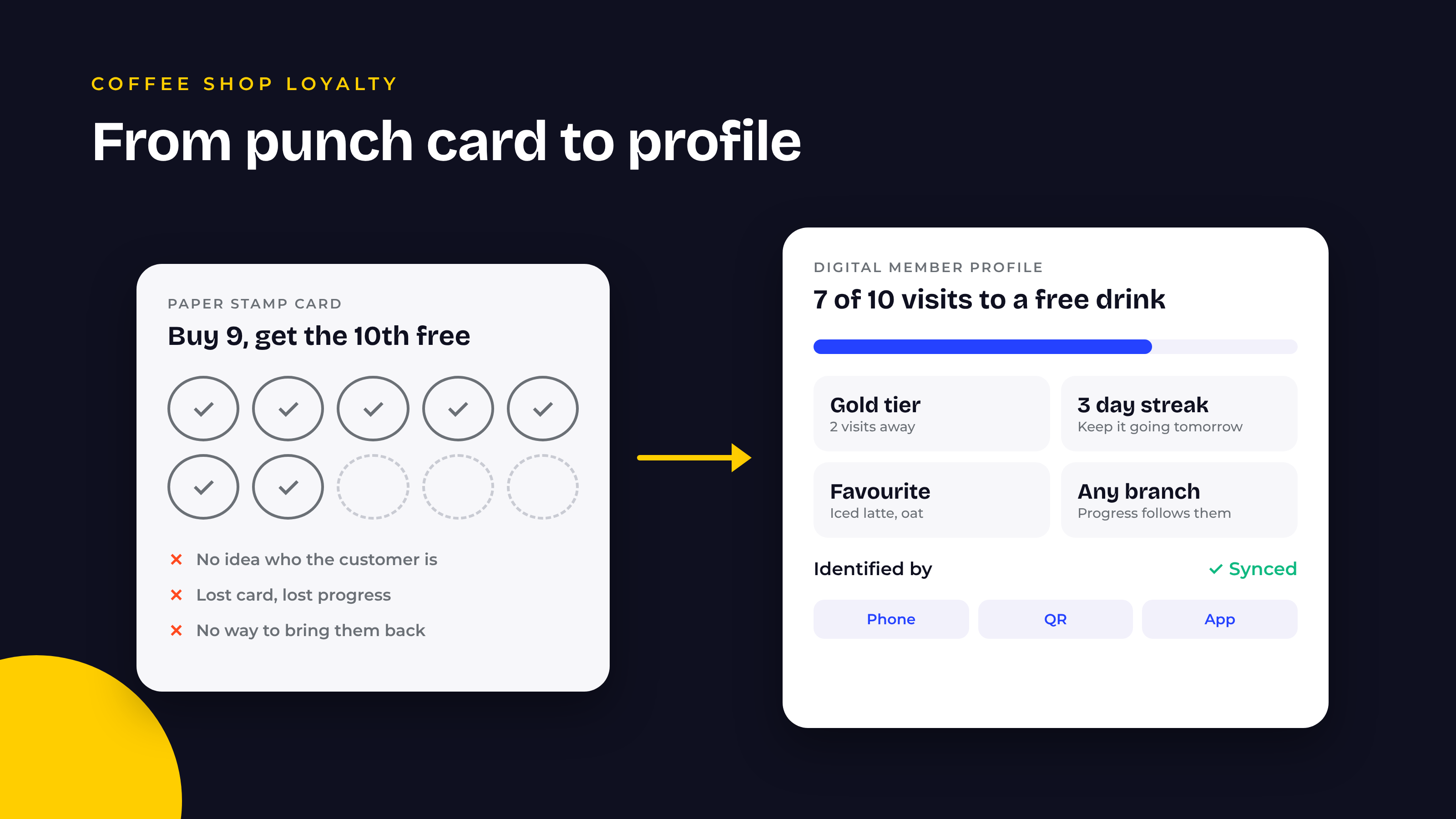
Going digital changes three things: you learn who your regulars are, you stop losing progress to lost or faked cards, and you can message customers between visits. The reward itself can stay exactly the same.
| Factor | Paper stamp card | Digital program |
|---|---|---|
| Customer identity | Anonymous | Phone number, app account or QR profile |
| Fraud and lost cards | Common, hard to detect | Each visit tied to a real transaction |
| Data you get | None | Visit frequency, basket, favourite drink, branch |
| Re-engagement | Only when they walk in | Push, SMS, email and in-app nudges |
| Multi-branch | Each card lives in one wallet | Progress follows the customer to any branch |
| Cost | Printing only | Software fee plus a till integration |
One habit is worth keeping from paper cards: the head start. In the original endowed progress study by Nunes and Dreze in the Journal of Consumer Research, car wash customers given a 10-space card with two stamps already filled completed it far more often than customers given a blank 8-space card, even though both needed eight purchases.
34% of customers with a pre-stamped 10-space card earned the reward, against 19% with a blank 8-space card.
Digital makes this trivial: credit a welcome stamp at sign-up. Our guide to whether loyalty cards still work in a digital era covers when a physical card is still worth printing as a backup.
Visit frequency economics: what one extra visit is worth
The value of a coffee loyalty program is almost entirely in frequency: the extra visits it creates, multiplied by the margin on each cup. The chart below uses illustrative numbers so you can see the shape of the math before plugging in your own average ticket.
Moving a regular from four to five visits a month adds $66 a year at a $5.50 ticket. Across 500 active members that is $33,000 in extra revenue, before any change in basket size. That is why the reward should be designed around the visit you want next, not around a generous headline.
Two levers raise frequency without raising reward cost. Short daily or weekly streaks turn an occasional Tuesday visit into a routine, and gamified challenges such as "try three new drinks this month" lift visits during slow weeks. Both run on the same points balance, so they do not need a separate budget line.
How to price a free drink so it stays profitable
Price the free drink by what it costs you to make, measured against the spend it takes to earn it, and keep that ratio low enough that one incremental visit pays for it several times over. The headline discount and the real cost are very different numbers.
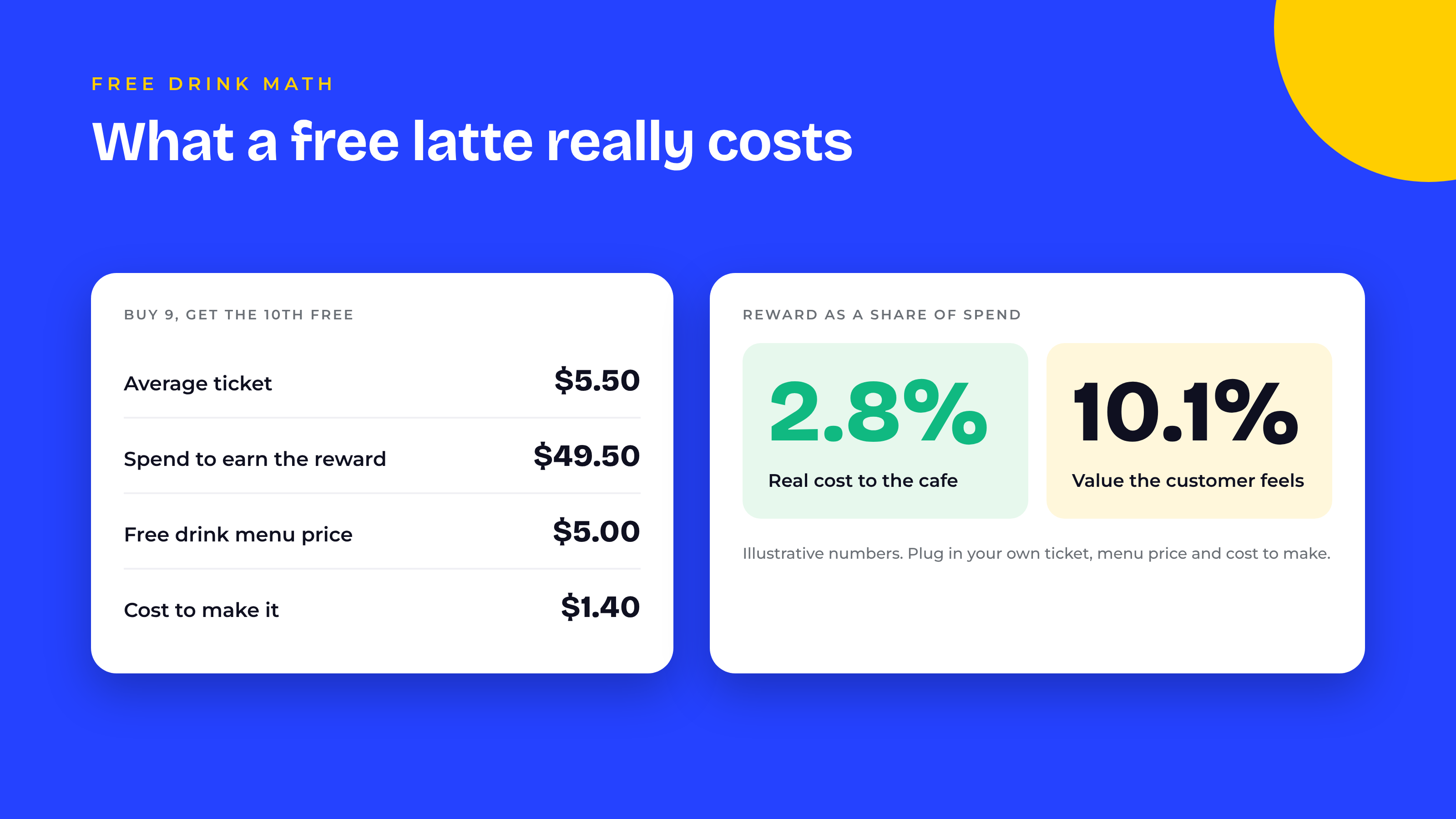
Take a buy nine, get the tenth free card. At a $5.50 average ticket the customer spends $49.50 to earn the reward. If the free drink lists at $5.00 but costs about $1.40 to make in beans, milk, cup and lid (an illustrative figure, so use your own), the real cost is 2.8% of the spend that earned it. The menu value the customer perceives is 10.1%. You are buying a 10% perceived reward for under 3% of cost.
Real reward cost = cost to make the free item / spend required to earn it
Keep this ratio low and check it against incremental margin. If the program adds even one visit per card cycle, the gross margin on that single visit usually covers the reward several times. If it adds none, the reward is a pure discount.
Four pricing rules keep the program healthy:
- Cap the free item at a base size. Upgrades, extra shots and alternative milk stay paid, which protects margin on the most expensive builds.
- Reward visits, not only spend, at entry level. A stamp per drink is easier to understand than points per dollar for a first-time member.
- Add a cheaper second reward. A pastry or a size upgrade at half the stamps gives a reason to return before the card is full.
- Set an expiry window. Progress that resets after 90 or 120 days of inactivity keeps the liability on your books predictable.
If you later move from stamps to a points engine, the same ratio applies. Price every reward in the catalogue by cost to make, not menu price, and check it against your loyalty program ROI each quarter.
App vs QR vs phone number: how should customers identify?
Pick the identification method by how fast your queue moves: phone number is the quickest to launch, QR is the fastest at the till once customers have it, and an app gives you the richest data but the slowest adoption. Most chains end up running two of them.
| Method | Speed at the till | Sign-up friction | Data and messaging | Best fit |
|---|---|---|---|---|
| Phone number | Fast, barista types or customer enters on a pad | Lowest, nothing to download | Good: SMS and WhatsApp reach | Independent cafes and launch phase |
| QR code | Fastest, one scan | Medium, needs a web profile or wallet pass | Good: profile plus push via wallet | Busy multi-branch counters |
| Mobile app | Fast once installed, supports order ahead | Highest, needs a download | Richest: push, order history, personalisation | Chains with enough regulars to justify an app |
Live in days, works with any till, thinner profile
Quick to launch and quick to scan, solid data
Fast to start, no data at all, easy to fake
Slowest to adopt, richest data and order ahead
In the Gulf, phone number is often the natural first step because customers are used to sharing it at checkout and messaging apps are a common way to reach them afterwards. Our deep dive on customer retention in the GCC covers what Gulf shoppers expect from a program. In the US, QR and app identification tend to dominate at chain scale, with phone lookup as the fallback.
Real coffee shop loyalty program examples
The best way to set up a program is to copy the structure of one that already works and change the reward to fit your margin. Three examples cover the range from global chain to regional brand.
Starbucks Rewards: app-first, ordering built in
Starbucks ties identification, payment and mobile ordering into a single app, which is why its members account for 59% of US company-operated tender. Mobile order and pay made up 33% of US company-operated transactions in the same quarter, according to its Q3 fiscal 2026 dashboard. The lesson for smaller shops is not to build an app on day one, but to make earning automatic. We unpack the rest in the secrets behind the Starbucks loyalty program.
QahwaBLK: one program across branches, app and campus counters
QahwaBLK started in 2019 as a single location and now runs more than 30 branches across Jordan and Lebanon, including university campuses, the arrivals terminal at Queen Alia International Airport and gas stations. Its program with Gameball rewards every purchase across physical branches and its upcoming mobile app, and uses gamified challenges, tiers and achievements to build the daily habit. You can read the announcement of the QahwaBLK loyalty partnership.
The setup lesson is the branch mix. A student who buys on campus, a traveller at the airport and a commuter at a gas station need to earn into the same balance, which only works when identity lives with the customer rather than on a card in one branch.
High frequency, price sensitive. Streaks and challenges fit the daily routine.
Low frequency, high basket. A welcome reward converts them into members for their home branch.
Speed matters most. QR or phone lookup keeps the queue moving.
Buffalo Burger: a QSR playbook coffee chains can borrow
Buffalo Burger is a quick-service burger chain rather than a cafe, but its counter model is close to a coffee bar. With more than 50 branches in Egypt, it lets customers open a personal QR code that cashiers scan to award and redeem points in store, runs four tiers, and uses Triple Points Sundays to lift a slow day. The Buffalo Burger case study reports a 63% uplift in repeat purchase rate and a 53% redemption rate.
How to set up a coffee shop loyalty program in six steps
Set up the program in this order: economics first, identification second, launch last. Skipping straight to the reward is how cafes end up giving away margin.
- 1Measure your baseline
Pull average ticket, visits per regular per month and gross margin per drink from your POS before you design anything.
- 2Pick the model and reward
Start with stamps or simple points and one free base-size drink. Check the real reward cost ratio stays low.
- 3Choose identification
Phone number for speed to launch, QR for busy counters, app only when the member base justifies it.
- 4Connect the till
Make sure every transaction earns automatically. Manual entry is where programs leak and staff give up.
- 5Train baristas
Give staff one sentence to ask at every order and a welcome stamp to offer on the spot.
- 6Launch, then add mechanics
After four to six weeks, layer in streaks, a birthday drink and a referral reward based on what the data shows.
- ✓Reward cost ratio calculated at cost to make, not menu price
- ✓Welcome stamp or bonus credited at sign-up
- ✓Every branch earns into the same customer balance
- ✓Staff script printed at the till
- ✓Counter signage and receipt line live
- ✓Expiry rule written into the program terms
- ✓Baseline metrics saved so you can measure the lift
For referrals, a "bring a friend, both get a drink" offer fits coffee well because regulars already come with colleagues. Gameball referral programs run on the same balance as the stamps, and you can see more launch tactics in our guide on getting customers to sign up for rewards.
Coffee shop loyalty metrics to track
Track five numbers monthly, and judge the program on frequency and repeat rate rather than member count.
| Metric | What it tells you | How to read it |
|---|---|---|
| Enrolment rate | Share of transactions tied to a member | Low means the till ask or the sign-up flow is too slow |
| Visits per member per month | Whether the habit is forming | The core number: compare against your pre-launch baseline |
| Repeat purchase rate | Share of customers who come back within 30 days | Rises before revenue does |
| Redemption rate | Share of earned rewards that get used | Too low means rewards feel out of reach |
| Reward cost as % of member spend | Whether the program pays for itself | Watch it monthly, especially after adding new rewards |
Gameball loyalty analytics report these per branch, which matters when campus and airport counters behave differently.
- A coffee shop loyalty program wins on visit frequency, so design the reward around the next visit, not the headline.
- Go digital to learn who your regulars are and to message them between visits. The reward can stay the same.
- Price the free drink by cost to make divided by the spend it takes to earn it, and keep that ratio low.
- Choose identification by queue speed: phone to launch fast, QR for busy counters, app when the member base justifies it.
- Give a head start at sign-up. The endowed progress effect lifts completion.
How Gameball helps
Gameball runs coffee and quick-service loyalty programs across app, web and in-store counters, with QR and phone identification, tiers and gamified challenges on a single customer balance. Brands use promotions, marketing automation and branch-level analytics to lift visit frequency, and you can book a demo or compare pricing plans to see how it fits your cafe.
Related reads
- The Complete Guide to Running a Loyalty Program for Restaurants
- 8 Secrets that Make the Starbucks Loyalty Program So Popular
- Streak Campaigns: Using Daily Streaks to Build Purchase Habits
Frequently asked questions
What is the best loyalty program for a coffee shop?
For most independent cafes the best starting point is a digital stamp program: buy nine drinks, get the tenth free, with customers identified by phone number or QR code. It is easy to explain at the till, cheap to run and captures visit data. Add tiers, streaks and referrals once enough regulars are enrolled to see what drives frequency.
How many stamps should a coffee loyalty card have?
Eight to ten stamps is a sensible range for a free drink. Fewer stamps make the reward feel close but raise your cost ratio, while a much longer card pushes the reward so far away that customers stop trying. Crediting one or two stamps at sign-up helps, because customers who feel they have started are more likely to finish the card.
How much does a free drink reward really cost a cafe?
The real cost is what the drink costs to make, not its menu price. Divide that cost by the total spend needed to earn the reward. In an illustrative example, a $1.40 cost against $49.50 of spend is about 2.8%, even though the customer perceives a reward worth around 10% of what they spent.
Should a coffee shop build its own loyalty app?
Not at first. An app gives the richest data and supports order ahead, but adoption is slow and the build is expensive. Most cafes launch with phone number or QR identification, prove the program lifts visits, and only add a branded app when they have enough regulars and branches to justify it.
How do coffee chains stop loyalty fraud?
Tie every stamp or point to a real transaction at the till instead of a hand-stamped card. Digital programs record which branch, time and order earned each reward, so duplicate scans and staff giveaways show up in the data. Expiry rules and caps on daily earning add another layer of protection.
What metrics show a coffee loyalty program is working?
Watch visits per member per month against your pre-launch baseline, repeat purchase rate within 30 days, redemption rate and reward cost as a share of member spend. Member count alone is misleading. A program with fewer members who visit more often is worth more than a large list of inactive sign-ups.
.svg)
.svg)
.svg)

Ready to level up your game?
Create your first campaign and start seeing results in 30 days.
Ready to grow?
Get in touch with our sales team today.
The loyalty vendor checklist your CTO
will thank you for
Discover engineering challenges, essentials, and more from global brands.

Gameball Staff
Stay ahead on retention
Subscribe to our newsletter and get all the latest updates as we post.

Ready to level up your game?
Create your first campaign and start seeing results in 30 days.
Read related articles
.avif)

Ready to level up your customer loyalty?
Level up your customer loyalty!


.avif)
.avif)
.avif)
.avif)