%207.svg)

.svg)

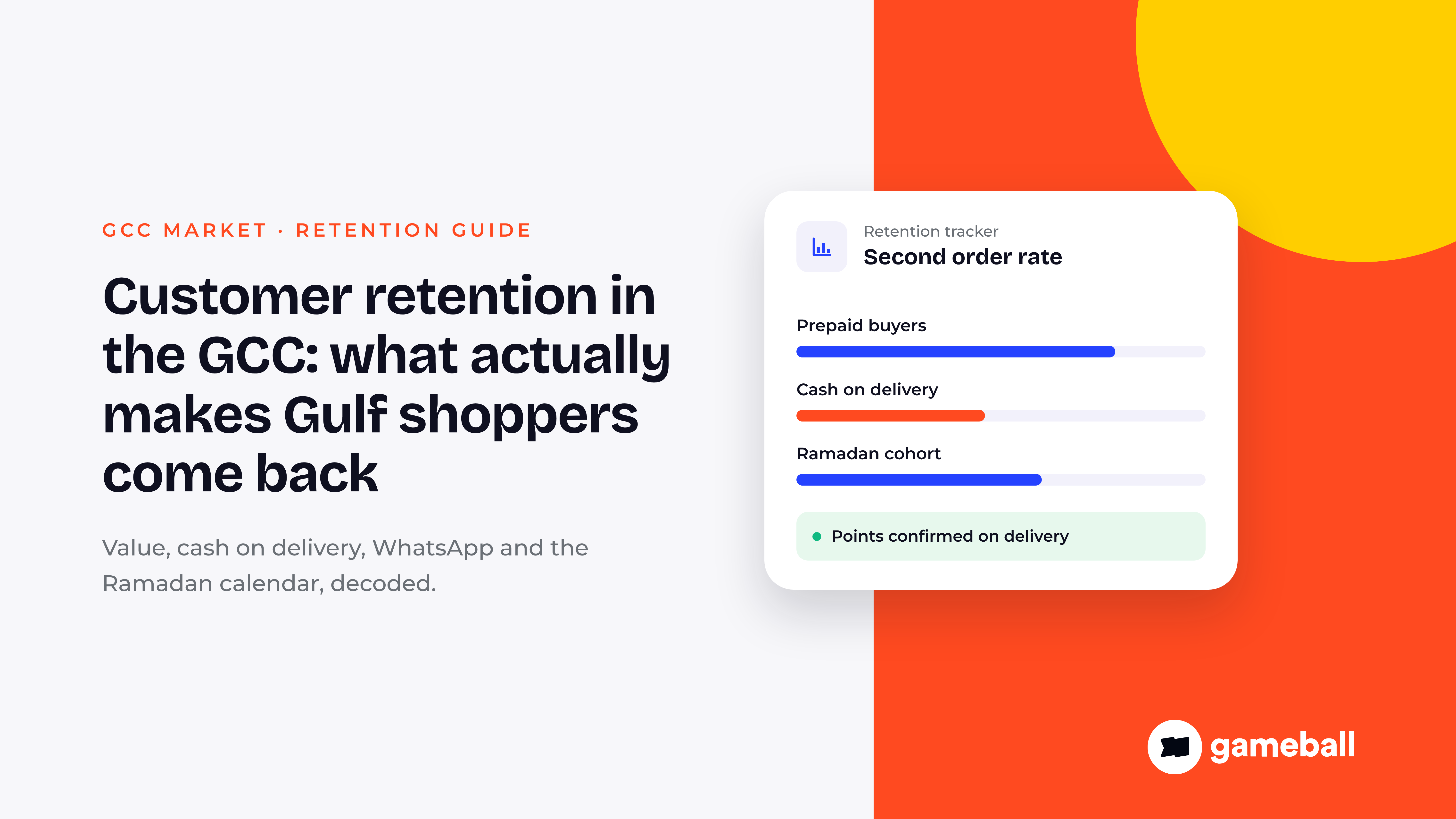
Customer retention in the GCC is the share of shoppers in Saudi Arabia, the UAE and the other Gulf markets who come back and buy again, and it runs on different levers than the Western playbooks most loyalty programs are copied from. Gulf shoppers respond to visible value, often pay in a way that delays real commitment, live inside WhatsApp, and shop to a calendar set by Ramadan and Eid rather than by the fiscal quarter.
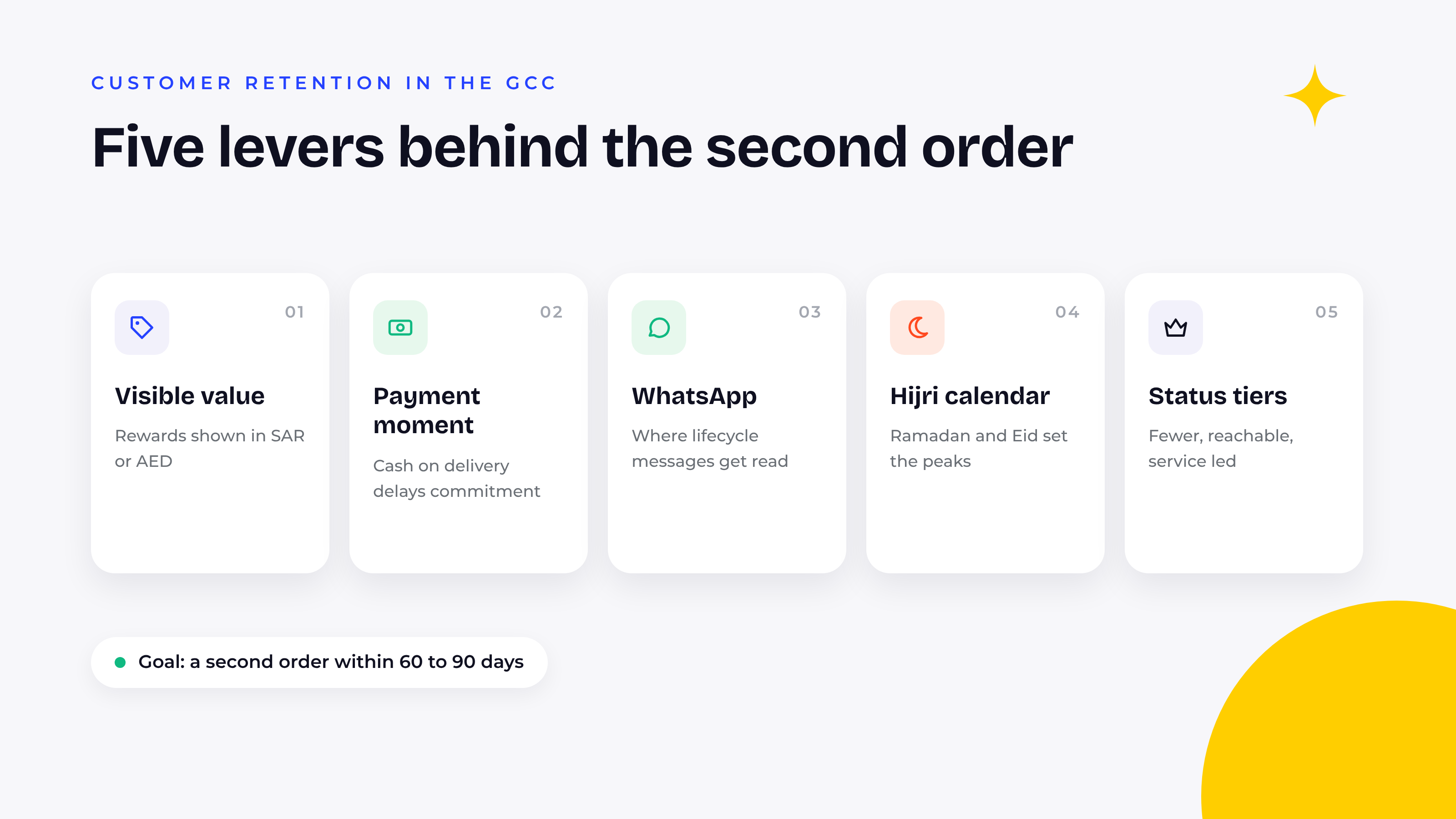
This guide breaks down the five forces that decide whether a Gulf customer places a second order: discount sensitivity, cash on delivery, WhatsApp, seasonality and status. For each one you get what the data says, what it means for your program, and a practical adjustment you can make this quarter.
What is customer retention in the GCC?
Customer retention in the GCC means keeping shoppers across the six Gulf Cooperation Council markets (Saudi Arabia, the UAE, Kuwait, Qatar, Bahrain and Oman) buying from you again over a set period. The math is the same as anywhere else. You track repeat purchase rate, churn and lifetime value. What changes is the behavior underneath those numbers.
Three things make Gulf retention its own discipline. First, the payment moment is not always the commitment moment, because some orders are still paid in cash at the door. Second, the main owned channel is a messaging app, not email. Third, the retail year runs on two calendars, and the Hijri one moves roughly 11 days earlier every Gregorian year, so Ramadan never lands in the same week twice.
To see how this plays out on the ground, read our companion guide on how the top retail brands in Saudi Arabia actually run their loyalty programs, which breaks down the mechanics behind the Kingdom's best known schemes.
Track the share of first time buyers who place a second order within 60 or 90 days, split by payment method and by the season they were acquired in. That one cut shows whether cash on delivery, Ramadan promotions or discount-led acquisition are filling your base with one-time buyers.
Why does customer retention in the GCC matter right now?
Customer retention in the GCC matters because the region's shoppers are maturing fast and competition for them is rising, so the brands that win are the ones that make the second and third purchase cheaper to earn than the first. The economics of retention are well established: Bain found that increasing retention by as little as 5 percent can boost profits by as much as 95 percent.
Regional brands are clearly betting on it. Khaleej Times reports that the Middle East loyalty market is forecast to grow from $3.4 billion in 2026 to $5.6 billion by 2030, with Saudi Arabia expected to reach $1.27 billion and the UAE $592.4 million. At the same time, payments are shifting online: the Saudi Central Bank says electronic payments made up 79 percent of total retail payments in 2024, up from 70 percent in 2023. More digital transactions mean more customer data, and more chances to recognize and reward a returning buyer.
If you are building the case internally, our guide to building a retention-first growth engine shows how to shift budget from acquisition to repeat revenue, and our breakdown of how to calculate customer churn rate covers the baseline you will need.
How does discount sensitivity shape Gulf retention?
Discount sensitivity shapes Gulf retention in two directions: rewards that do not read as real savings get ignored, but a program built only on codes trains customers to wait for the next one. Value is front of mind. In PwC Middle East's 2025 Voice of the Consumer survey of shoppers in Saudi Arabia, the UAE and Qatar, 49 percent named the cost of living as a top national concern. And Euromonitor International found that more than 50 percent of loyalty program members in the Middle East and Africa favour discounts and offers, alongside free products.
The answer is not to stop discounting. It is to make value visible and earned. Show balances in riyals or dirhams rather than abstract points, give a small instant reward on the first action so the program pays off before the second order, and keep deep promotions for specific jobs such as win-back or clearing a category. Our guide on increasing lifetime value without offering more discounts goes deeper on the mechanics.
- ✕Site-wide codes every few weeks
- ✕Customers learn to wait for the next sale
- ✕Margin falls with every campaign
- ✕No reason to stay once a rival offers more
- ✓Balance shown in SAR or AED, so value is obvious
- ✓Rewards earned through orders, reviews and referrals
- ✓Deep offers reserved for win-back and lapsed buyers
- ✓Status and perks that a rival cannot copy overnight
How does cash on delivery affect repeat purchase in the GCC?
Cash on delivery affects repeat purchase because it moves the real commitment from checkout to the doorstep. Until the parcel is accepted and paid for, the order is a promise, and any points or welcome credit issued at checkout can leak to orders that are refused. The good news is that the share of shoppers who prefer it is shrinking fast.
Checkout.com's fourth annual MENA report found that preference for cash on delivery in the region halved from 41 percent in 2020 to 20 percent in 2023, and fell as low as 10 percent in Saudi Arabia, the UAE and Kuwait. The same report found that a third of shoppers would switch to a competitor after a single failed payment, which makes the checkout itself a retention risk.
So the cash on delivery cohort is smaller than it was, but it still deserves its own playbook. Shoppers who pick it are, by definition, deferring commitment, and your program should treat the delivered and paid order as the real first purchase.
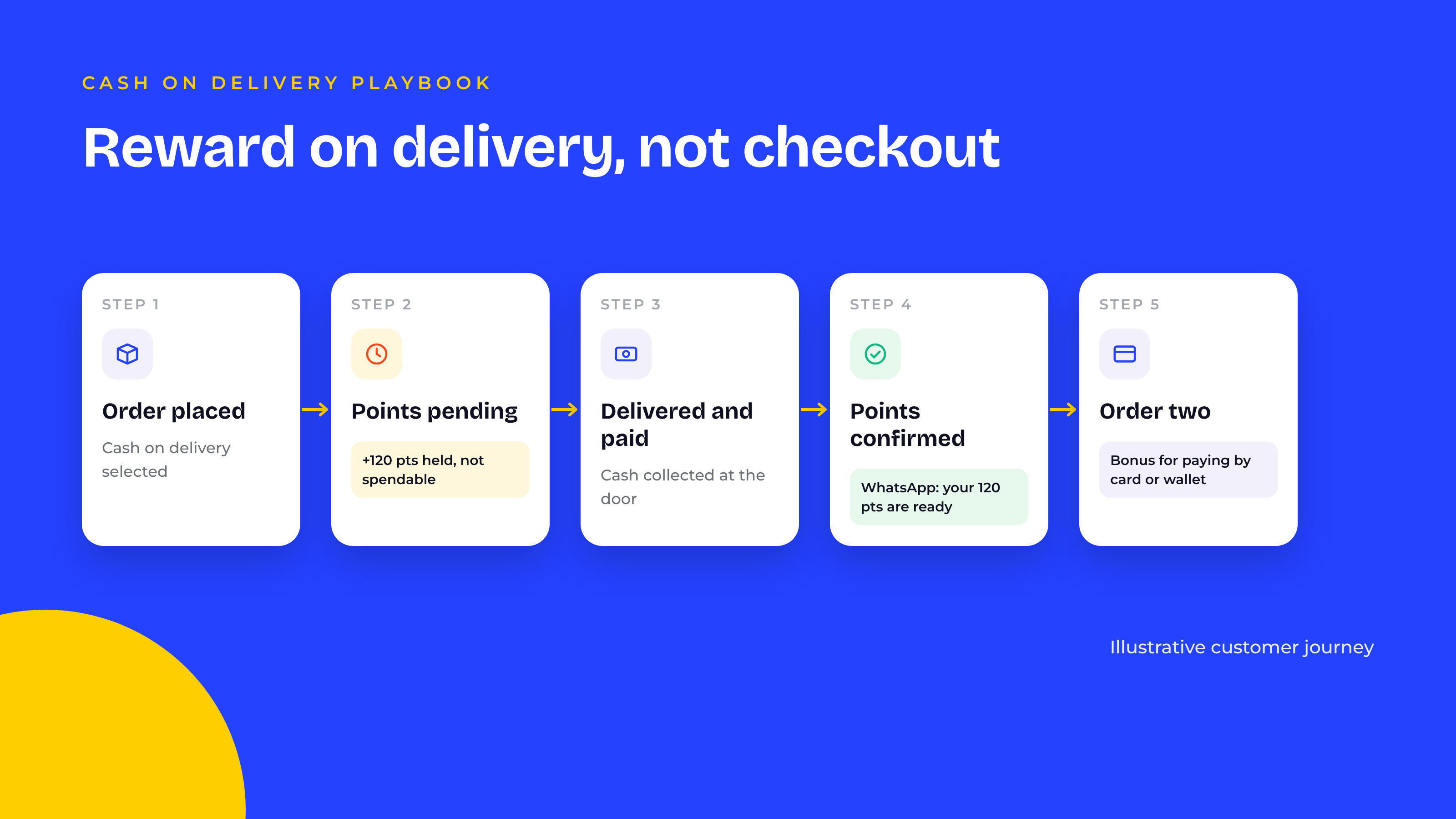
Here is how the two payment paths should differ inside your loyalty program:
| Program element | Cash on delivery orders | Prepaid orders |
|---|---|---|
| When points are confirmed | After the parcel is delivered and the cash is collected | After the return window closes |
| Welcome reward | Issued on the first delivered order, not at signup | Can be issued at signup or on first order |
| Second order incentive | Bonus points or free shipping for paying by card or wallet next time | Standard earn rate, with a time-limited bonus |
| Refusal handling | Cancel pending points automatically when an order is refused | Reverse points on refund or cancellation |
| What to measure | Delivered rate, then second order rate within 60 days | Second order rate and time between orders |
Why is WhatsApp the main retention channel in the Gulf?
WhatsApp is the main retention channel in the Gulf because it is where customers already spend their day, which makes it the most reliable place to tell them about points, rewards and tier changes. The Saudi Communications, Space and Technology Commission's Saudi Internet Report 2025 found that 61.3 percent of users spend seven hours or more online every day, and coverage of the same report shows WhatsApp as the most used app in the Kingdom.
WhatsApp is used by 94.4 percent of male and 90.4 percent of female internet users in Saudi Arabia.
Social commerce adds to the case. Deloitte's 2025 Digital Consumer Trends research found that 73 percent of consumers in Saudi Arabia and the UAE made a purchase through social media in the previous year. Email still has a job, but the lifecycle messages that drive the second order (points earned, reward unlocked, balance about to expire) belong in the chat thread. Our guide to digital customer engagement channels compares the options, and marketing automation lets you trigger each message from a customer action rather than a calendar blast.
- ✓Collect explicit opt-in at checkout and in the account page
- ✓Use approved templates for points earned, reward unlocked and tier upgrades
- ✓Write every template in Arabic and English, and send in the customer's language
- ✓Show balances in SAR or AED, with a one-tap link to the rewards wallet
- ✓Confirm cash on delivery orders by message before dispatch to cut refusals
- ✓Cap frequency and avoid late night sends outside campaign peaks
How do Ramadan and Eid change the retention calendar?
Ramadan and Eid change the retention calendar by packing a large share of the year's buying intent into a few weeks, and because the Hijri calendar moves about 11 days earlier each year, the plan has to move with it. Checkout.com reported that during Ramadan 2023 in Saudi Arabia, digital payment transaction volume rose 22 percent, with food stores up 94 percent and apparel up 76 percent.
The retention lesson is that Ramadan is an acquisition peak and the weeks after Eid are the retention test. Brands that recruit heavily during the holy month and then go quiet risk watching those new buyers lapse. Plan the second order before the first one happens. Our guides on preparing your online store for Ramadan and keeping customers engaged after Ramadan ends cover both halves, and national days such as Saudi National Day give you more peaks in the Gregorian half of the year.
White Friday, the Gulf's name for the late November sales period, is the other big acquisition moment. Our BFCM preparation guide explains why loyalty set up in October makes November stronger.
How should loyalty tiers differ from Western templates?
Loyalty tiers in the Gulf work best when there are fewer of them, they can be reached within a season, and they pay out in status and service rather than slow-burning points. Most templates are built for a calendar year and an individual shopper. Gulf shoppers often buy for a whole household, spend most around religious holidays, and tend to notice recognition, priority and convenience more than a points multiplier.
| Design choice | Typical Western template | Gulf-adapted tier design |
|---|---|---|
| Qualification period | Calendar year, reset every January | Rolling 12 months, so every member gets one full Ramadan and Eid cycle |
| Number of tiers | Four or five | Three, with the first upgrade reachable within one season |
| Main benefit | Higher points multiplier | Priority delivery, free returns, early access to Ramadan and Eid collections |
| Value display | Points only | Points with the SAR or AED value shown next to them |
| Who earns | One individual account | Option to pool or gift points within a household |
| Recognition channel | WhatsApp, the app and the rewards widget |
Our explainer on how tiered loyalty programs work covers the basics, and gamification mechanics such as challenges and streaks give members a reason to engage between big seasonal purchases. If you are choosing a platform to run all of this, compare the options in our guides to loyalty program software in Saudi Arabia and loyalty program software in the UAE.
How do you build a customer retention plan for the GCC?
You build a GCC retention plan by fixing the reward moment first, then the channel, then the calendar, and only then the tier design. Each step builds on the one before. Personalization pays off when it is done right: McKinsey reports that personalization most often drives a 10 to 15 percent revenue lift, and each of these steps gives you a sharper segment to personalize against.
- Customer retention in the GCC hinges on the second order, so measure it by payment method and by acquisition season.
- Gulf shoppers are value-seeking: show rewards in SAR or AED and keep deep discounts for win-back, not for every campaign.
- Preference for cash on delivery halved between 2020 and 2023, but those orders still need pending points and a prepaid incentive on order two.
- WhatsApp is where lifecycle messages get read, so put points, rewards and tier updates there in Arabic and English.
- Plan around Ramadan and Eid, and treat the 30 days after Eid as the real retention test.
How Gameball helps
Gameball runs loyalty, gamification, referrals and promotions from one engine, with a native Salla app, multi-country and multi-brand setups, and notifications that can go out through Gameball's built-in WhatsApp channel or your own provider. It powers programs for retail and ecommerce brands across the Gulf, and you can book a demo or see pricing to plan your GCC retention program.
Related reads
- Loyalty Programs in Saudi Arabia: How the Top Retail Brands Actually Run Them
- Best Loyalty Program Software in the UAE (2026 Comparison)
- Salla Loyalty Apps Compared: How to Pick Rewards for Your Saudi Store
Frequently asked questions
What is the biggest driver of customer retention in the GCC?
The biggest driver is whether a first time buyer places a second order, and that depends on visible value, a smooth payment experience and timely contact. Gulf shoppers are value-seeking and highly mobile, so rewards shown in local currency and delivered over WhatsApp tend to outperform abstract points sent by email.
How does cash on delivery affect customer retention in Saudi Arabia?
Cash on delivery delays commitment until the parcel is paid for, so some first orders never become customers. Checkout.com found preference for it fell to as low as 10 percent in Saudi Arabia by 2023. Hold points as pending until delivery, then reward the switch to prepaid on the second order.
Is WhatsApp better than email for retention in the UAE and Saudi Arabia?
For lifecycle messages, usually yes. Saudi Arabia's Saudi Internet Report 2025 shows WhatsApp as the most used app, with over 90 percent of internet users on it. Use WhatsApp for points, rewards and tier updates with explicit opt-in, and keep email for receipts, newsletters and longer content.
When should GCC brands plan Ramadan retention campaigns?
Start planning two to three months ahead, because the Hijri calendar moves about 11 days earlier each year. Build balances in the weeks before Ramadan, recruit and engage during the month, open a burn window at Eid al-Fitr, then run a second order push in the 30 days after Eid.
Do loyalty tiers work differently in the Gulf?
Yes. Gulf tiers work best with fewer levels, a first upgrade reachable within one season, and benefits built on service and status, such as priority delivery and early access to Eid collections. A rolling 12 month qualification period makes sure every member experiences one full Ramadan and Eid cycle.
How do you measure customer retention in the GCC?
Use the standard metrics (repeat purchase rate, churn rate and customer lifetime value) but cut them by payment method, acquisition season and market. The most useful single number is the share of first time buyers who place a second order within 60 or 90 days, compared against a holdout group.
.svg)
.svg)
.svg)

Ready to level up your game?
Create your first campaign and start seeing results in 30 days.
Ready to grow?
Get in touch with our sales team today.
The loyalty vendor checklist your CTO
will thank you for
Discover engineering challenges, essentials, and more from global brands.

Gameball Staff
Stay ahead on retention
Subscribe to our newsletter and get all the latest updates as we post.

Ready to level up your game?
Create your first campaign and start seeing results in 30 days.
Read related articles

.png)

Ready to level up your customer loyalty?
Level up your customer loyalty!


.avif)
.avif)
.avif)
.avif)