
%207.svg)

.svg)

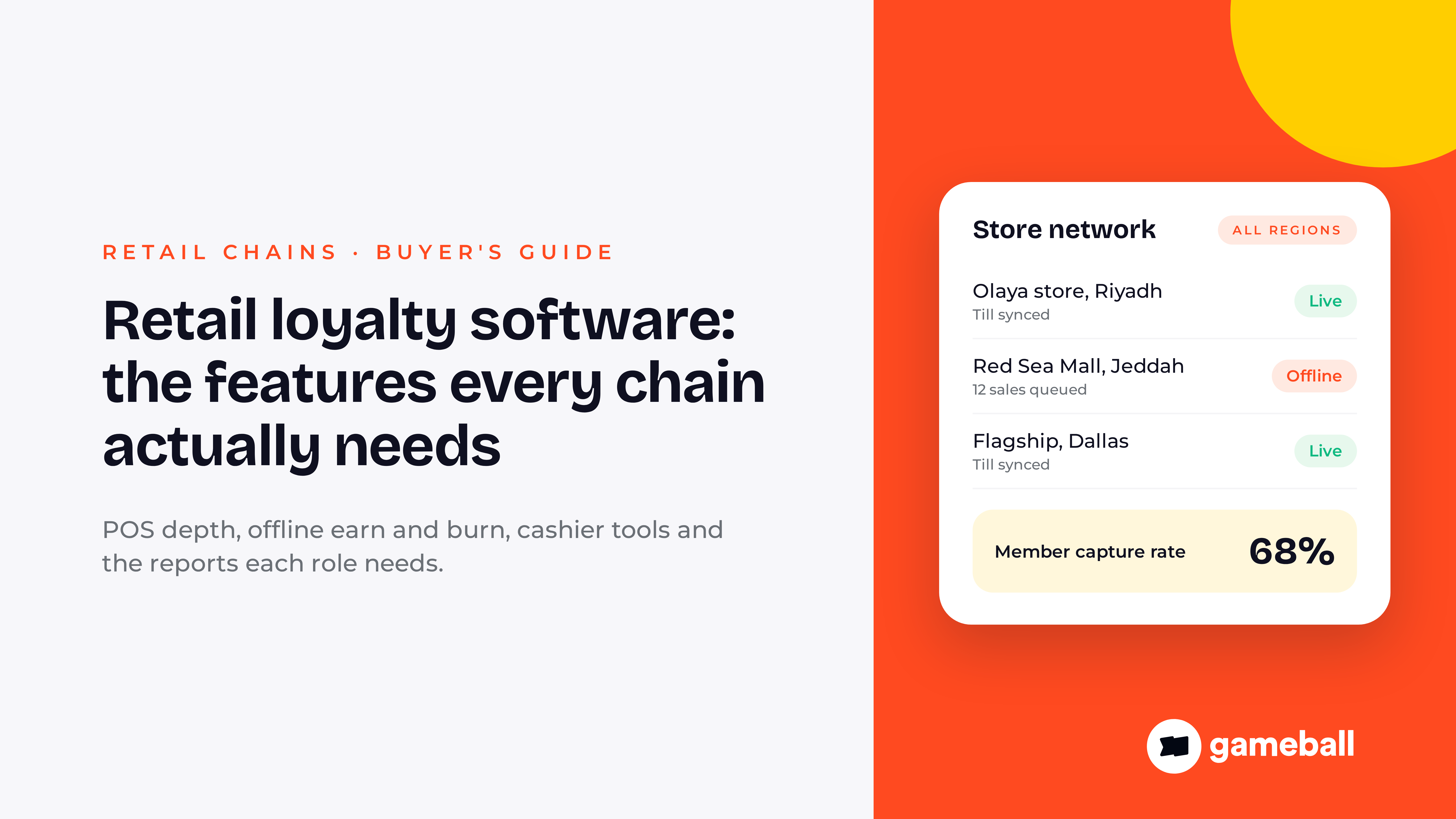
Retail loyalty software is the system a store chain uses to recognize a member at any till, website or app, award and redeem rewards against one balance, and report what that behaviour is worth by store, region and brand. For a single shop almost any points app will do. For a chain with dozens or hundreds of doors, the features that decide success are the unglamorous ones this guide focuses on.
Most comparisons of retail loyalty software list the same marketing features: points, tiers, referrals and a nice widget. This guide covers what those lists skip and what multi-location retailers in the US and the GCC actually trip over after signing: how deep the point of sale integration goes, what happens when a store loses its connection, what the cashier sees, how franchise data is kept apart, and why a regional manager needs different reports from head office. If you are still defining the category itself, start with our companion customer loyalty platform buyer's guide, which sets out the scoring framework this article applies to retail chains.
What is retail loyalty software?
Retail loyalty software is a loyalty engine built for businesses whose customers buy in physical stores as well as online, so the store counter is treated as a first-class channel rather than an afterthought. It holds the member record, applies the earning and redemption rules, and connects to the point of sale, the ecommerce platform and the app so that one customer has one balance everywhere.
That in-store focus is not nostalgia. In the US, e-commerce accounted for 17.1 percent of total retail sales in the second quarter of 2026, according to the Census Bureau. The other 82.9 percent still happens through stores and other non-ecommerce channels, which is exactly where a web-only loyalty app cannot see the customer.
Why retail loyalty software matters more for chains
Retail loyalty software matters more for chains because every extra store multiplies the number of places where a member can be missed, a reward can fail, or a report can mislead. A program that works in one flagship can quietly break across fifty locations with different tills, staff and managers.
The economics make those failures expensive. Acquiring a new customer is five to 25 times more expensive than retaining an existing one, and research by Bain's Frederick Reichheld found that raising retention by 5 percent lifts profits by 25 to 95 percent. McKinsey adds that personalization most often drives a 10 to 15 percent revenue lift, and that 71 percent of consumers expect it. A chain can only personalize what it records, and it only records what the till passes to the loyalty program. Our piece on why loyalty programs work for retail stores covers the business case in more depth.
Retail loyalty software vs a generic loyalty app
The difference between retail loyalty software and a generic loyalty app is where the program stops. Most ecommerce loyalty apps stop at the edge of the website. Retail loyalty platforms have to reach the counter, the stockroom tablet and the regional manager's inbox.
- Earns points on web orders and maybe a POS add on
- One admin view for the whole business
- Assumes a constant connection to the checkout
- Staff never see or touch the program
- Earns and redeems at every till, site and app on one balance
- Store, region, brand and franchise level permissions
- Keeps working when a store loses connectivity
- Gives cashiers a fast way to identify members and apply rewards
The seven features every retail chain actually needs
Every retail chain needs seven things from its loyalty software before any campaign feature matters. Score each vendor on these first, then compare the marketing layer.
1. POS integration depth
POS integration depth decides whether members get rewarded at the moment they pay or days later, and that timing is what customers judge the program on. Ask each vendor exactly which integration method they will use with your POS, because the same word "integrated" covers four very different things.
| Integration level | How it works | What the member experiences | Risk for a chain |
|---|---|---|---|
| Receipt code or scan | Customer enters a code or photographs the receipt afterwards | Points arrive later, if they remember | Low capture rate and easy to game |
| Batch file import | The POS exports sales once a day and the platform loads them | Balance updates the next day and cannot be redeemed at the till | No in-store redemption and slow issue resolution |
| Real time API | The till calls the loyalty platform on each transaction | Earn and burn happen at checkout | Needs POS development work and good latency |
| Native POS plugin | A certified app inside the POS handles lookup, earn and burn | Fastest experience with no extra screens | Only available for supported POS systems |
For chains running an ERP-led stack, check the connector list before the demo. Gameball, for example, lists connections for Shopify POS and ERP systems including Odoo, Microsoft Dynamics 365, Oracle and SAP on its integrations page. Whatever the vendor, ask for the earn call's response time under load, since a slow call at a busy counter is a queue, not a loyalty problem.
2. Offline earn and burn
Offline earn and burn means a store can keep rewarding and redeeming members when its internet connection drops, then reconcile safely once it is back. Almost no competitor guide mentions it, yet every chain with stores in malls, basements or rural areas will face it within weeks of launch.
In the demo, ask the vendor to show a duplicate transaction being rejected and a redemption attempt during an outage. If the answer is "our uptime is very high", the platform has not been designed for stores.
3. Staff side tooling
Staff side tooling is what the cashier and store team use to run the program, and it decides whether the program is offered to every customer or forgotten on busy days. Store staff are the program's real sales force, so the screen they use has to be faster than saying "no, thanks" on the customer's behalf.
Instant recognition at the counter is also a reward in itself, as our guide to instant rewards explains. Consider rewarding staff for enrolments too, using the same gamification mechanics you use for customers, but watch for self-enrolment abuse.
4. Franchise data separation
Franchise data separation lets each franchisee or brand see and act on its own members and results while head office keeps a network-wide view, and it is often a contractual requirement rather than a nice to have. A franchisee in Jeddah should not be able to export the Riyadh operator's customer list, and a group running several brands may need separate programs that share one engine.
Ask how the platform models the hierarchy: group, brand, region, franchisee, store. Check who funds the points when a member earns in one franchisee's store and redeems in another's, and whether the platform can report that cross-store liability so it can be settled. Settle this before launch, because retrofitting separation onto a live program means re-permissioning every user and re-cutting every report.
5. Reporting by role: regional manager vs head office
A regional manager and head office need different reports because they make different decisions: the region runs stores this week, while head office decides where to invest next year. One dashboard for both usually serves neither.
| Question | Regional manager needs | Head office needs |
|---|---|---|
| Main decision | Which stores need coaching or stock this week | Whether the program earns its budget and where to expand it |
| Core metrics | Member capture rate per store, enrolments per staff member, redemptions at the till | Incremental revenue, repeat purchase rate, points liability and program ROI |
| Time frame | Daily and weekly | Monthly, quarterly and cohort based |
| Comparison | Store against store in the same region | Region against region, members against non members |
| Data access | Own region only | Whole network, by brand and franchisee |
Member capture rate, the share of transactions linked to a member, is the single best store level health check, because it shows whether the till process is working. For the head office view, our guides to measuring loyalty program success and calculating loyalty program ROI cover the formulas, and Gameball's analytics and intelligence module is built around that return rather than points issued.
6. Store level campaign control
Store level campaign control lets marketing run an offer in one region, one format or one new store without cloning the whole program. Typical examples are double points for a store opening, a regional heat wave promotion, or a clearance push at outlet locations. Ask to see a campaign scoped to three named stores, with a cap per member, built live in the demo. The same scoping matters for seasonal peaks such as Ramadan, White Friday and Black Friday, which are usually run through promotions and marketing automation rather than by editing the base earn rate.
7. Fraud and liability controls
Fraud and liability controls stop points being created or spent where they should not be, and they give finance a reliable figure for the value of unredeemed rewards. In retail the usual risks are staff linking their own account to customers' purchases, returns that do not claw back points, and the same reward being redeemed twice during an outage. Look for per member and per store limits, automatic reversal on returns, an audit trail on manual adjustments, and a liability report finance can reconcile each month.
How to run a retail loyalty software demo
The best way to run a retail loyalty software demo is to bring your own awkward scenarios instead of watching the vendor's standard script. Send them a week before, and ask for each one to be shown live.
If you sell across channels, add one omnichannel test as well. Our step by step guide to building an omnichannel loyalty strategy lists the journeys worth checking, and tiered loyalty programs are a good stress test, because tier status has to show correctly at the till as well as in the app.
What retail loyalty software costs
Retail loyalty software is priced on one of four models, and the model matters more than the headline number because it decides how your bill grows as the chain grows.
| Pricing model | How you are charged | Works well for | Watch out for |
|---|---|---|---|
| Per active member | A fee per rewarded or active customer each month | Chains with high frequency, lower value visits | Large sign up drives that inflate the member count |
| Per transaction or order | A fee on each loyalty transaction | Low frequency, high value categories | Grocery and coffee volumes that multiply the bill |
| Per store or location | A licence per store or till | Networks with steady store counts | Paying for stores with low loyalty usage |
| Tiered subscription | A monthly plan sized by volume, with enterprise quotes above it | Predictable budgeting | Overage charges and features held back for upper tiers |
For reference, Gameball's published pricing starts at $399 per month on the Growth plan for businesses under 10,000 monthly rewarded customers, with Enterprise from $599 per month above that. Whichever vendor you choose, budget separately for the rewards themselves and for POS development time, which are often larger than the software fee. If you are comparing vendors in the Gulf specifically, our guides to loyalty program software in the UAE and loyalty program software in Saudi Arabia cover the local shortlists.
How Gameball helps
Gameball runs loyalty, gamification, referrals and promotions on one customer record across your online store, app and POS, with an earn API that responds in under 300 ms. Its retail and ecommerce customers include Tamimi Markets, which runs its program across more than 200 branches, and Deraah, which unified loyalty across more than 850 stores, web and app and reports 4X the lifetime value from redeemers compared with non redeemers.
To see how it would sit on your own POS and store structure, book a demo, or check Gameball pricing if you are still sizing the business case.
Related reads
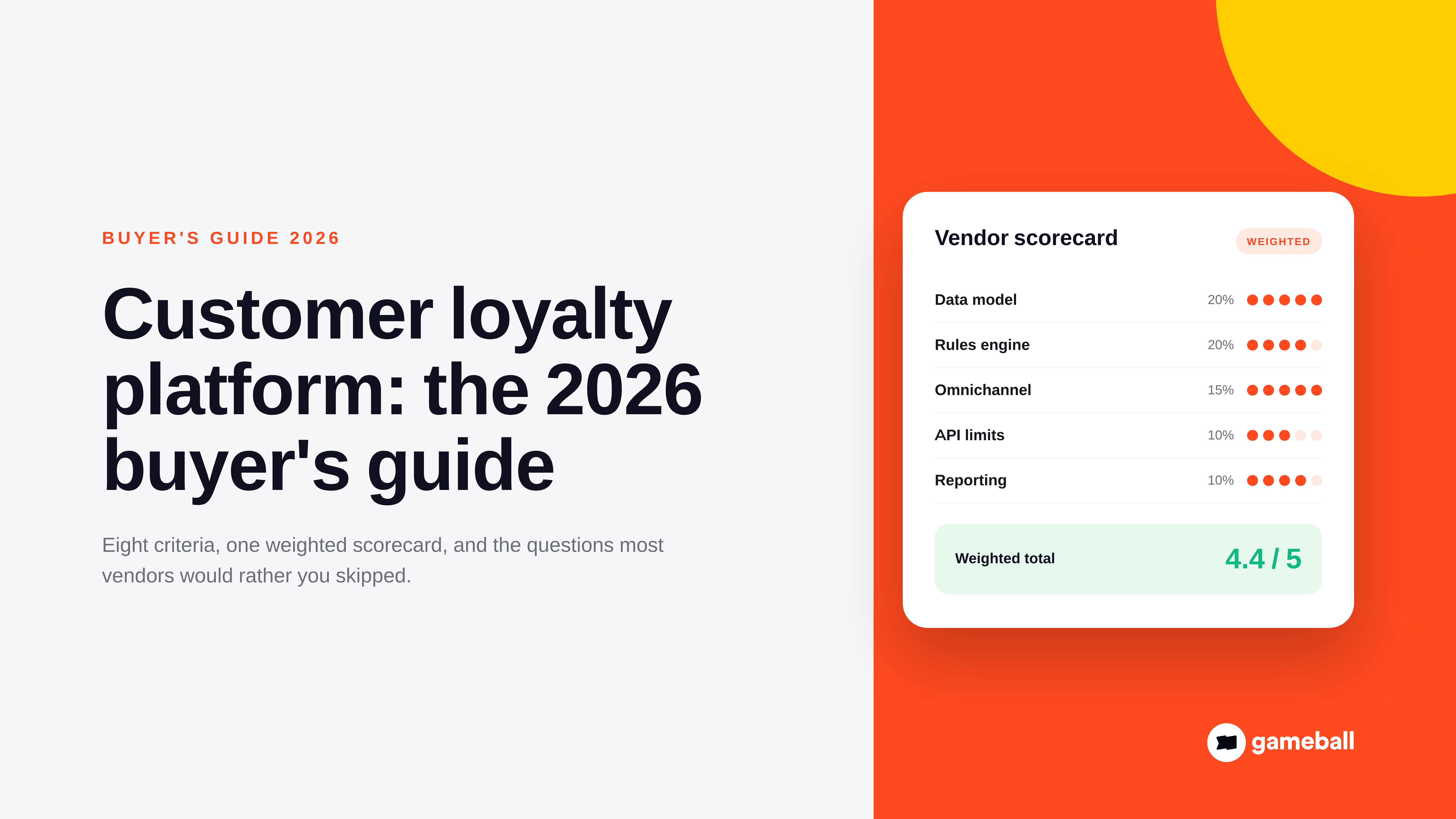
- Customer Loyalty Platform: The 2026 Buyer's Guide
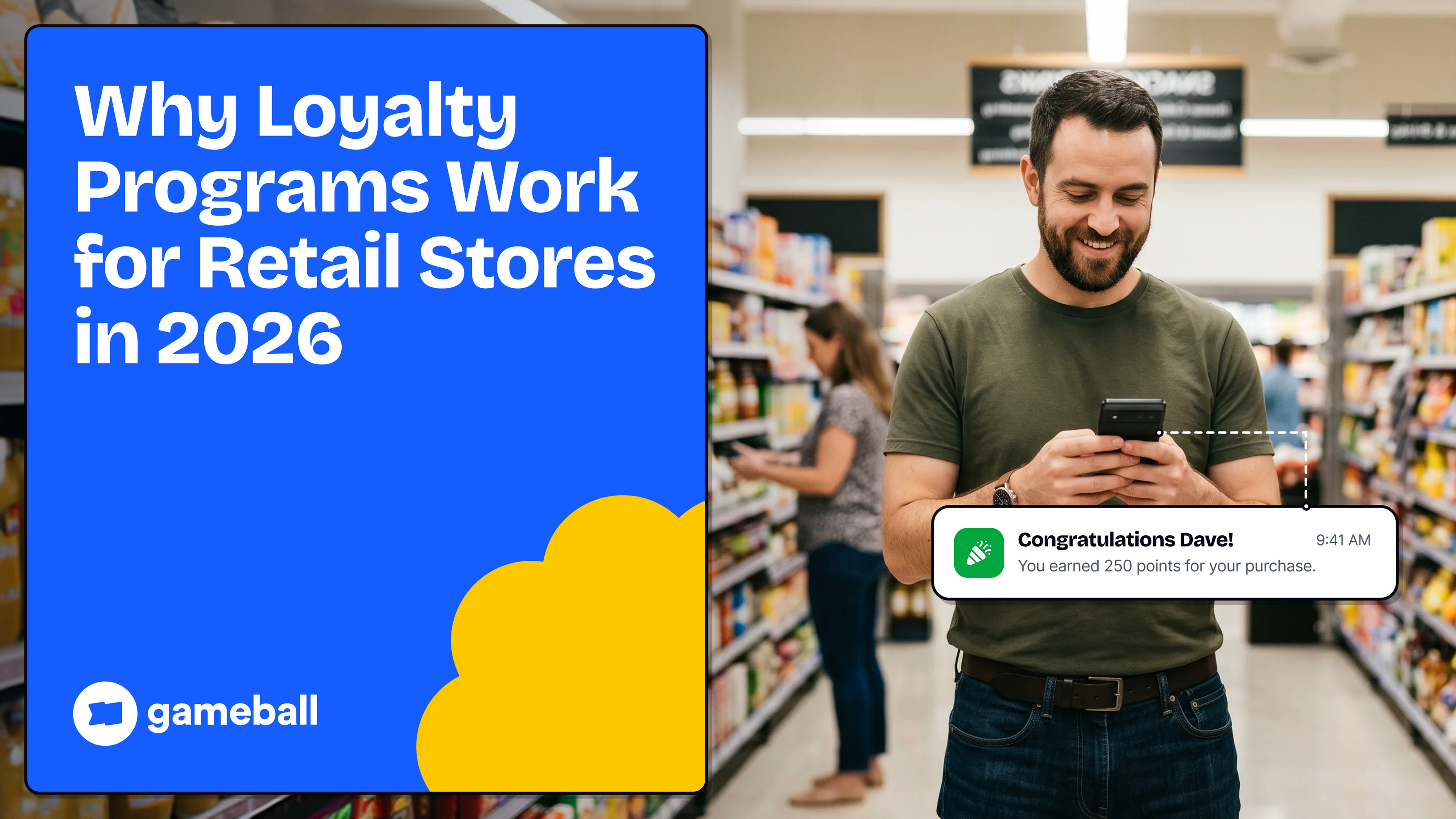
- Why Loyalty Programs Work for Retail Stores in 2026
- How To Build an Omnichannel Strategy: Step by Step Guide
Frequently asked questions
What is retail loyalty software?
Retail loyalty software is a platform that lets a store chain run one loyalty program across its tills, website and app. It identifies members at checkout, awards and redeems points or perks on a single balance, and reports results by store, region and brand, so both store teams and head office can see what the program returns.
What is the difference between retail loyalty software and a loyalty app?
A loyalty app usually rewards online orders from one store and offers one admin view. Retail loyalty software adds real time POS earn and burn, offline handling, cashier tools, franchise and brand permissions, and role based reporting. Those features only matter once you run several physical locations, which is why chains outgrow simple apps quickly.
Does retail loyalty software work when a store is offline?
It depends on the vendor, so test it in the demo. Good retail loyalty software lets the POS queue earn transactions locally with a unique ID, limits redemptions during the outage, and syncs when the connection returns without double counting. Platforms that rely entirely on a live connection will lose or delay points whenever a store goes offline.
What POS integration does retail loyalty software need?
For a chain, aim for a real time API or a native POS plugin so members can earn and redeem at checkout. Receipt codes and daily batch imports are cheaper to set up but delay points and block in-store redemption. Confirm the exact method for your POS and ERP, and ask for the response time at peak trading.
How much does retail loyalty software cost?
Pricing is usually per active member, per transaction, per store, or a tiered subscription with enterprise quotes. Published mid market plans start from a few hundred dollars a month, while large chains are typically quoted. Model a year of your own transaction and member volume under each model, and budget separately for rewards and POS development.
What reports should retail loyalty software provide?
Store and regional managers need daily member capture rate, enrolments per staff member and redemptions by store. Head office needs incremental revenue, repeat purchase rate, points liability and program ROI by region, brand and franchisee. The best platforms serve both from one data set, with permissions that limit each user to their own scope.
.svg)
.svg)
.svg)

Ready to level up your game?
Create your first campaign and start seeing results in 30 days.
Ready to grow?
Get in touch with our sales team today.
The loyalty vendor checklist your CTO
will thank you for
Discover engineering challenges, essentials, and more from global brands.

Gameball Staff
Stay ahead on retention
Subscribe to our newsletter and get all the latest updates as we post.

Ready to level up your game?
Create your first campaign and start seeing results in 30 days.
Read related articles
_compressed%2520(1)%2520(1).avif)
Ready to level up your customer loyalty?
Level up your customer loyalty!


.avif)
.avif)
.avif)
.avif)