%207.svg)

.svg)

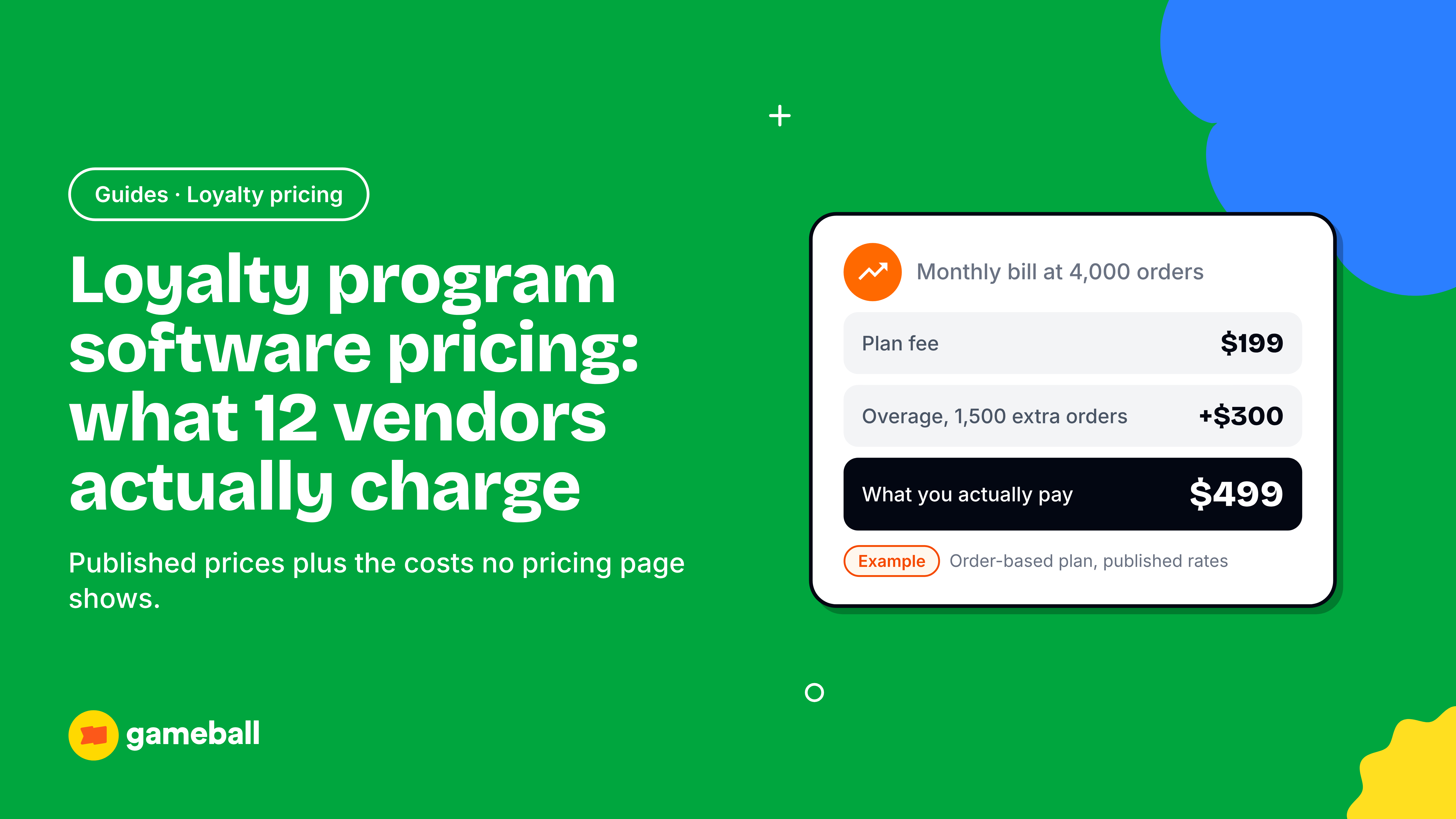
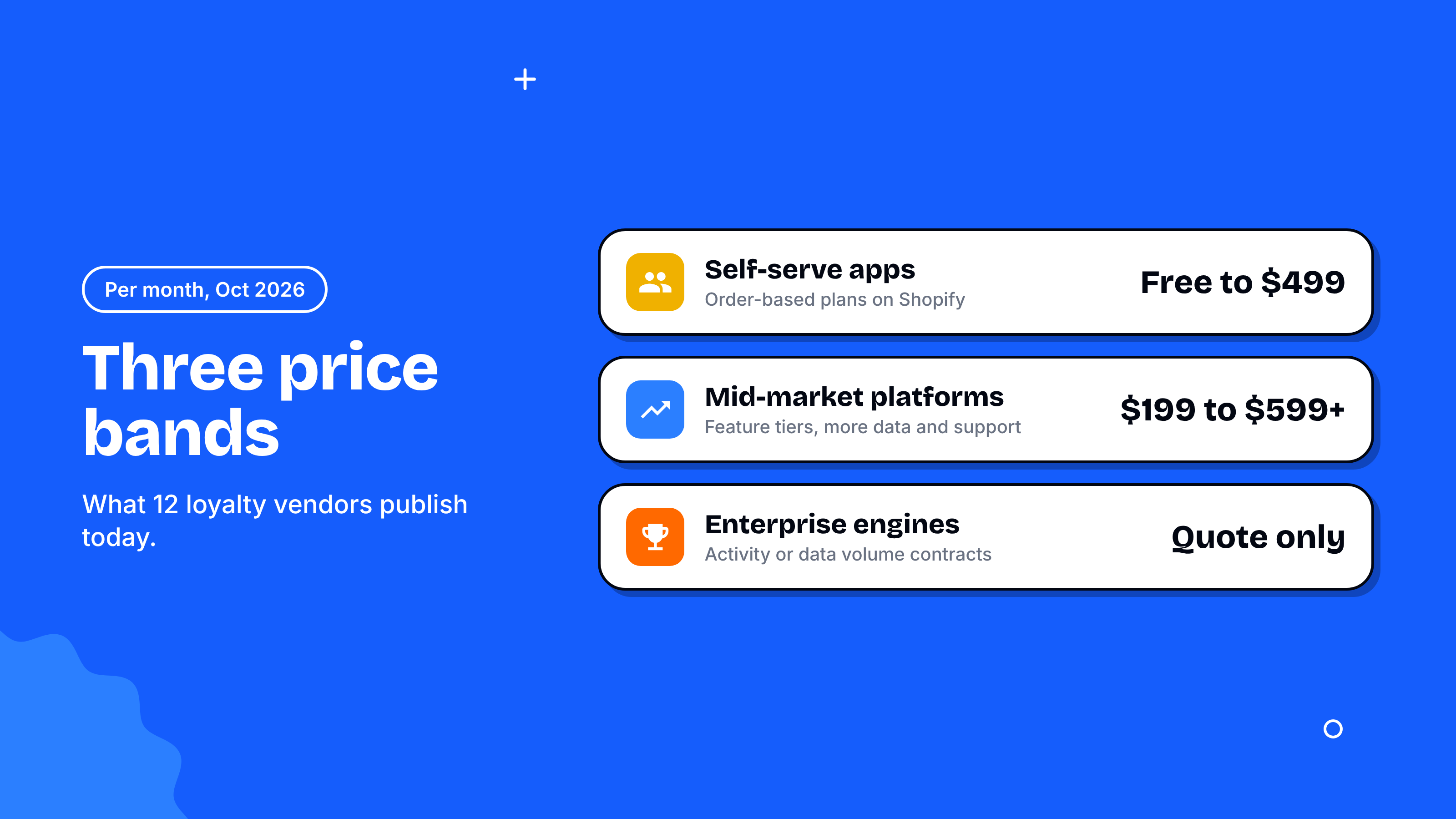
Loyalty program software pricing ranges from free starter plans to $499 a month for self-serve Shopify apps, $199 to $599 or more a month for mid-market platforms, and custom annual contracts for enterprise engines. The number on the pricing page is only the starting point, so this guide puts the published prices for 12 vendors in one table and then adds the costs that never appear there.
Most vendors hide behind "contact sales", which makes a fair comparison hard. We checked every vendor's own pricing page or Shopify App Store listing on 18 October 2026 and recorded exactly what they publish, what they leave out, and how each one bills you as you grow. Then we cover per-order overage, implementation, integration engineering and point liability, the four costs that decide what a loyalty program really costs you in year one.
What does loyalty program software pricing include?
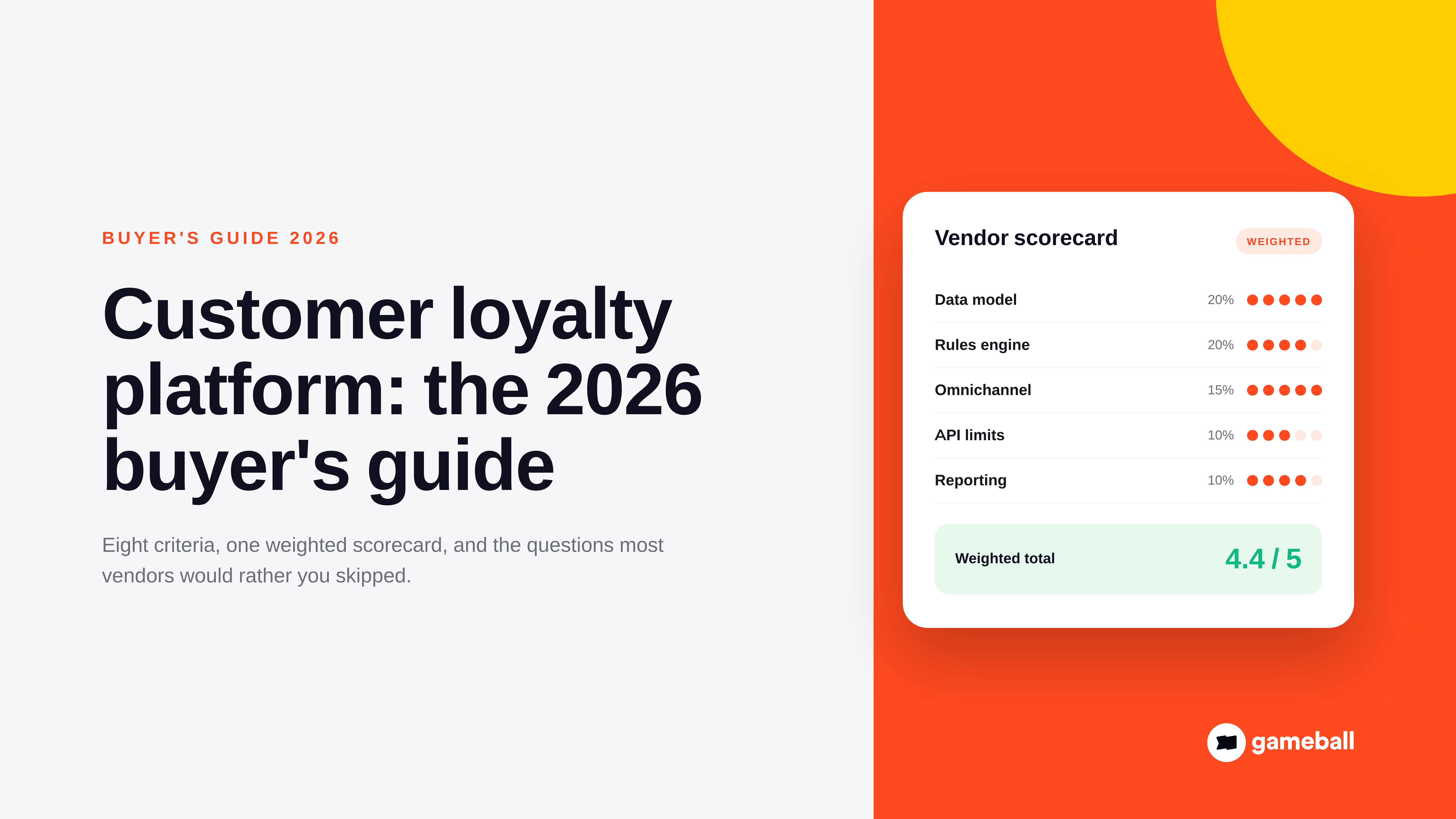
Loyalty program software pricing is the subscription a vendor charges to run your points, tiers, rewards and referrals, plus any usage fees tied to how many orders, members or customer actions the program processes. Almost every vendor prices on one of four models, and the model matters more than the headline number because it decides how your bill moves as you grow. To see how pricing fits into the wider selection process, read our companion guide, the customer loyalty platform buyer's guide, which maps every evaluation criterion side by side.
Here are the four models you will meet on pricing pages:
Order-based tiers
A flat monthly fee covers a set number of orders, with a per-100-orders overage above it. Used by Smile.io, Joy, Rivo and Growave.
Per-order usage
A base plan plus a fee on every order processed. Yotpo Loyalty Pro lists $0.08 to $0.20 per order from 500 orders a month.
Per-site or per-feature plans
A fixed fee per store or per feature set, regardless of order count. Marsello charges per site; Gameball prices by feature tier and business size.
Quote-based contracts
No public price. Fees follow customer activity, data volume or coupons issued. Open Loyalty, Antavo and Talon.One work this way.
Why is loyalty software pricing so hard to compare?
Loyalty software pricing is hard to compare because vendors meter different things. One counts orders, another counts members, a third counts API activity, and enterprise vendors publish nothing at all. A plan that looks cheaper at 500 orders a month can be the most expensive option at 4,000, and a quote-only platform can turn out cheaper than a self-serve app once you add the integrations you would otherwise build yourself.
The stakes are real. Paying for a program is only worth it if the program pays back, and the research on that is sobering:
Around two thirds of established loyalty programs fail to deliver value, and many actually erode it.
McKinsey, Next in loyalty: Eight levers to turn customers into fans, 2021
That finding, from McKinsey's research on next-generation loyalty, is why the cheapest plan is rarely the right one. The same study found that members who redeem rewards spend 25 percent more than enrolled but inactive members, so the software you pick needs the features that get members to redeem, not just the lowest fee. Before you compare prices, it helps to know how to calculate your loyalty program ROI, because that number tells you how much software cost the program can carry.
Loyalty program software pricing: 12 vendors compared
The table below lists what each vendor publishes as of 18 October 2026, taken from its own pricing page, help center or Shopify App Store listing. Where a vendor publishes nothing, we say so rather than guess. Shopify App Store charges are billed in USD every 30 days, which matters for GCC merchants paying in SAR or AED.
| Vendor | Published plans and price per month | What the price is metered on |
|---|---|---|
| Smile.io | Free, Essential $15, Standard $79, Growth $199 | Orders: 200, 500, 1,000 and 2,500 a month; Growth adds $20 per extra 100 orders |
| BON Loyalty | Free, Starter $15, Basic $29, Growth $129; Enterprise unpriced | Orders: 150, 300, 500, then unlimited on Growth |
| Joy Loyalty | Free, Essential $29, Advanced $129, Ultimate $499 | Orders: 250, 500, 2,000 and 7,000 a month; overage $15, $10 and $5 per extra 100 orders |
| Rivo | Free, Essential $15, Scale $49, Plus $499 | Orders: 200, 500, 400 included on Scale with $20 per extra 100 (capped at $499), 2,500 on Plus; custom above that |
| Growave | Free, Entry $15, Growth $199, Plus $499 | Orders: 200, 500, 1,500 and 3,000 a month; overage $20, $15 and $10 per extra 100 orders |
| LoyaltyLion | Classic $199; Advanced and Plus custom | Orders: 500 a month on Classic; no published overage fee |
| Yotpo Loyalty | Free under 100 orders; Pro $199 | Orders: usage pricing of $0.08 to $0.20 per order from 500 orders a month |
| Marsello | Loyalty Launch from $60, Loyalty Accelerate from $120; Enterprise quote | Sites: price is per site; SMS add-on from $0.028 per message |
| Gameball | Growth from $399, Enterprise from $599 | Business size and feature tier: Growth has up to 5 user seats and 1 year of data retention, Enterprise unlimited seats and 2 years |
| Open Loyalty | Custom only | Platform fee plus allowance fee, both quoted by sales |
| Antavo | Start, Grow and Enterprise; no public prices | Customer activity |
| Talon.One | Starter, Professional and Enterprise; no public prices | Data volume; Starter requires at least 500,000 coupons; no API call limits |
Three patterns stand out. First, the self-serve Shopify apps cluster tightly at entry level, with paid plans from $15 a month, but their top published plans reach $499. Second, mid-market platforms such as LoyaltyLion, Yotpo and Gameball start around $199 to $599 a month and add depth, data and support rather than order allowance. Third, the enterprise engines publish no prices at all. The only public benchmark we found for that tier is a third-party estimate: CostBench reports a median Open Loyalty contract of $72,000 a year, based on three buyer reports, and labels it indicative rather than official.
If you are already shortlisting, our comparisons of the best Smile.io alternatives, LoyaltyLion alternatives and Yotpo Loyalty alternatives go deeper on features for each one.
What does loyalty software cost at 4,000 orders a month?
At 4,000 orders a month, the same stores pay anywhere from $129 to $574 a month on published self-serve plans, because overage fees compound fast once you pass a plan's included orders. We calculated each figure below from the published plan price plus the published overage rate, choosing the cheapest plan that covers 4,000 orders.
The working is simple. Smile.io Growth includes 2,500 orders, so 1,500 extra orders add 15 blocks at $20, taking $199 to $499. Joy Advanced includes 2,000, so 2,000 extra orders at $10 per 100 take $129 to $329. Growave Growth includes 1,500, and 2,500 extra orders at $15 per 100 take $199 to $574. Rivo Scale would reach $769 on its overage rate, but Rivo caps the plan at $499. BON Growth charges a flat $129 with no order limit.
Order count is not the only variable. Growave bundles wishlist and reviews into its plans, LoyaltyLion's Advanced and Plus tiers are custom, and Yotpo's per-order rate varies between $0.08 and $0.20 without a public schedule, so ask any vendor for a written quote at your forecast volume for the next 12 months, not just today's.
The costs that never appear on a pricing page
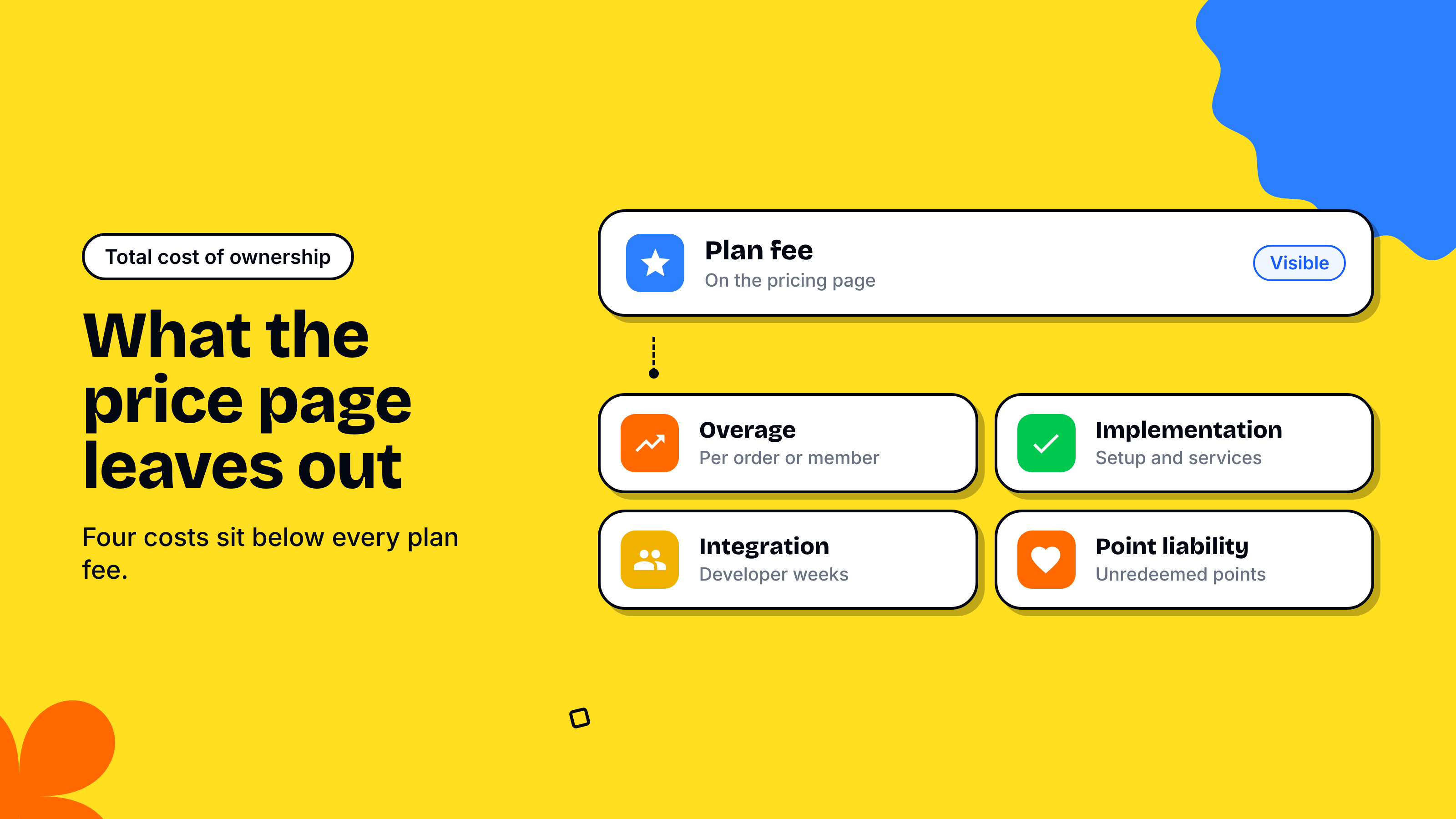
The subscription is usually the smallest part of what a loyalty program costs. Four other costs decide the real number, and none of them shows up in a pricing table.
1. Per-order and per-member overage
Overage is the fee for exceeding your plan's allowance, and it scales with your success. The bars above show how a store that doubles its order volume can see its loyalty bill more than double. Model your peak month, not your average one: if November orders run at twice your normal rate, an order-metered plan bills you for that spike.
2. Implementation and setup
Implementation covers program design, data import, widget setup and testing. Self-serve apps keep this close to zero on a standard Shopify theme. Enterprise platforms usually need a partner or professional services: CostBench lists professional services and integration for Open Loyalty at $3,000 to $15,000, again as a third-party estimate rather than a vendor rate. Ask every vendor how long go-live takes and who does the work.
3. Integration engineering
If you sell through a mobile app, POS, marketplace or a custom stack, someone has to connect it. API-first platforms publish SDKs and webhooks but expect your developers to build the experience. Count the developer weeks, because an engineer's time on a loyalty integration is a real cost even when it never appears on an invoice.
4. Point liability
Point liability is the value of points your members have earned but not yet redeemed, and under accounting standards it is a balance sheet obligation, not free money. Milliman's analysis of loyalty program accounting explains that IFRS 15 and ASC 606 require part of each sale to be deferred as loyalty liability until points are redeemed or expire.
deferred as point liability on $100M of sales in Milliman's worked example (1 point per $10, 90% expected redemption)
more spend from members who redeem than from enrolled but inactive members, per McKinsey
of established loyalty programs fail to deliver value, per McKinsey
The software price and the liability are linked. A platform that makes rewards easy to reach turns liability into redemptions and repeat orders, while one that lets points pile up builds an obligation with nothing to show for it. Our guide to loyalty redemption rate shows how to keep that balance healthy, and points engines that support expiry rules and reward tiers, like those covered in how loyalty points software works, are what make it manageable.
How to estimate what a loyalty program will really cost
To estimate the true cost of a loyalty program, add the subscription at your peak forecast volume, the one-off setup and integration work, and a realistic reward budget, then compare that total against the extra repeat revenue you expect. Five steps get you there:
Forecast 12 months of orders and members
Use your peak month, not the average, since metered plans bill on it.
Price every shortlisted plan at that volume
Add plan fee plus overage for each vendor and get quotes in writing.
Add setup and integration work
Count partner fees and developer weeks for POS, app and custom channels.
Budget the rewards themselves
Estimate points issued, expected redemption and the liability you will carry.
Compare against the revenue lift
Set total cost against expected repeat purchases to see the payback month.
Step five is where most buyers stop too early. A cheaper plan that cannot run tiers, referrals or targeted campaigns may never generate the repeat revenue that justifies any fee at all, which is how programs end up in McKinsey's two thirds.
Which loyalty pricing model fits your business?
The right pricing model depends on your order volume, your channels and how much of the program you want to build yourself. Use this as a starting point, then check the vendor questions below before you sign.
| Your situation | Pricing model that usually fits | Watch out for |
|---|---|---|
| New Shopify store under 500 orders a month | Free or entry plan on an order-based app | Feature gates on referrals, tiers and branding |
| Growing store, 1,000 to 5,000 orders | Mid-tier app or a flat feature-tier platform | Overage on peak months; compare at your November volume |
| Omnichannel retailer with POS and app | Feature-tier platform with APIs and SDKs | Integration engineering and data retention limits |
| Enterprise with custom stack across markets | Quote-based engine or enterprise tier | Professional services fees and multi-year commitments |
For merchants in Saudi Arabia and the UAE, two more checks matter: Arabic and right-to-left support in the member widget, and native integrations with regional platforms such as Salla and Zid. Our comparisons of loyalty program software in Saudi Arabia and loyalty program software in the UAE cover which vendors handle both.
Before you sign, ask every vendor these five questions:
Five questions to ask before you sign
How Gameball helps
Gameball publishes its starting prices and runs points, tiers and rewards, gamified challenges, referral programs and automated campaigns for retail and ecommerce brands across the US and the GCC from one platform. Built-in loyalty analytics show how members earn and redeem, so you can judge payback, not just cost; see Gameball pricing or book a demo to get a quote at your volume.
Related reads
- Customer Loyalty Platform: The 2026 Buyer's Guide
- How To Calculate Your Loyalty Program ROI
- Loyalty Redemption Rate: The Metric Most Brands Get Wrong
Frequently asked questions
How much does loyalty program software cost?
Loyalty program software costs from nothing to $499 a month for self-serve Shopify apps such as Smile.io, Joy, Rivo and Growave, about $199 to $599 or more a month for mid-market platforms like LoyaltyLion, Yotpo and Gameball, and custom annual contracts for enterprise engines such as Antavo, Talon.One and Open Loyalty, based on pricing published in October 2026.
How much does a loyalty program cost to run in total?
A loyalty program's total cost is the software subscription at your peak volume, plus setup and integration work, plus the rewards themselves and the liability for unredeemed points. For many brands the rewards and integration work cost more than the software, so build a 12-month budget that includes all four before comparing vendors.
Why do loyalty apps charge by order volume?
Loyalty apps charge by order volume because orders are a simple proxy for how much the program is used and how much value it creates. The downside for merchants is that the bill rises with every sales spike, so a plan that looks cheap at 500 orders can cost several times more at 4,000 once overage fees apply.
Are free loyalty program plans worth it?
Free loyalty plans are worth it for testing a program on a small store, typically up to 100 to 250 orders a month depending on the vendor. They usually limit branding, tiers, referrals and integrations, so treat a free plan as a trial of the mechanics, not a long-term program, and check the upgrade price before you launch.
What hidden costs should I budget for with loyalty software?
Budget for four hidden costs: per-order or per-member overage above your plan allowance, implementation and professional services, developer time to integrate POS, apps or custom channels, and the balance sheet liability for points members earn but have not redeemed. None of these appears on a typical pricing page.
Is per-order or flat pricing better for a loyalty program?
Flat or feature-tier pricing is usually better for growing and seasonal brands because the cost stays predictable when order volume spikes. Per-order pricing can be cheaper for very small or stable stores. Model both at your busiest month of the coming year, since that is when the difference between them is largest.
.svg)
.svg)
.svg)

Ready to level up your game?
Create your first campaign and start seeing results in 30 days.
Ready to grow?
Get in touch with our sales team today.
The loyalty vendor checklist your CTO
will thank you for
Discover engineering challenges, essentials, and more from global brands.

Gameball Staff
Stay ahead on retention
Subscribe to our newsletter and get all the latest updates as we post.

Ready to level up your game?
Create your first campaign and start seeing results in 30 days.
Read related articles

_compressed%2520(1)%2520(1).avif)
Ready to level up your customer loyalty?
Level up your customer loyalty!


.avif)
.avif)
.avif)
.avif)