
%207.svg)

.svg)

How Mano Runs One Loyalty Program Across Two Markets and Six Verticals
41,406
Reward-Led Orders
90K+
Loyalty Members Enrolled
48,844
Reward Redemptions

The problem
Mano had scale and a twenty-minute delivery promise across Nigeria and Angola, and wanted a stronger reason for customers to come back to the app every time. In on-demand delivery the switching cost is close to zero, and any loyalty program had to work across two currencies, two languages and six verticals without slowing a single order down.

The solution
In late November 2024 Mano went live with Gameball in both markets at once, embedded directly in its React Native app. Cashback points quoted in local currency, three levels earned on order count rather than spend, a challenge board built around the second order and the customer's birthday, and campaign levers on top, with Mano keeping its own couponing engine.
Region
Vertical
Objective
Solutions

Ready to level up your game?
Create your first campaign and start seeing results in 30 days.
About Mano: Africa's household super app
One app for groceries, restaurant food, pharmacy, flowers, electronics and bulk buying, delivered across Lagos, Abuja and Luanda
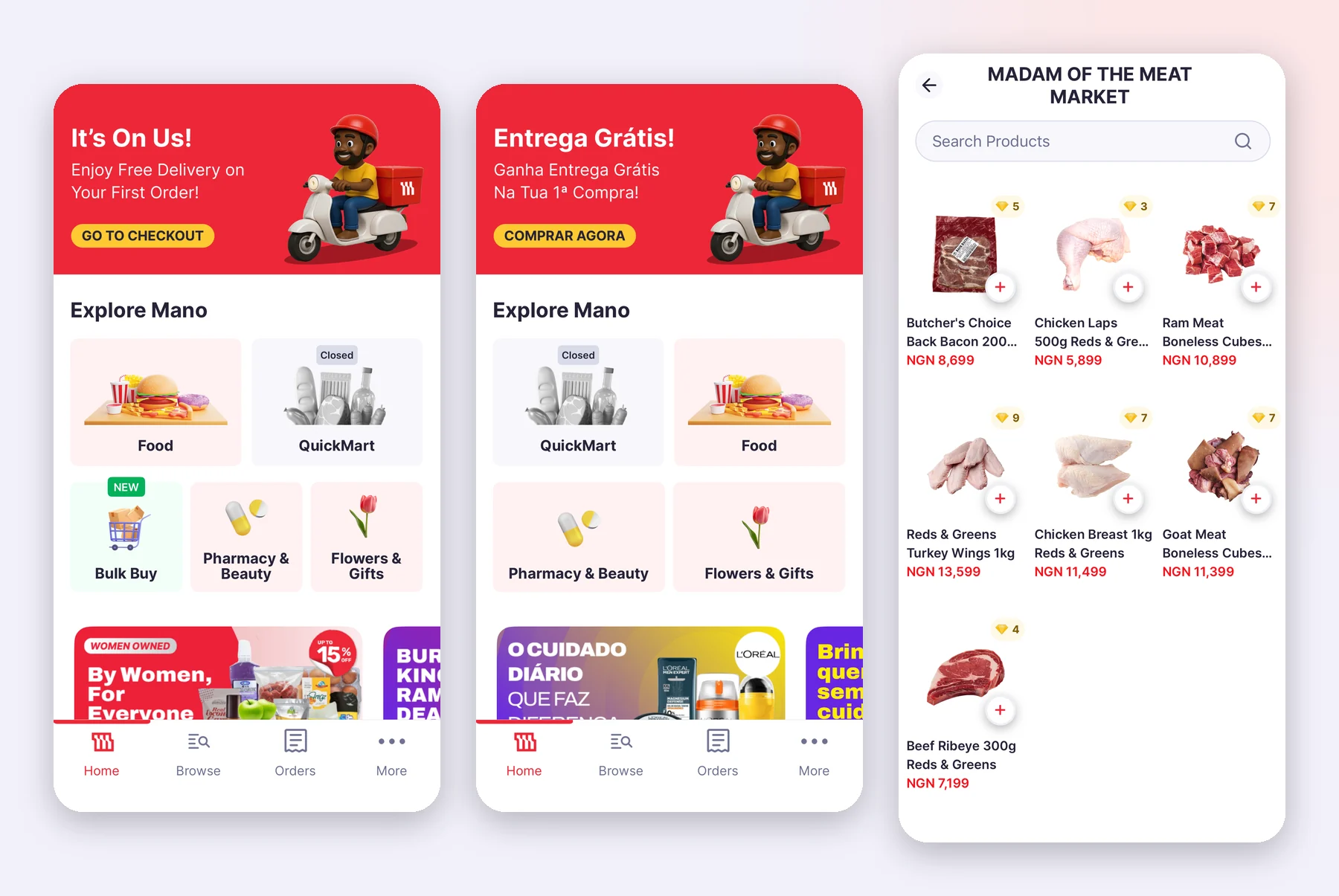
Mano is a multi-category delivery platform operating in Nigeria and Angola. It started as an ultra-fast grocery service and grew into what the company calls a household super app: a single basket that can hold a week of groceries, a restaurant order, a prescription, a bunch of flowers and a phone charger. Customers in Lagos and Abuja shop in naira and in English. Customers in Luanda shop in kwanza and in Portuguese. Same app, same account structure, two very different markets.
The promise that holds it together is speed. Mano built its reputation on deliveries that arrive in under twenty minutes, with a catalogue of over three thousand grocery items and free delivery on bulk orders within twenty four hours.
Source: Mano App company figures, manoafrica.com. These describe Mano's scale, not Gameball program results.
The Challenge
By late 2024 Mano had the scale and the delivery promise. The next step was giving customers a reason to choose Mano every time, rather than whichever app was on the next home screen. In on-demand delivery the switching cost is close to zero: the products are the same, the prices are comparable, and the only thing a customer really buys is the twenty minutes. Mano needed a retention layer that worked inside that constraint rather than against it.
1. One program, two currencies, two languages
Nigeria and Angola are separate operations with separate catalogues, separate pricing and separate languages. A loyalty program that had to be configured twice, or that could only express value in one currency, would have doubled the operational cost of running it and halved the chance that either market got attention.
2. A basket that changes shape every order
Six verticals under one roof is a merchandising advantage and a loyalty problem. A customer buying paracetamol, a customer buying a week of groceries and a customer buying a birthday bouquet are not the same customer, but they are the same account. Any earning rule had to work across all of them without accidentally over-rewarding one category or turning the program into a discount on regulated items.
3. Speed is the product, so loyalty cannot add friction
Mano's customers arrive with intent. They want to order and close the app. That rules out the kind of loyalty design that asks people to browse a rewards catalogue, hunt for a code, or play through something before they can check out. Whatever went in had to be visible at a glance and ignorable by anyone in a hurry.
Speed. The whole product is the twenty minutes.
- Every extra tap between cart and checkout costs an order
- Customers arrive with intent, not with time to browse
- Anything that looks like a game risks reading as friction
- Loyalty has to survive a session that lasts ninety seconds
Give a reason to come back to Mano rather than the next app.
- Points visible in the header, not buried in a settings menu
- Earning explained in local currency, not in abstract points
- Levels that reward frequency, which is what the business needs
- Rewards that fire on their own, without a campaign each time
4. Keeping the systems Mano had already built
Mano was not starting from nothing. The team already ran its own couponing engine, its own product catalogue and its own messaging stack. A loyalty platform that insisted on owning all of that would have meant a migration project on top of a launch, which is the fastest way to make a launch date slip.
The Solution
Mano went live with Gameball in late November 2024. The program launched in both markets at once, embedded directly in the Mano mobile app rather than bolted onto a separate loyalty website.
The integration was deliberately narrow at the seams:
- Mobile SDK: Gameball runs inside Mano's React Native app, so the rewards experience lives in the same navigation as the store
- Server to server: orders, customer profiles, cart contents and refunds move between the Mano backend and Gameball over secure server-side APIs
- Multi-currency and multi-language: one program configuration covers naira and kwanza, English and Portuguese
- Mano keeps its own couponing engine: Gameball validates and triggers against it rather than replacing it, which removed a migration from the critical path
Integration shape as implemented by the Mano engineering team. Gameball is embedded in the app through the React Native SDK with server-to-server calls behind it.
What Mano Built
Cashback points that read in real money
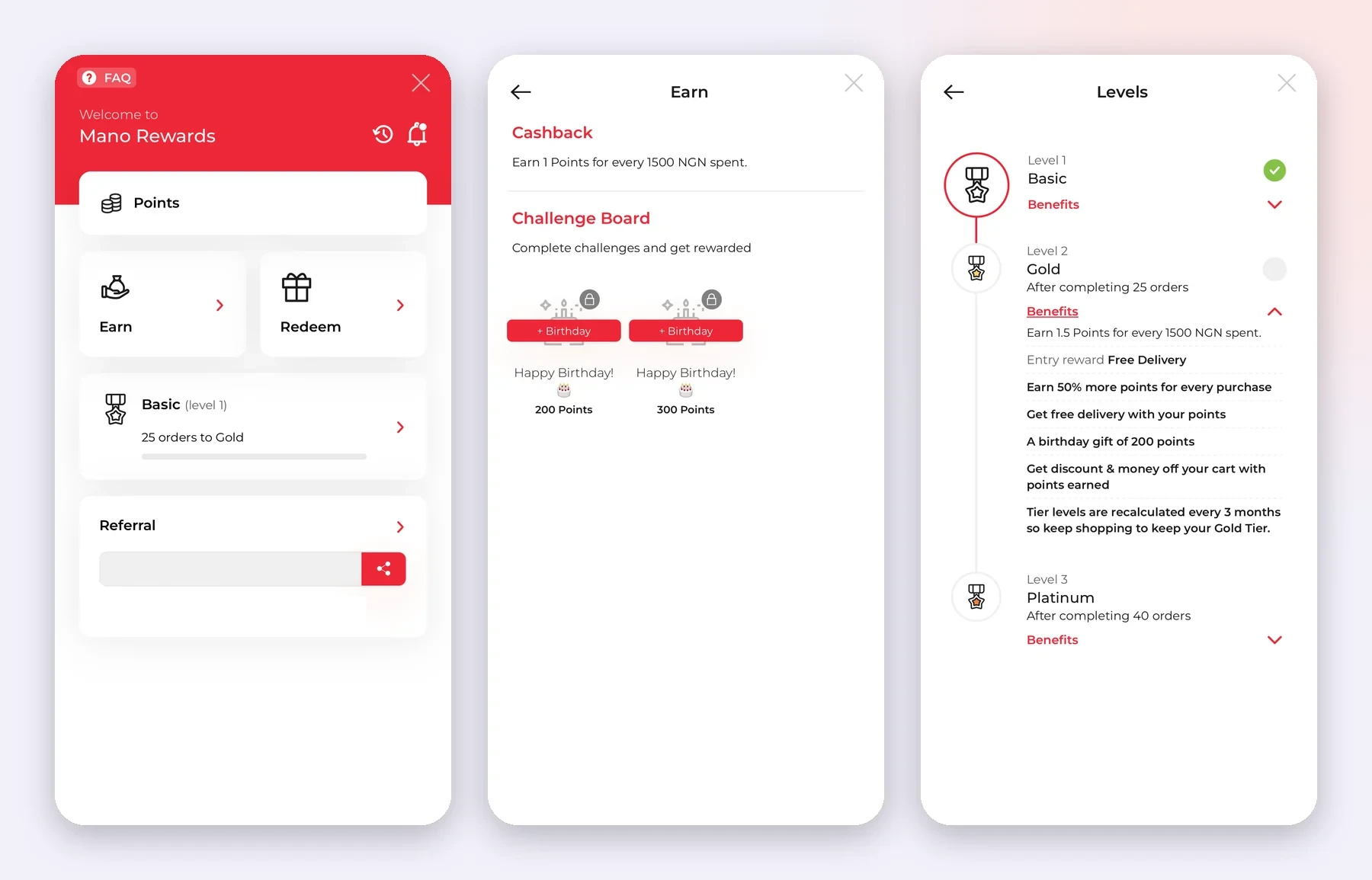
Every order earns points at a published rate, stated in local currency rather than in an abstract unit. A customer on the entry level earns one point for every 1,500 naira spent, and the rate improves as they move up. That single design decision does most of the work: it means a customer can look at a basket and know roughly what it is worth to them, without opening a rewards explainer.
Points sit behind a balance in the app header and inside a Mano Rewards hub with two doors, Earn and Redeem. Nothing about it requires a tutorial.
Three levels earned on orders, not on spend
Mano's ladder has three rungs. Basic is where everyone starts. Gold unlocks after twenty five completed orders. Platinum after forty. Levels are recalculated every three months, so status is something a customer keeps rather than something they win once.
The choice to base tiers on order count rather than total spend is the interesting one. In a delivery business the metric that matters is how often someone opens the app, not how large a single basket gets. Gold benefits reinforce that: a better earning rate, free delivery as an entry reward, free delivery paid for with points, and a birthday gift on top.
Challenges aimed at the moments that actually matter
Rather than a generic points balance and nothing else, Mano put a challenge board in the Earn screen, with named goals and the reward attached to each one. Two of them do most of the retention work:
- The second order. In on-demand delivery the gap between a first order and a second one is the hardest gap in the funnel. Mano launched with a campaign built specifically for it.
- The birthday reward. A dated, personal reason to open the app that has nothing to do with a promotion calendar, and which asks the customer to hand over a date the business can use.
A redemption list short enough to read in one glance
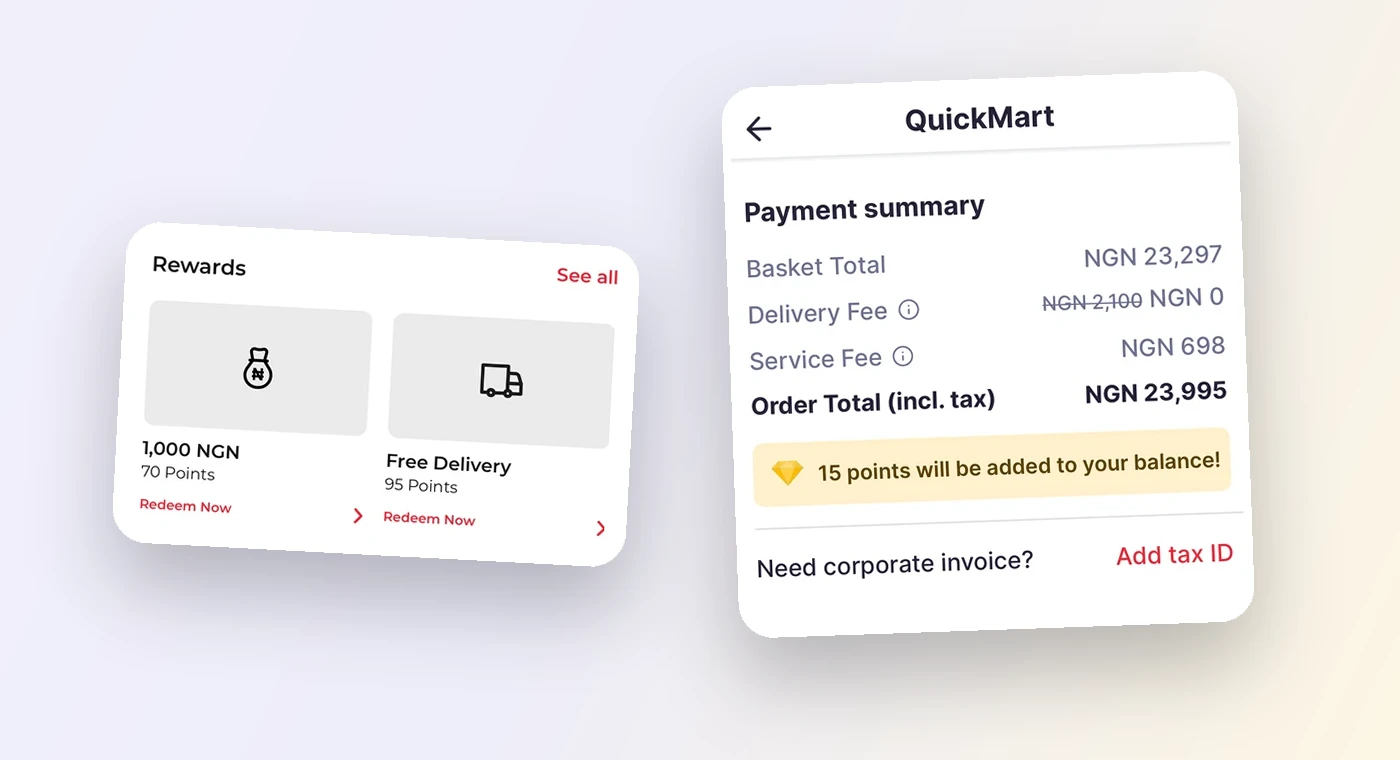
A points balance only means something if spending it is obvious. Mano's list is deliberately short: 1,000 naira off an order for 70 points, free delivery for 95 points, with fixed discounts and free products alongside them. Two tiles, a price in points, a Redeem Now link. No catalogue to browse.
The proof is at checkout. The payment summary shows the delivery fee struck through and dropped to zero, and tells the customer how many points this basket will add to their balance before they pay. Earning and spending both happen inside the flow the customer was already in, rather than in a separate rewards destination they have to remember to visit.
Referral on a single link
Mano built referral on one dynamic link a customer could share anywhere, with the reward gated behind the friend actually completing an action rather than just installing the app. Two steps, stated plainly on the screen, and 300 points on each side. No code to remember.
Mano also ran it as a headline offer rather than a quiet setting: 5,000 naira into the referrer's wallet, and an immediate 5,000 naira discount for a friend whose first order cleared 15,000 naira, with a shareable code in place of a link.
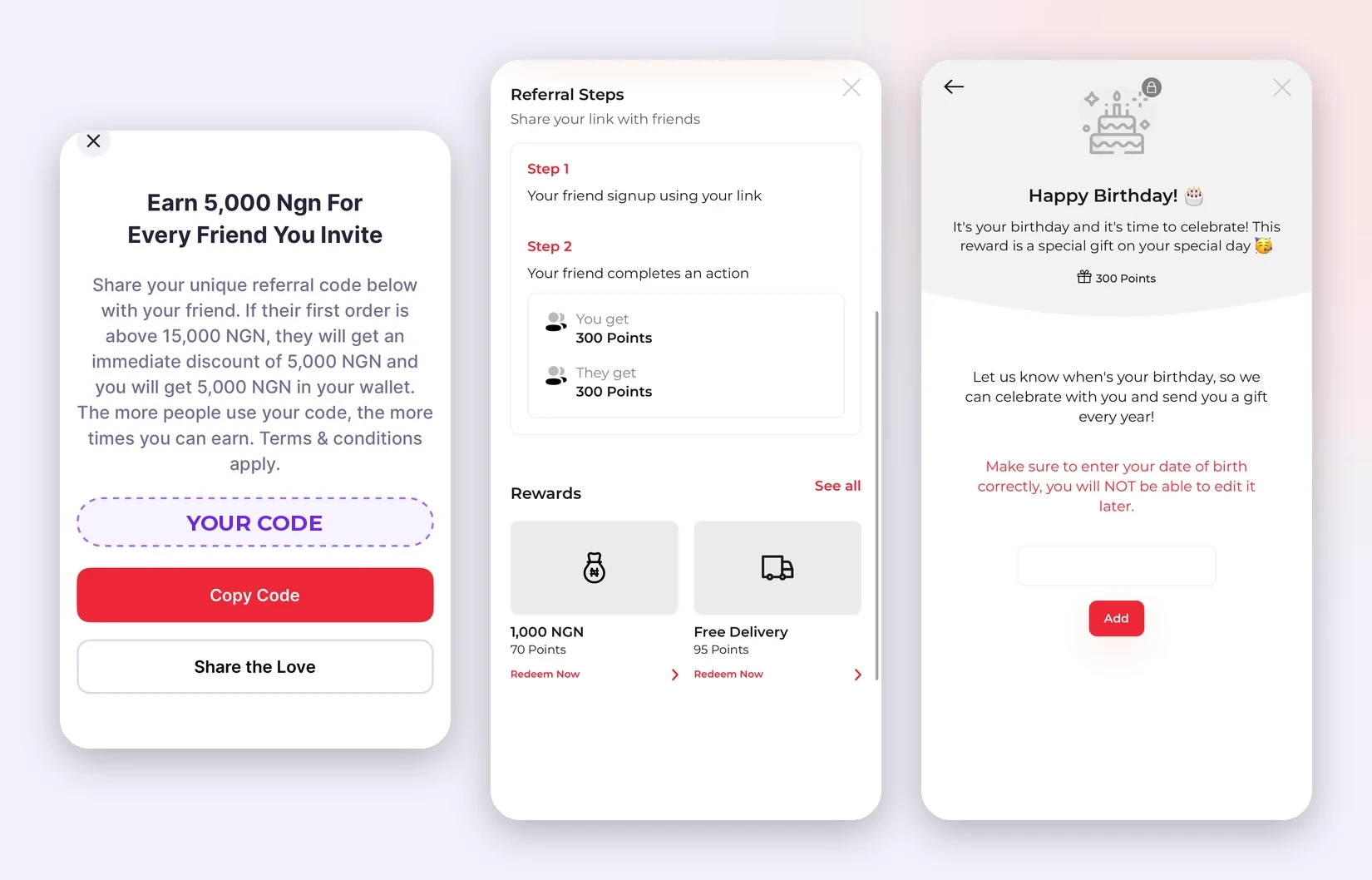
Games and multipliers for the moments that need a push
Mano launched with a weekend Spin the Wheel to put the new program in front of the existing base quickly, and has since added points multiplier campaigns so merchandising can push a category for a period without touching the base earning rate. The base program stays stable; the campaign layer moves.
Cashback points
Every order earns points at a published rate, so the value of a basket is legible before checkout rather than after it.
Three levels
Basic, Gold and Platinum, earned on completed orders rather than spend, and recalculated every three months.
Challenge board
Named goals with a visible reward attached, including the second-order challenge that targets the hardest repeat in delivery.
Birthday reward
A dated, personal reason to open the app that has nothing to do with a discount campaign.
Spin the Wheel
A weekend game used at launch to put the new program in front of the existing base quickly.
Points multipliers
Campaign-level boosts that let merchandising push a category without touching the base earning rate.
The Results
Program performance from launch to September 2026
Since the program went live, 41,406 Mano orders have carried a Gameball reward or arrived through a referral link. Over the same window members made 48,844 redemptions, spending points on free delivery, money off a basket and fixed discounts, and more than ninety thousand customers are enrolled in the program.
Source: Gameball dashboard, Mano App account, November 2024 to September 2026. Reward orders are those that carried a Gameball coupon or arrived through a referral.
The campaign layer accounts for a good share of that. Mano has built twenty four reward campaigns since launch and keeps a handful running at any one time, so merchandising always has a live lever to pull without touching the base earning rate.
The shape of those numbers matters as much as their size. Redemptions are the busiest part of the program, which tells you the earn-and-burn loop is what customers actually use. That is consistent with everything else about the design: Mano's customers came to order groceries quickly, and the program that works for them is the one that quietly makes the next order cheaper.
Why It Worked
1. The program is in the main navigation, not in settings
The points balance sits in the app header on every screen, next to the cart. The home feed carries a Mano Rewards prompt in the same column as the merchandising banners, with a one-tap route to redeem. Loyalty programs fail quietly when customers forget they are enrolled, and the fix is almost always placement rather than mechanics.
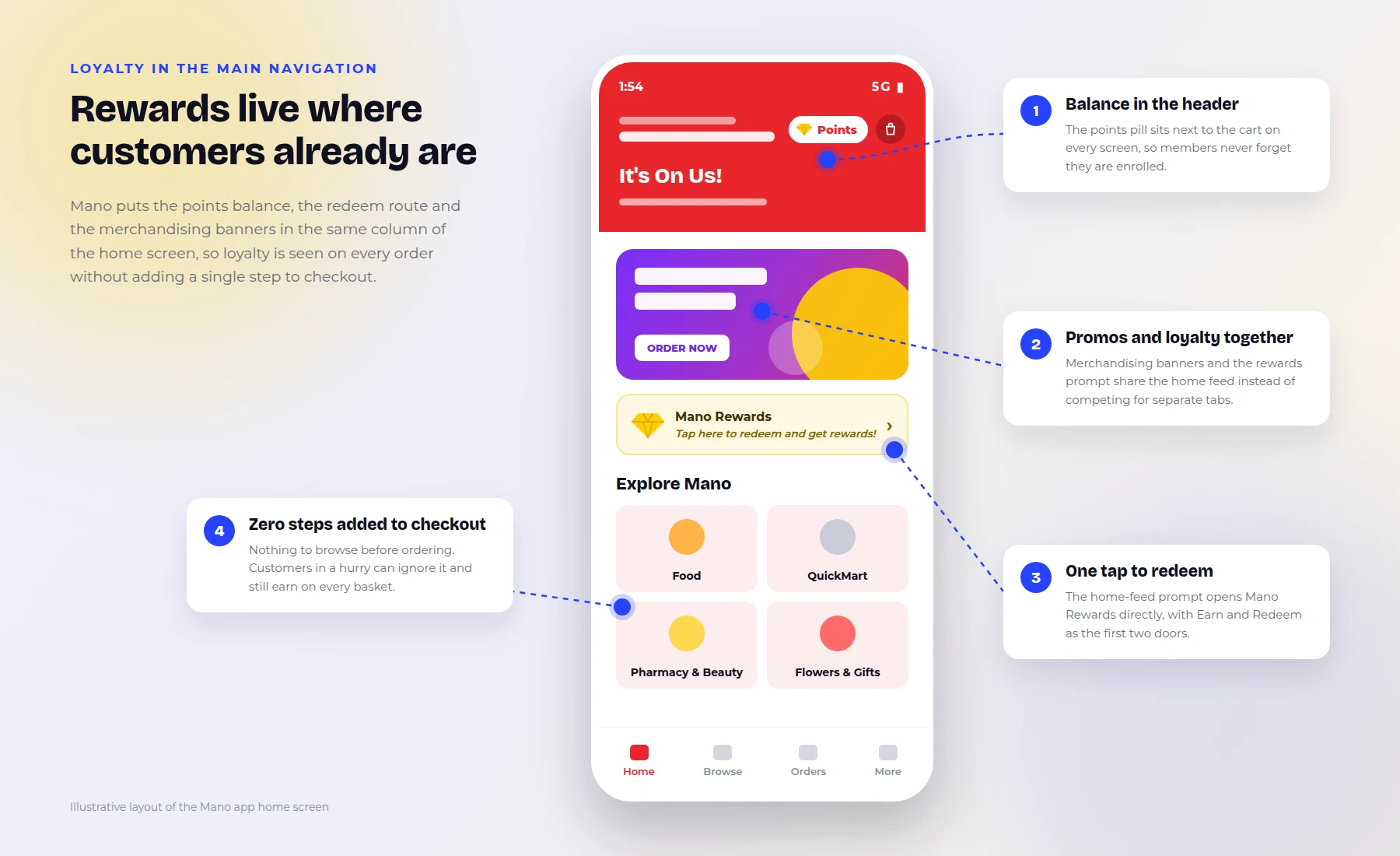
2. One configuration, localised per market
Nigeria and Angola run the same program structure with market-appropriate currency and language. A campaign designed once can be reasoned about in both places, which is what makes a two-market program manageable by a small team.
3. Earning rules tuned to frequency
Tiers on order count, benefits that reduce delivery cost, challenges aimed at the second order. Every lever points at the same behaviour: order again, sooner. In a category where basket size is largely fixed by what a household needs this week, frequency is the only number that moves.
4. Adding one mechanic at a time
Mano did not launch everything at once. Points and a launch game first, then levels, then the personal triggers, then the campaign levers. Each addition could be judged on its own before the next one went in.
Go live
Points system launches alongside a weekend Spin the Wheel and a second-order challenge.
Add the ladder
Basic, Gold and Platinum levels go in, with benefits that change the earn rate rather than just the badge.
Personal triggers
Birthday rewards and the referral link join the challenge board.
Merchandising levers
Points multipliers let category campaigns run without changing the base program.
Rollout sequence since launch. Mano added one mechanic at a time rather than launching everything at once.
The Takeaway
A pattern for multi-market, multi-vertical delivery apps
Mano's program is worth studying less for any single mechanic than for what it declines to do. It does not ask a customer in a hurry to slow down. It does not run two programs for two markets. It does not replace the systems the engineering team already built and trusts. It puts a legible number in the header, ties status to how often someone comes back, and reserves the playful mechanics for the moments where a push is actually wanted.
Since launch, that restraint shows up as 41,406 reward-led orders, 48,844 redemptions and a base of more than ninety thousand enrolled members, built by a small team running one configuration across two countries.
For any on-demand business running more than one market or more than one vertical, that sequence is the transferable part: make the value legible in local terms, tie status to frequency rather than spend, keep the integration narrow, and add mechanics one at a time.
90K+
Loyalty Members Enrolled
41,406
Reward-Led Orders
48,844
Reward Redemptions
Ready to level up your game?
Create your first campaign and start seeing results in 30 days.
Download case study
Get a PDF version of the case study
Read other articles
How Whites Built an Award-Winning Omnichannel Loyalty Program
2.7M+
Reward Transactions Earned
Stay ahead on retention
Subscribe to our newsletter and get all the latest updates as we post.
Ready to level up your customer loyalty?
Level up your customer loyalty!


.avif)
.avif)
.avif)
.avif)