%207.svg)

.svg)

%2520v2.png)
Loyalty program software in Saudi Arabia is the system that records what a customer buys, decides what that behaviour earns, and delivers the reward in Arabic, in riyals, and through the channels Saudi shoppers actually use. That last clause is what separates a real shortlist from the generic top ten lists that rank the same Shopify apps for every country on earth.
This comparison covers the platforms Saudi merchants genuinely shortlist in 2026, scored on the things that decide the contract here: native Salla and Zid support, point of sale reach, Arabic quality, riyal billing, and how the vendor handles customer data under the Personal Data Protection Law. It is written for the person who has to defend the choice to a finance team, not for someone browsing categories.
What is loyalty program software in Saudi Arabia?
Loyalty program software in Saudi Arabia is a points and rewards engine built or configured to work inside the local commerce stack: the hosted platforms most Saudi stores run on, the payment methods Saudi shoppers use, and the data rules the Kingdom enforces. The mechanics are the same everywhere. The integrations, the language and the paperwork are not.
The market is big enough that the difference matters. Saudi ecommerce is valued at $31.29 billion in 2026 and forecast to grow at 11.92% a year to 2031, and most of that volume sits on two local platforms rather than on Shopify.
Before you compare vendors, it helps to see how Saudi brands already structure their programs. Our companion guide on how the top retail brands in Saudi Arabia actually run their loyalty programs walks through the live examples, from grocery to fashion, and is the best way to calibrate what "good" looks like here before a single demo.
Why the Saudi shortlist looks different
The Saudi shortlist looks different because the platform layer is local. Salla reports more than 68,000 active merchants and over 900 app integrations, and Zid has passed 12,000 active merchants. A loyalty vendor with a beautiful Shopify app and nothing else is simply not installable for most stores in the Kingdom.
Language is the second divide. An Arabic widget is table stakes. What separates vendors is whether the entire customer journey translates: tier names, points names, redemption copy, the email that confirms a reward, and the message at checkout. Half translated programs read as broken, and members stop engaging with them.
The third divide is money. Retention economics are the reason any of this is worth budget: acquiring a new customer is five to 25 times more expensive than retaining an existing one, and McKinsey finds that personalization typically drives a 10 to 15 percent revenue lift, with 71 percent of consumers now expecting personalized interactions. A platform that cannot hold the attributes you want to segment on cannot deliver that lift, however good the campaign builder looks.
The seven criteria that decide a Saudi shortlist
Score every vendor on these seven before you look at price. Price only becomes meaningful once you know which platforms can actually do the job in this market.
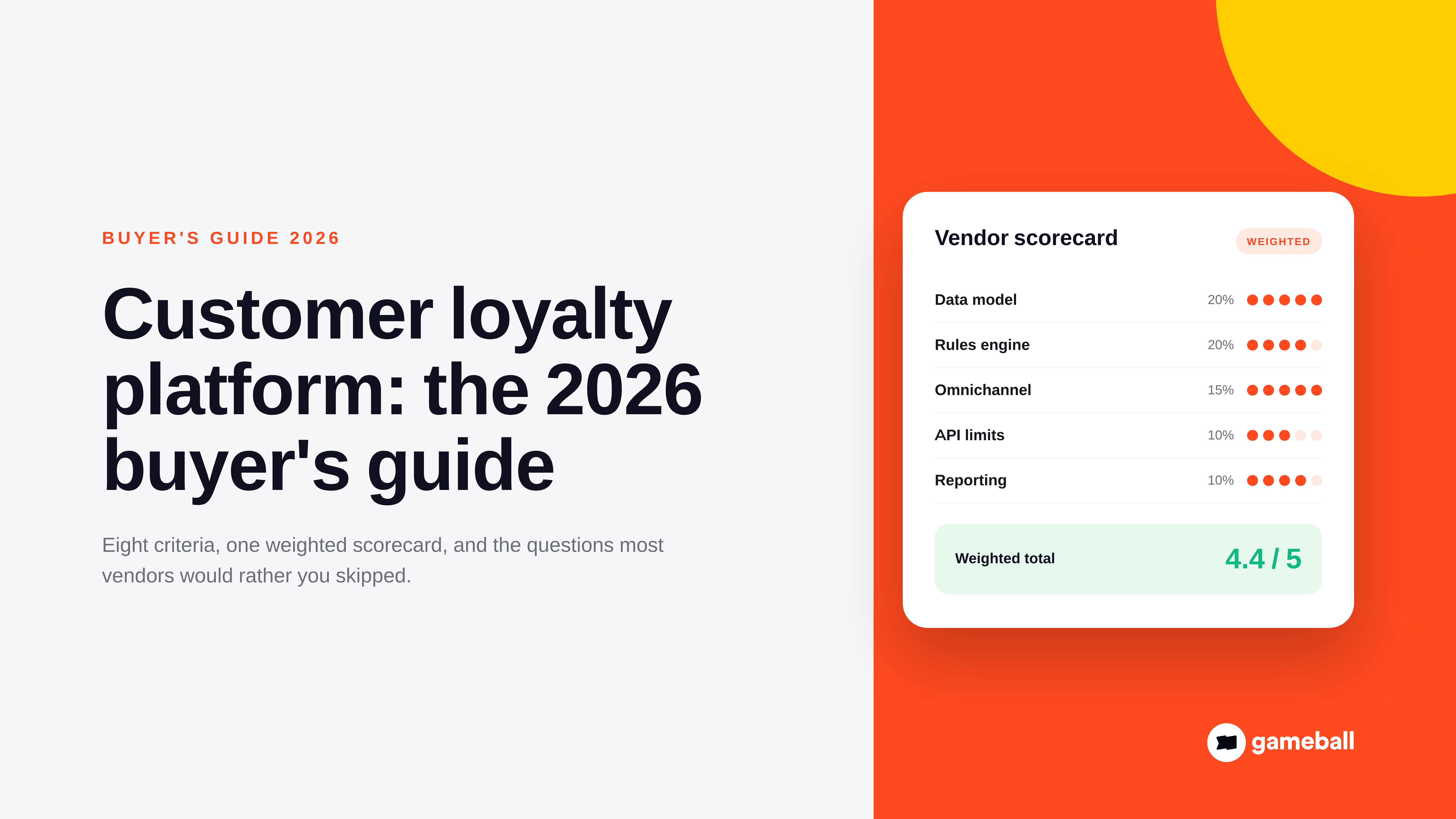
If you want the vendor neutral version of this exercise with a weighted scorecard you can copy into a spreadsheet, work through our 2026 customer loyalty platform buyer's guide alongside this page.
Best loyalty program software in Saudi Arabia compared
Here is how the platforms Saudi merchants shortlist compare on the thing that blocks a project fastest: whether they install on the platform you already run.
| Platform | Where it fits | Salla | Zid | Shopify |
|---|---|---|---|---|
| Gameball | Gamified loyalty, tiers, challenges and referrals for stores that want one engine across web, app and point of sale | Native app | Via REST API | Native app |
| Zid built in loyalty | Simple points on order value for merchants already on Zid who do not yet need tiers | No | Included | No |
| Salla App Store loyalty apps | Fast, low cost points and rewards widgets for Salla only stores | Native app | No | No |
| Smile.io | Entry level points and referrals for Shopify stores, with a free tier to start | No | No | Native app |
| LoyaltyLion | Mid market Shopify programs with deeper campaign tooling | No | No | Native app |
| Yotpo Loyalty | Brands that already run Yotpo reviews and SMS and want loyalty in the same suite | No | No | Native app |
| Foodics Loyalty | Restaurants and coffee shops running the Foodics point of sale in the Kingdom | No | No | No |
Two patterns fall out of that table. Global Shopify apps are strong products with no answer for Salla or Zid, which is most of the Saudi market. Local options install instantly but usually stop at simple points, so brands outgrow them once they want tiers or behaviour based rewards. The platforms that span both sides are the short list.
Gameball sits in that middle group. It ships as a native app in the Salla App Store with riyal pricing, as a Shopify app, and as a REST API integration for Zid, custom storefronts and point of sale systems, so one program can span the channels a Saudi retailer actually sells through.
What each platform actually costs
Published prices tell you two useful things: the shape of the pricing model, and whether the vendor bills in riyals. Both affect the business case more than the headline number.
| Platform | Entry price | Billing currency | Pricing notes |
|---|---|---|---|
| Gameball on Salla | 49 SAR per month | SAR | Starter 49 SAR, Pro 399 SAR and Guru 3,748 SAR per month on the Salla App Store, all excluding 15% VAT, each with a seven day trial |
| Gameball direct | $399 per month | USD | Growth from $399 and Enterprise from $599, split at 10,000 monthly rewarded customers |
| Zid built in loyalty | Included | SAR | Part of the Zid subscription, so there is no separate loyalty line item |
| Smile.io | Free | USD | Free tier, then $15, $79 and $199 monthly, with Plus at $999 on annual billing and Enterprise by quote |
| LoyaltyLion | $199 per month | USD | Classic covers 500 orders a month, Advanced and Plus are quoted |
| Yotpo Loyalty | By quote | USD | No public price list, so budget for a sales cycle before you see a number |
| Foodics Loyalty | By quote | SAR | Sold alongside the Foodics point of sale subscription rather than as a standalone product |
Watch the billing currency. A dollar priced plan is a moving target once your card provider adds a conversion spread, and it complicates the VAT treatment your finance team has to reconcile. A riyal priced plan with 15% VAT stated is simply easier to approve.
Watch the metric too. Order based pricing punishes a high frequency category like grocery or coffee, while customer based pricing punishes a slow, high value category like furniture. Model your own twelve months before you compare two headline numbers, the same way you would when you work out what actually moves average basket size.
How to choose based on where you sell
The fastest route to a decision is to start from your commerce platform rather than from a vendor list.
Whichever route applies, bring one awkward earning rule to every demo. Something like double points on one collection, for tier three members only, during the last ten nights of Ramadan, capped per order. The gap between vendors shows up in minutes, and it is the same gap that decides whether your Ramadan campaign and your Saudi National Day campaign are built once or rebuilt by hand every season.
What PDPL and ZATCA mean for your loyalty data
A loyalty program is a customer database with a rewards layer on top, which makes it a data protection question before it is a marketing question. Saudi Arabia's Personal Data Protection Law does not force absolute data residency, but it does require a lawful basis and an approved safeguard for moving personal data outside the Kingdom, using standard contractual clauses, binding common rules or a certificate of accreditation. The law also reaches entities outside Saudi Arabia that process the data of people living in it, so a foreign vendor is not exempt from the question.
The invoicing side is simpler but easy to forget. ZATCA's e-invoicing programme requires invoices and credit notes to be issued in a structured electronic format through a compliant solution. If a points redemption behaves like a discount at checkout, it has to appear correctly on that invoice. Ask the vendor how redemptions surface in the order payload, and have your finance team look at one real example before launch.
How Gameball helps
Gameball runs loyalty, gamification, referrals and promotions on one customer record, so points, tiers, challenges and referral rewards all read from the same behaviour rather than from four disconnected tools. For retail and ecommerce brands in the Kingdom that means a Salla store, a Shopify store and a point of sale can share one balance, with reporting that shows what the program returned rather than how many points were issued.
If you want to see it against your own catalogue and earning rules, book a demo, or check the pricing if you are still sizing the business case.
Related reads
- Loyalty Programs in Saudi Arabia: How the Top Retail Brands Actually Run Them
- Customer Loyalty Platform: The 2026 Buyer's Guide
- Loyalty Management Software: What It Is and How to Choose One
Frequently asked questions
What is the best loyalty program software in Saudi Arabia?
There is no single best option, because the answer depends on your commerce platform. Salla merchants should shortlist apps in the Salla App Store, Zid merchants should test the built in points program first, and Shopify merchants can use the global apps. Brands selling across more than one channel need a platform that integrates with all of them through an API.
Does loyalty program software work with Salla and Zid?
Some of it does. Salla has a native App Store where loyalty apps install in a few clicks, and Gameball is listed there with riyal pricing. Zid ships a built in points program that merchants activate from the dashboard, and third party platforms connect to Zid through its API rather than through a one click app.
How much does a loyalty program cost in Saudi Arabia?
Entry level apps start near 49 SAR a month on the Salla App Store, mid market platforms run from roughly $199 to $399 a month, and enterprise programs are quoted. Zid merchants pay nothing extra for the built in points feature. Budget separately for the reward cost itself, which is usually larger than the software line.
Do I need the software to support Arabic?
Yes, and not only in the widget. Tier names, points names, redemption copy, confirmation emails and checkout messages all need to read naturally in Arabic with correct right to left layout. A half translated program signals carelessness to members and measurably depresses engagement.
Is a loyalty program allowed under Saudi data protection rules?
Yes. The Personal Data Protection Law regulates how you collect, store and transfer member data rather than prohibiting loyalty programs. Collect a lawful basis, tell members what you hold, and make sure any transfer of data outside the Kingdom is covered by an approved safeguard such as standard contractual clauses.
Should I use the built in loyalty feature or a dedicated platform?
Start with the built in feature if simple points on order value are all you need, since it costs nothing extra and launches in a day. Move to a dedicated platform when you need tiers, challenges, segmentation, referral mechanics or one balance shared across online and in store channels.
.svg)
.svg)
.svg)

Ready to level up your game?
Create your first campaign and start seeing results in 30 days.
Ready to grow?
Get in touch with our sales team today.
The loyalty vendor checklist your CTO
will thank you for
Discover engineering challenges, essentials, and more from global brands.

Gameball Staff
Stay ahead on retention
Subscribe to our newsletter and get all the latest updates as we post.

Ready to level up your game?
Create your first campaign and start seeing results in 30 days.
Read related articles

Ready to level up your customer loyalty?
Level up your customer loyalty!


.avif)
.avif)
.avif)
.avif)