
%207.svg)

.svg)

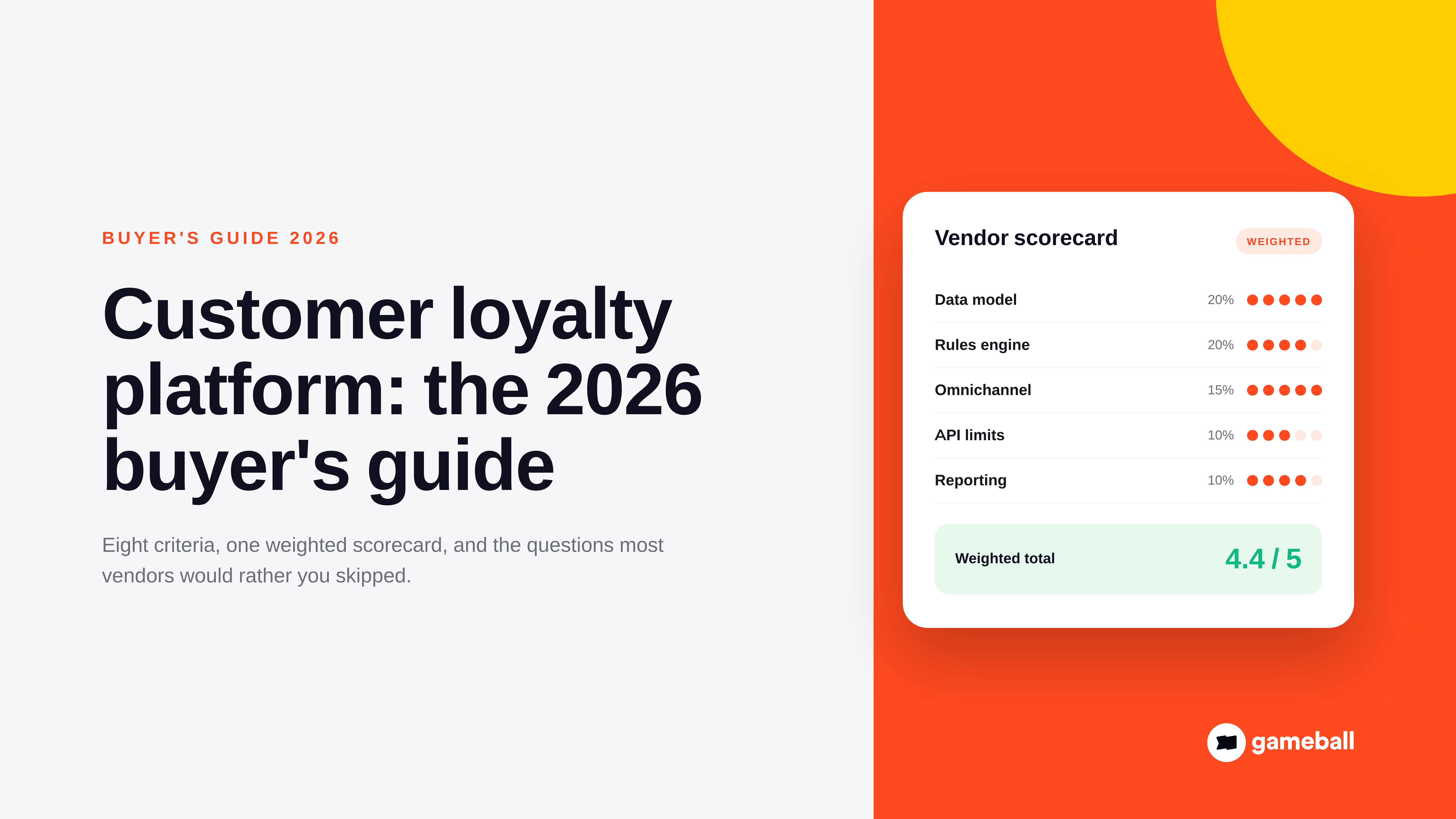
A customer loyalty platform is the software that records what every customer does, decides what that behavior earns, and delivers the reward across every channel the customer shops in. That definition sounds simple, which is exactly why loyalty platform evaluations go wrong. Two vendors can both claim all three functions and still differ by a factor of ten in what they let you build.
This guide gives you the eight criteria that actually separate platforms once the demo ends, a weighted scorecard you can copy into a spreadsheet, and the questions vendors would rather you did not ask. It is written for the person who has to defend the choice internally, not for the person browsing categories.
What is a customer loyalty platform?
A customer loyalty platform is a system of record plus a decision engine: it stores customer and transaction data, applies earning and redemption rules to that data, and pushes the resulting rewards, tiers and messages out to your storefront, app, point of sale and marketing channels. Most platforms bundle four capabilities: a points or currency ledger, tier logic, campaign and challenge mechanics, and a rewards catalogue.
Points ledger
The balance of record. Every earn, burn, adjustment and expiry, with a date attached to each one.
Tier logic
How customers move up, how they hold status, and what happens when they slip below the threshold.
Campaign mechanics
Challenges, streaks, multipliers and limited-time offers that change behavior rather than just record it.
Rewards catalogue
What points buy, who qualifies, and the exclusions that keep redemption margin under control.
The category is crowded because the word covers very different products. A Shopify app that adds a points widget is a customer loyalty platform. So is an enterprise engine that runs a bank's rewards currency across 40 markets. To see how the underlying program structures differ before you shortlist any vendor, read our companion guide on loyalty management software and how to choose one, which frames the category from the program side rather than the software side.
Why the right customer loyalty platform matters
It matters because the platform sets a ceiling on your retention economics that no amount of campaign work can lift. Retention is the cheapest growth you have: acquiring a new customer is anywhere from five to 25 times more expensive than retaining an existing one, and the same Bain analysis found that increasing retention rates by 5% increases profits by 25% to 95%.
The lever that converts that math into revenue is personalization, and personalization is a data-model problem before it is a creative problem. McKinsey found that personalization most often drives 10 to 15 percent revenue lift, with 71 percent of consumers now expecting personalized interactions. A platform that cannot hold the customer attributes you segment on cannot deliver that lift, whatever the campaign builder looks like.
5x to 25x
More expensive to acquire a new customer than to retain an existing one
Harvard Business Review
25% to 95%
Profit increase from lifting customer retention by just 5 percent
Bain & Company
10% to 15%
Revenue lift personalization most often delivers when the data supports it
McKinsey & Company
This is the part buyers underestimate. Switching costs are high, migrations are painful, and a points liability you have already issued follows you to the next vendor. Most teams live with the choice for three to five years.
The eight criteria that decide a loyalty platform shortlist
Every credible evaluation comes down to these eight. Score each one before you look at price, because price only becomes meaningful once you know which platforms can actually do the job.
1. Data model
Ask what the platform can store about a customer beyond points and email. The answer determines every segment you will ever build. You want custom attributes, event-level transaction history, and the ability to write back to the customer record from an external system. If the data model only holds a balance and a tier, your loyalty segmentation will stay shallow no matter how good the campaign tools are.
Red flag: a vendor who answers this question by describing their segment builder. Ask again about the underlying schema.
2. Rules engine
The rules engine is where a platform either bends to your program or forces your program to bend to it. Test it against a rule you already know you need, not a generic one. Can you earn differently by product collection, by channel, by customer tier, and by time window, all at once? Can you cap earning per order? Can you expire points on a rolling schedule rather than a fixed date?
Bring one awkward rule to every demo. The gap between vendors shows up in minutes.
3. Omnichannel reach
Omnichannel means one balance visible and spendable everywhere the customer transacts, not a separate program per channel. Confirm the platform supports your point of sale as a first-class channel rather than a nightly file import, and ask what happens when the network drops mid-transaction in store. Brands running physical retail alongside ecommerce should read how the top retail brands in Saudi Arabia run their programs across both.
4. API limits and performance
This is the criterion buyers skip and engineers regret. Get the numbers in writing: requests per minute, burst allowance, webhook delivery guarantees, and median plus p95 response time on the endpoints that sit in your checkout path. A loyalty call that adds 800ms to checkout will be switched off within a quarter.
Ask whether rate limits are per account or per endpoint, and whether they change by plan. They usually change by plan.
5. Reporting and attribution
You need to answer one question at board level: what did the program earn us? That requires incremental measurement, not a dashboard of points issued. Look for cohort comparison between enrolled and non-enrolled customers, holdout group support, and export access to raw event data. Vanity metrics are the default; incrementality is the exception. If you are still defining the underlying numbers, our guide on how to calculate customer lifetime value sets the baseline you will report against.
6. Migration path
Ask how customers, balances, tier status and expiry dates come in, and how they come out. Specifically: is there a bulk import that preserves earned-on dates, and is there a full export including the transaction ledger? A platform that imports balances but loses earning history leaves you unable to run expiry or anniversary logic for a year.
Ask for the export format before you sign, not after you leave.
7. Pricing model
Loyalty pricing is usually indexed to one of three things: monthly active or enrolled customers, orders processed, or a flat platform fee with feature gates. Each punishes a different growth pattern. Model your cost at three times your current volume and see which curve you can live with, then check what sits behind the gates: API access, segmentation depth and automation are the three most commonly withheld.
8. Support SLA
Get the response-time commitment in the contract, distinguish support from customer success, and ask who owns the relationship after month three. A named CSM, a shared channel and a quarterly review are meaningfully different from a ticket queue, and the difference shows up the week of your first peak season.
The customer loyalty platform scorecard
Copy this into a spreadsheet, score each vendor 1 to 5 on every criterion, multiply by the weight and total. The weights below suit a mid-market brand running ecommerce plus retail. Move weight toward API limits and data model if you have an in-house engineering team, and toward support and migration if you do not.
| Criterion | Weight | What a 5 looks like | What a 1 looks like |
|---|---|---|---|
| Data model | 20% | Custom attributes, event-level history, two-way write access | Points balance and tier only |
| Rules engine | 20% | Your awkward rule built live on the demo call | Fixed templates, roadmap promises |
| Omnichannel reach | 15% | One balance live across web, app and point of sale | Nightly file sync per channel |
| API limits | 10% | Published limits, sub-second p95, webhook retries | Limits "available on request" |
| Reporting | 10% | Holdout groups and raw event export | Points issued and redeemed |
| Migration path | 10% | Import and export both preserve earning history | Balance import only |
| Pricing model | 10% | Predictable at 3x volume, no gates on core needs | Costs scale faster than revenue |
| Support SLA | 5% | Contracted response times, named CSM | Shared inbox, best effort |
A weighted total under 3.5 means the platform will need workarounds from month one. Anything above 4.2 across the top four criteria is a genuine contender.
How long should a loyalty platform evaluation take?
Four weeks is enough if you run it in sequence rather than letting demos sprawl. The sequence below keeps vendors comparable, because every one of them answers the same questions in the same order.
Write the rules you need
Document your three hardest earning rules and your must-have integrations before you speak to anyone. This becomes the test script.
Scripted demos only
Every vendor builds your awkward rule live. No slideware. Score the eight criteria the same afternoon while it is fresh.
Technical and commercial diligence
API limits, export format, SLA and pricing at 3x volume, all in writing. Two finalists maximum past this point.
Sandbox and reference calls
Build one real rule in a trial account and speak to a customer of similar size in your region. Then decide.
What should you ask every loyalty vendor on the demo call?
Ask the questions that have a number for an answer. Anything answered with an adjective is not an answer.
The demo call checklist
- ✓What custom attributes can I store on a customer, and how many?
- ✓Build this rule now: double points on one collection, for tier two only, on weekends, capped per order.
- ✓What are the published API rate limits on my plan, and the p95 latency on the earn endpoint?
- ✓Can I export the full transaction ledger, including earned-on dates, without an engineering ticket?
- ✓Show me an incrementality report from a real account, with the holdout group visible.
- ✓What does this cost at three times my current order volume?
- ✓What is the contracted first-response time, and who owns my account in month six?
If you are comparing named vendors rather than building a shortlist from scratch, our roundups of the best customer retention software and the leading Smile.io alternatives cover the products most mid-market teams end up evaluating, and customer engagement software covers the adjacent category buyers often confuse with loyalty.
Which loyalty program structure should the platform support?
Decide the structure before the software, because the structure dictates which criteria carry weight. A tiered program leans hard on the data model and the rules engine. A points program leans on ledger accuracy and expiry logic. A paid program leans on billing integrations. Our guide to the eight types of loyalty programs maps them side by side, and tiered loyalty programs covers the structure most mid-market brands land on. If you are earlier than that, the points to consider before creating a loyalty program is the right starting place.
How Gameball helps
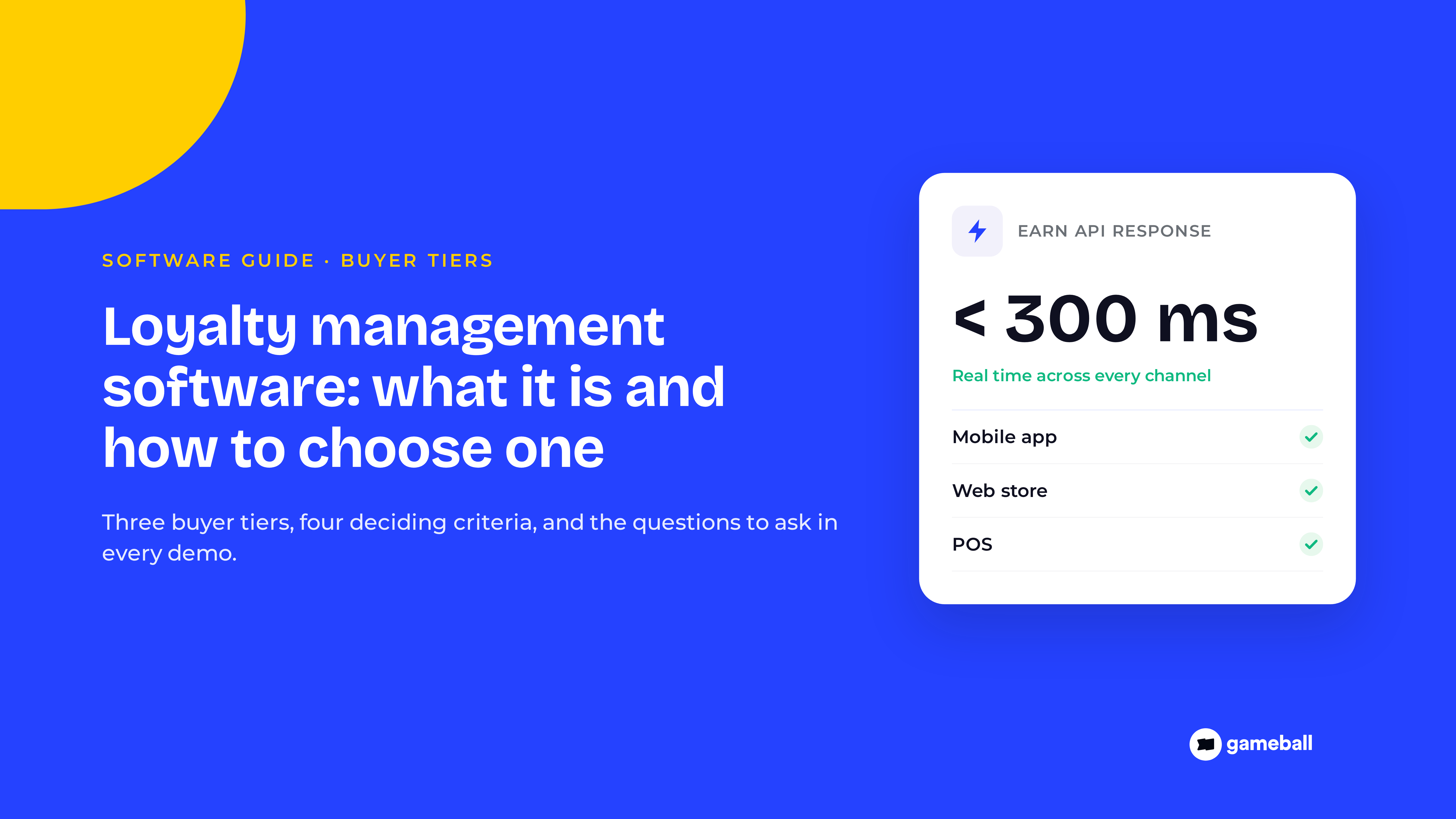
Gameball runs loyalty, gamification, referrals and promotions on one customer record, with marketing automation and analytics and intelligence built on the same data rather than bolted alongside it. The platform handles 15M+ API calls daily at under 300ms latency across 57M+ enrolled customers, and is used by brands in retail and ecommerce and fintech. Bring your awkward rule to a demo and build it on the call, or check what sits in each tier on pricing.
Related reads
- Loyalty Management Software: What It Is and How to Choose One
- Customer Retention Software: 10 Best Tools Compared (2026)
- 10 Best Smile.io Alternatives for 2026 (Ranked and Compared)
Frequently asked questions
What is a customer loyalty platform?
A customer loyalty platform is software that records customer behavior, applies earning and redemption rules to it, and delivers rewards across every channel a customer shops in. It typically combines a points ledger, tier logic, campaign mechanics and a rewards catalogue on a single customer record.
How much does a customer loyalty platform cost?
Pricing is usually indexed to enrolled or monthly active customers, orders processed, or a flat platform fee with feature gates. Mid-market platforms commonly start in the low hundreds of dollars per month and rise with volume. Model your cost at three times current volume, because the curve matters more than the entry price.
What is the difference between a loyalty platform and a loyalty app?
A loyalty app is usually a single-channel add-on, most often a storefront widget with points and a basic tier. A loyalty platform holds the customer record itself, exposes an API, and serves multiple channels including point of sale. The practical test is whether one balance is spendable everywhere.
How long does it take to implement a loyalty platform?
A straightforward ecommerce launch on an app-based platform can go live in days. A program spanning ecommerce, point of sale and a mobile app, with historical balances migrated, typically runs several weeks and depends far more on your data migration than on the vendor's setup time.
Which criteria matter most when comparing loyalty platforms?
Data model and rules engine carry the most weight, because together they set the ceiling on what your program can ever do. Omnichannel reach comes next if you sell in physical stores. API limits, reporting, migration path, pricing model and support SLA then separate the remaining contenders.
Can I migrate an existing loyalty program to a new platform?
Yes, but confirm two things before signing: that the import preserves earned-on dates rather than just balances, and that a full export including the transaction ledger is available on your plan. Without earning history you cannot run expiry or anniversary logic for a full year after migrating.
.svg)
.svg)
.svg)

Ready to level up your game?
Create your first campaign and start seeing results in 30 days.
Ready to grow?
Get in touch with our sales team today.
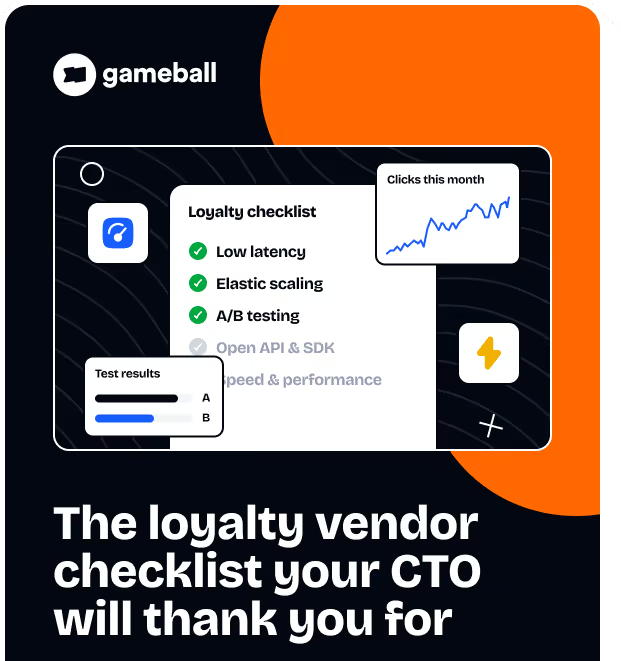
The loyalty vendor checklist your CTO
will thank you for
Discover engineering challenges, essentials, and more from global brands.

Gameball Staff
Stay ahead on retention
Subscribe to our newsletter and get all the latest updates as we post.

Ready to level up your game?
Create your first campaign and start seeing results in 30 days.
Read related articles
.png)
.png)
Ready to level up your customer loyalty?
Level up your customer loyalty!


.avif)
.avif)
.avif)
.avif)