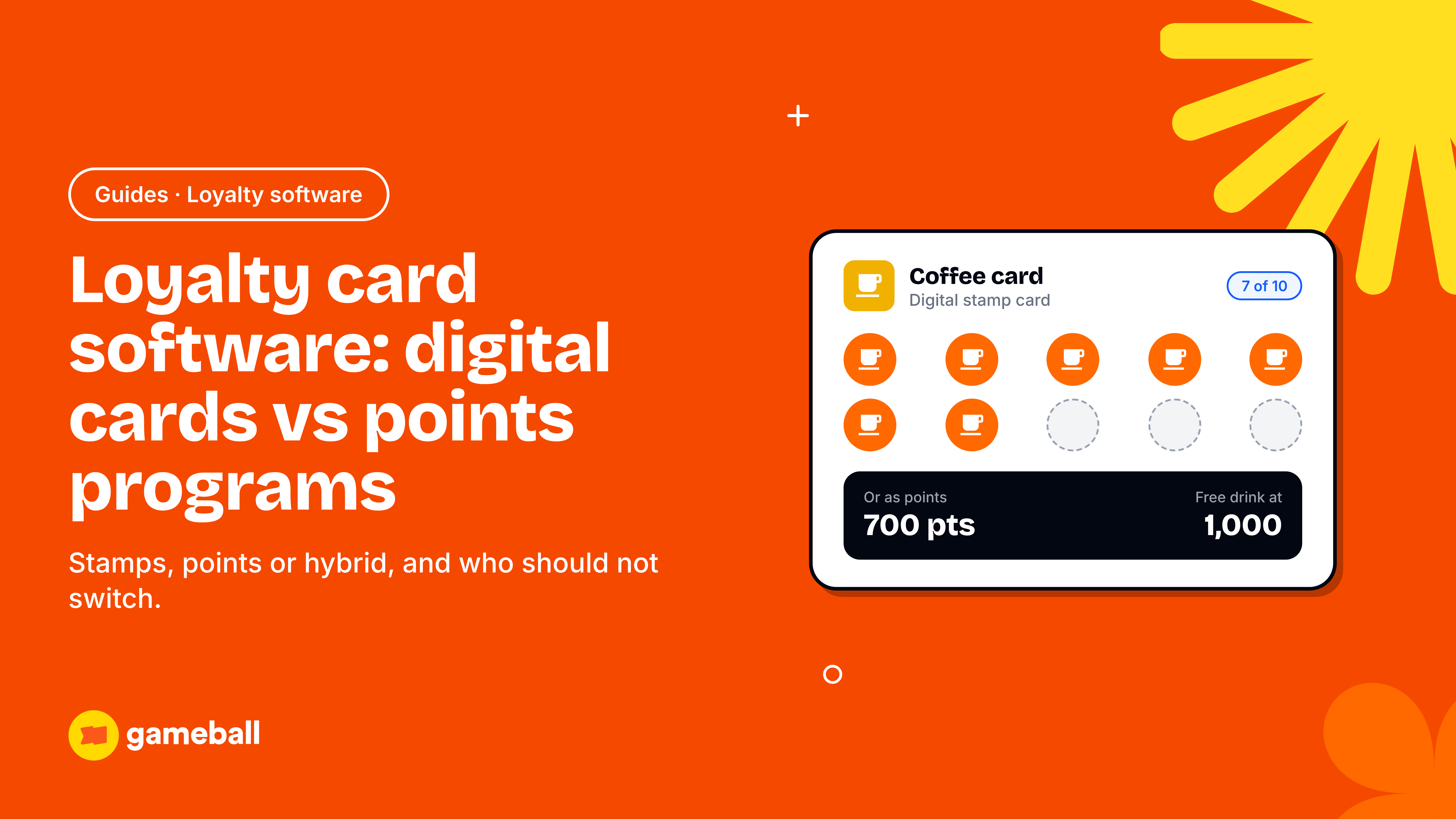
Loyalty card software is the tool a business uses to issue, track and redeem loyalty cards digitally, whether the card is a stamp card that fills up with visits, a points balance that grows with spend, or a hybrid of the two. It replaces the paper punch card and the plastic swipe card with a phone number, an app or a wallet pass, and it decides which reward model your customers actually experience.
Most comparisons treat this as a features question. It is really a model question first. This guide compares the three models, stamp cards, points programs and hybrids, on setup cost, how easily customers understand them, how exposed they are to fraud and how much data they capture. It also explains which businesses should stay on stamps instead of migrating to points just because the software allows it.
What is loyalty card software?
Loyalty card software is the system behind a digital loyalty card: it identifies the customer at checkout, adds stamps or points to their balance, and lets them redeem a reward without a paper card or a staff member keeping count. A digital loyalty card can live in a branded app, in Apple Wallet or Google Wallet as a pass, or simply behind the customer's phone number at the till. To see where card tools sit in the wider market, read our companion guide, the customer loyalty platform buyer’s guide, which maps every category of loyalty software side by side.
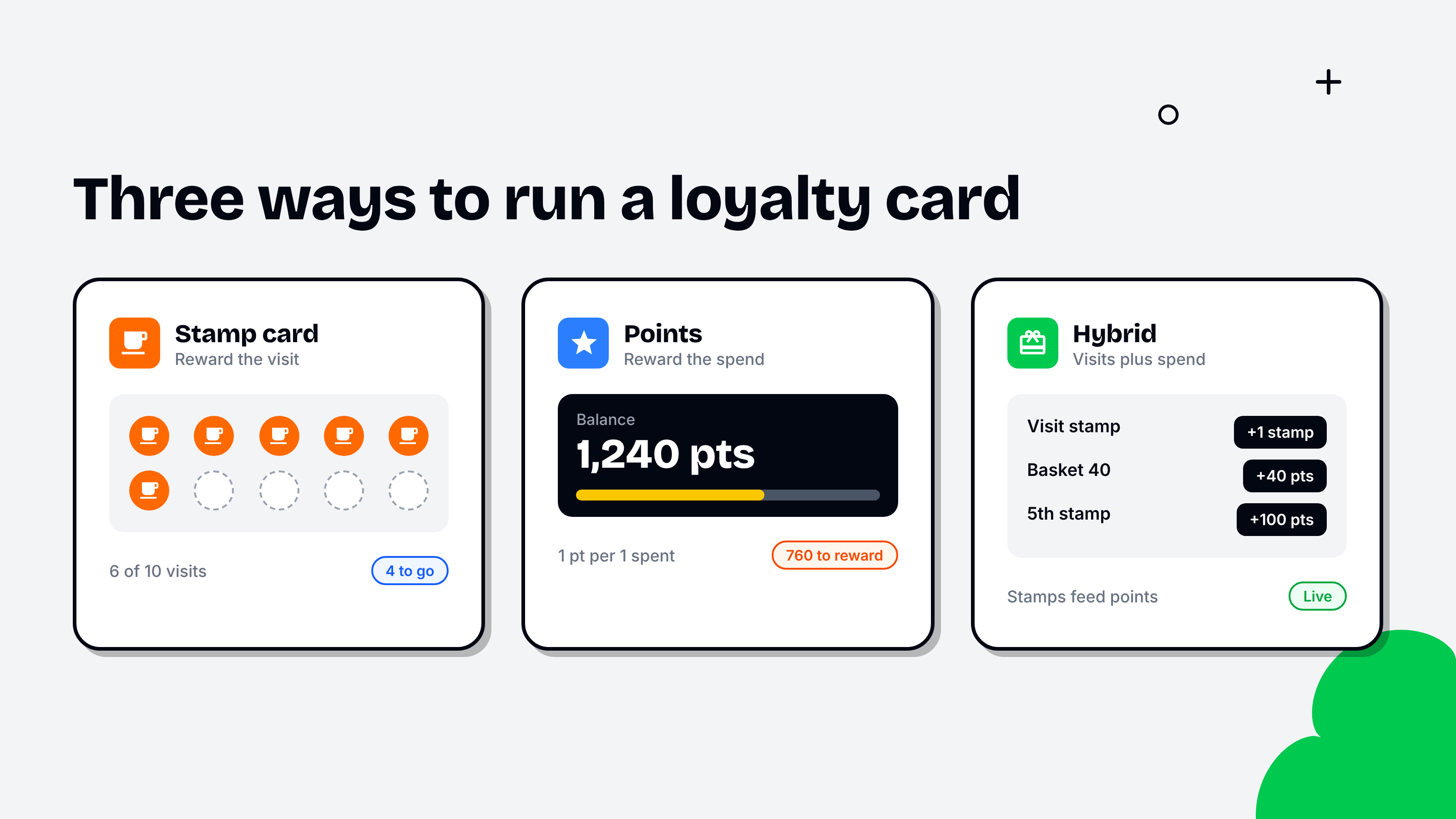
Whatever the format, the software runs one of three reward models:
One stamp per visit or per qualifying item. Fill the card, get the reward. A loyalty card app or stamp card app digitises the classic punch card.
Points per unit of spend, redeemed from a catalogue of rewards. The engine behind most retail and ecommerce programs.
Visits earn stamps, spend earns points, and milestones convert one into the other. More levers, more rules to explain.
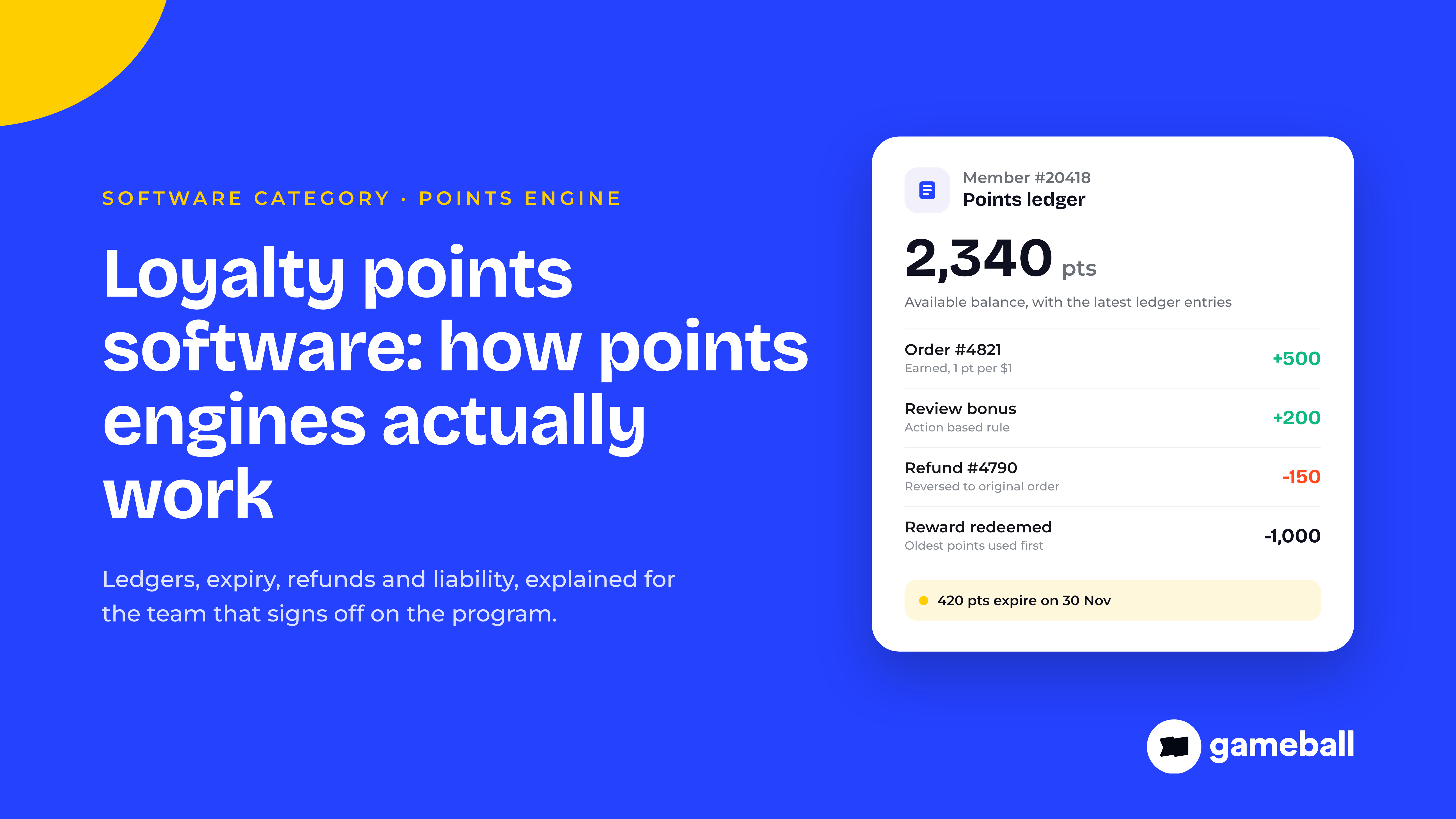
If you want to see how a points engine calculates earn and burn behind the scenes, our guide on how loyalty points software works goes deeper. For the wider menu of formats beyond these three, see the eight types of loyalty programs.
Why loyalty card software matters in 2026
Loyalty card software matters because the card has moved into the phone, and customers now expect their balance to be there. In Antavo’s Global Customer Loyalty Report 2026, which surveyed 10,000 loyalty program members, 42.4% named a digital loyalty card on their phone as a favourite way to interact with a program, up from 34.7% the year before. Logging in to a mobile app fell from 59.0% to 44.1%, which Antavo suggests may reflect app fatigue. Plastic cards still held 41.0%.
The last number is the one to remember when you choose a model. More than a quarter of earned points sat unused, and unredeemed points do not build habits. A stamp card has a natural finish line; a points balance only works if members can see how close the next reward is. That is why redemption rate is the first metric to watch after launch.
The format also changes behaviour. Square reports, from its own 2022 Square Loyalty data, that enrolled customers at food and drink businesses visit 57% more often and spend 46% more, while at retail businesses they spend 61% more and visit 27% more often, according to Square’s loyalty product page. These are vendor figures and members are not a random sample, but the split is telling: in food and drink the lift shows up in visits, in retail it shows up in spend.
Stamp cards vs points vs hybrid: how the three models compare
The three models differ on four things that matter more than any feature list: what they cost to set up and run, how quickly a customer understands them, how easy they are to abuse, and how much they tell you about the customer. The table compares them side by side.
| Criteria | Stamp card | Points program | Hybrid |
|---|---|---|---|
| Setup cost | Lowest. One rule, one reward, often included with a POS or a low monthly app fee | Medium. Earn rates, a reward catalogue and expiry rules to design and test | Highest. Two currencies, conversion rules and more staff training |
| Customer comprehension | Instant. Progress is visible at a glance | Slower. Members must translate points into value | Mixed. Clear on the card, harder to explain at the till |
| Fraud exposure | High on paper (copied stamps, staff over-stamping), low once digital | Lower, but balances become a target for account takeover | Same as points, plus rules that can be gamed between currencies |
| Data capture | Visits and frequency only | Spend, basket, category and channel | Visits plus spend, the richest picture |
| Best for | High-frequency, single-product businesses | Retail, ecommerce and multi-category brands | Brands with both frequent visits and varied baskets |
Setup cost: what each model really costs to run
A stamp card is the cheapest model to set up because there is almost nothing to design: one action earns one stamp, and a full card earns one reward. Many point of sale systems include a basic version, and a standalone stamp card app is usually a low flat monthly fee. Points programs cost more, not mainly because of the software subscription, but because someone has to set earn rates, price rewards and decide on expiry. Our breakdown of what loyalty program software actually costs shows how much the published price can understate the real bill.
Whatever the model, the costs fall into four buckets:
The monthly subscription, which often rises with members, orders or locations.
Connecting the card to your POS, online store and app so every channel reads one balance.
The free coffee or the money off. Price it as a share of the revenue the program protects.
Training, checkout seconds and handling questions. Hybrids cost the most here.
Customer comprehension: why stamps win on clarity
Stamp cards win on clarity because progress is visible without any arithmetic. Seven filled circles out of ten tells a customer exactly where they stand. Points ask them to convert 700 points into a reward value, and that small mental step is where many members drop off.
Progress also motivates in its own right. In a well known field experiment published in the Journal of Consumer Research in 2006, Joseph Nunes and Xavier Drèze gave car wash customers either an eight stamp card or a ten stamp card with two stamps already filled. Both needed eight purchases, yet the head start changed completion sharply.
Customers given a ten stamp card with two stamps already filled redeemed it 34% of the time, against 19% for a blank eight stamp card needing the same eight purchases.
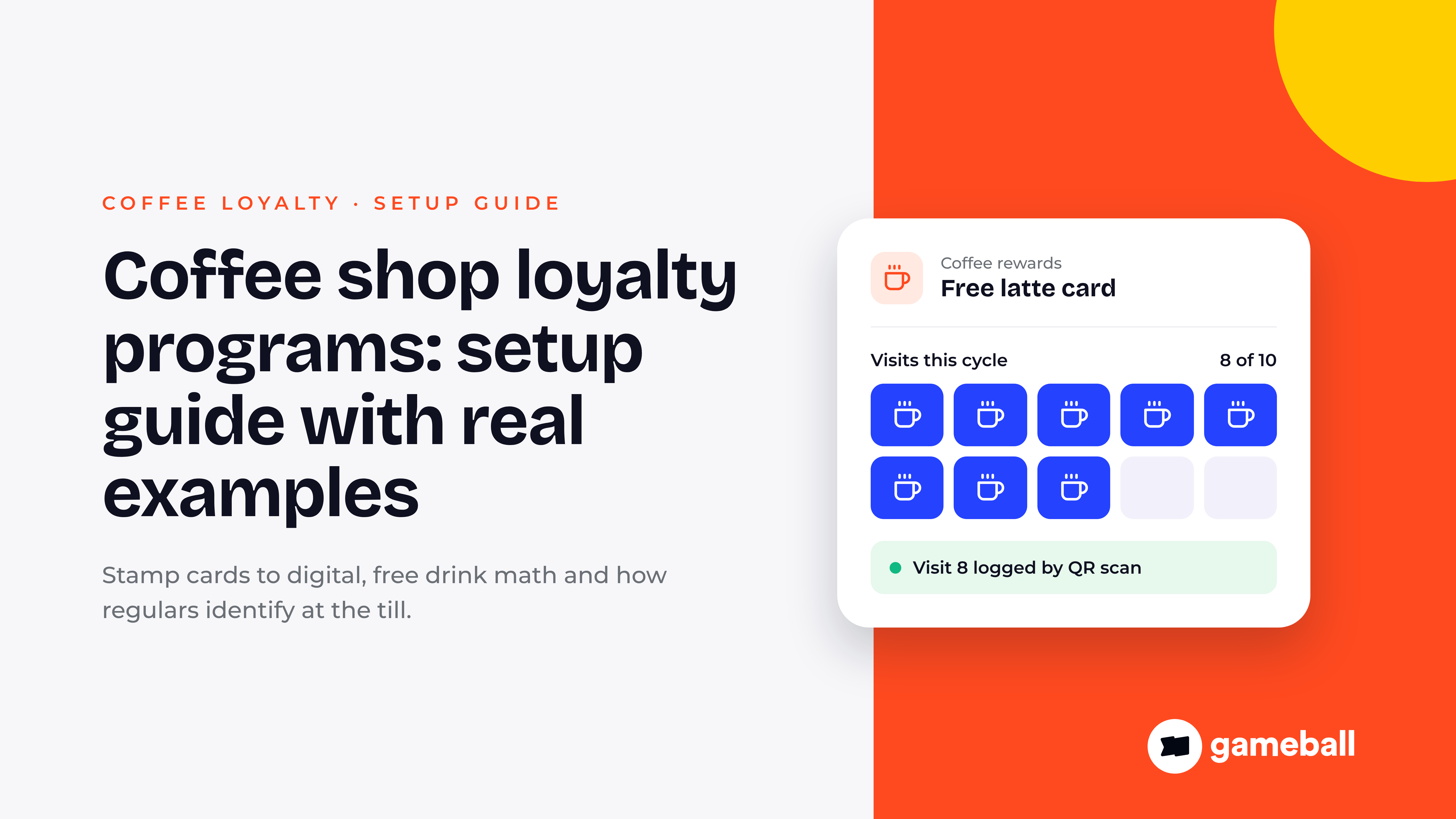
Points programs can borrow this effect with a welcome bonus or a progress bar toward the next reward, but they have to design for it deliberately. Stamp cards get it for free. That is one reason the classic card still dominates in cafés, as our guide to coffee shop loyalty programs shows.
Fraud exposure: where each model leaks
Paper stamp cards are the most exposed model, because a stamp is just ink. Customers can copy stamps, staff can over-stamp for friends, and nobody can audit a card after it is redeemed. Digital stamp cards remove most of that risk, while points programs move the risk elsewhere: a stored balance has cash value, so it attracts account takeover and abuse of earning rules.
- ✕Stamps can be copied or bought online
- ✕Staff can stamp twice, or stamp for friends
- ✕No record of who earned what, or when
- ✕Lost cards mean lost progress and unhappy customers
- ✓Every stamp or point tied to a transaction ID
- ✓Daily earning caps and minimum time between stamps
- ✓Redemption only on a verified account or phone number
- ✓Audit trail by staff member, store and day
If you run a points or hybrid program, treat balances like money: require verification before redemption, cap how fast points can be earned, and watch for unusual patterns by store. A good loyalty platform handles these controls in the rules engine rather than leaving them to staff.
Data capture: what each model tells you about customers
A stamp card tells you who came back and how often. A points program tells you what they bought, how much they spent and through which channel. That difference decides what you can do next: with visit data you can remind lapsed regulars, but with basket data you can personalise offers, build tiers and measure repeat purchase rate by category.
Points data becomes more valuable as a program grows. When a brand adds a premium or paid layer, the payoff can be large: a McKinsey survey found members of paid loyalty programs were 60 percent more likely to spend more on the brand after subscribing, against 30 percent for free programs. You can only design that kind of tier if you know who your highest-value members are.
Which businesses should stay on stamps instead of migrating to points?
Businesses should stay on stamps when customers visit often, spend roughly the same each time and buy one hero product. Coffee shops, car washes, barbers, juice bars, bakeries and laundries fit this pattern. For them, a points program adds complexity without adding much information, because the visit is the purchase.
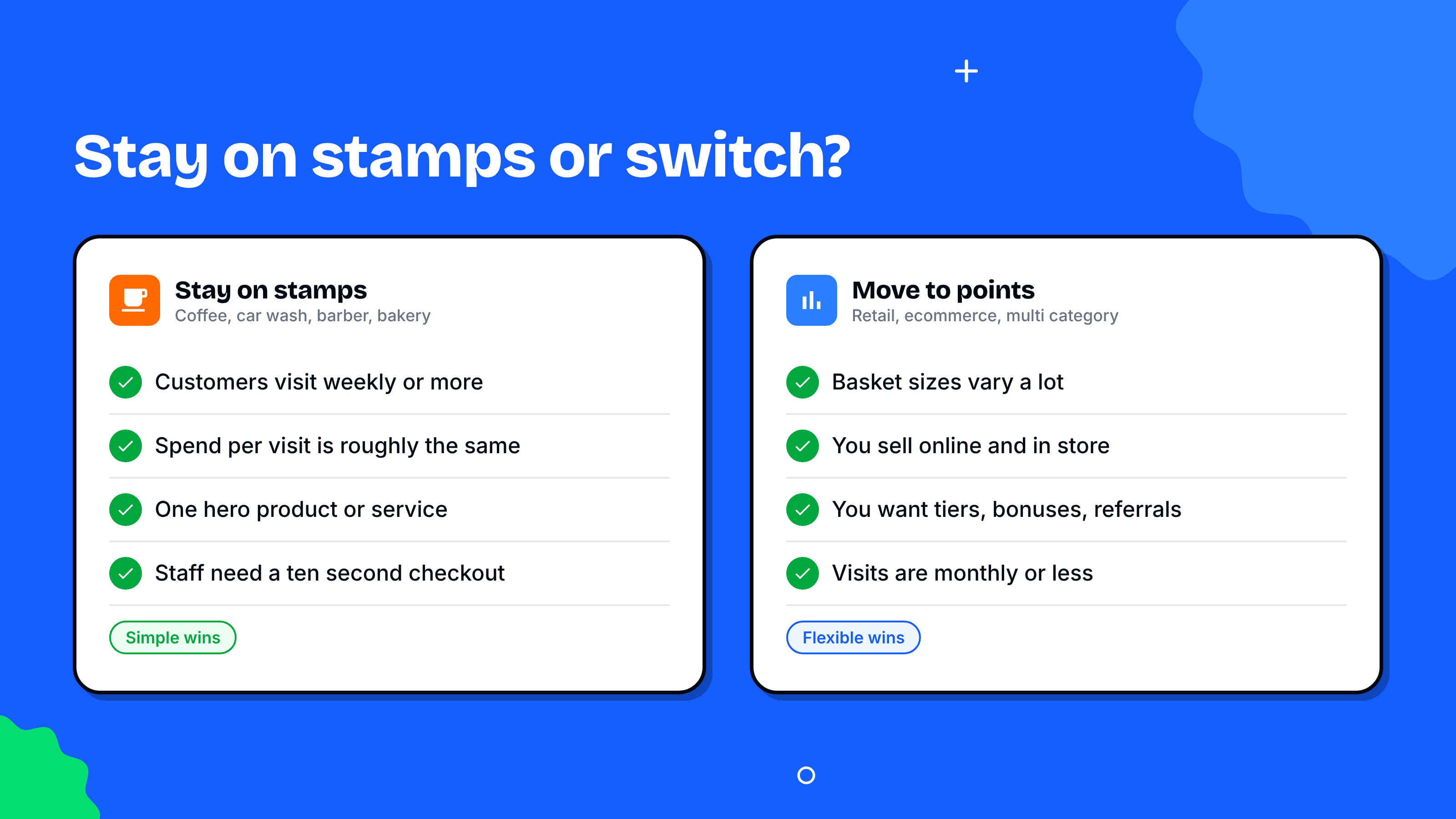
The test is not the size of the business. It is the shape of demand. Plot your business on two questions, how often customers come back and how much their spend varies, and the right model usually becomes obvious.
Frequent, similar baskets. Coffee, car wash, barber. Keep it simple and fast.
Frequent visits but varied baskets. Bakery café, QSR, pharmacy. Stamps for visits, points for spend.
Rare, similar purchases. Oil change, dental cleaning. A digital card plus timed reminders beats points.
Rare visits, varied baskets. Fashion, electronics, ecommerce. Points, tiers and personalised offers.
Retail chains with many categories almost always outgrow stamps; our guide to retail loyalty software covers what they need instead. If you already run a paper card and wonder whether digital is worth it at all, our article on whether loyalty cards are still relevant makes the case.
How to move from stamps to points or a hybrid
Move from stamps to points when you add channels, categories or tiers that a single stamp cannot reward fairly. The move is common for merchants who start in store and then open an online shop, including Saudi merchants on Salla who want one balance across channels; our comparison of Salla loyalty apps covers that case. In the UAE the phone is fast becoming the default wallet: a SixthFactor survey of 1,050 UAE residents in early 2026 found 70.7% were more willing to use digital wallets than cash or cards, as reported by TechAfrica News.
- 1Honour every existing stamp
Convert open cards into points at a generous rate so no customer loses progress in the switch.
- 2Set an earn rate that mirrors the old card
If ten coffees earned a free one, make the first reward reachable in about the same number of visits.
- 3Keep a visit bonus
Award bonus points for the fifth or tenth visit so frequent customers still feel the stamp card rhythm.
- 4Show progress everywhere
Put the balance and the distance to the next reward on the receipt, the app and the wallet pass.
- 5Measure before and after
Compare visit frequency, spend and redemption for three months against the stamp card baseline.
What to look for in loyalty card software
Good loyalty card software lets you start simple and change the model later without migrating platforms. Check these before you sign:
- ✓Supports stamps, points and hybrid rules on the same platform
- ✓Works at the POS, online and in a wallet pass or app, with one balance
- ✓Fraud controls: earning caps, verified redemption and an audit trail
- ✓Reporting on visits, redemption and repeat purchase, not just sign-ups
- ✕Avoid tools that lock your member data in or charge to export it
- ✓Loyalty card software runs one of three models: stamp cards reward the visit, points reward the spend, and hybrids connect the two.
- ✓Stamp cards are cheapest to run and easiest to understand, and a head start on the card can lift completion from 19% to 34%.
- ✓Paper stamps are the most fraud exposed format; a digital card with earning caps and verified redemption closes most gaps.
- ✓Points capture spend, basket and channel data, which you need for tiers, personalisation and multi-channel retail.
- ✓Stay on stamps if customers visit often for one hero product; move to points or a hybrid when baskets, channels or categories vary.
How Gameball helps
Gameball lets you run stamp style visit rewards, points and hybrid rules from one loyalty engine, with gamification for progress bars and challenges, promotions for bonus events and analytics that show visits, redemption and repeat purchase in one place. It works for retail and ecommerce brands and on-demand services, so you can book a demo to map your current card to the right model or compare plans.
Related reads
- Loyalty Points Software: How Points Engines Actually Work
- Coffee Shop Loyalty Programs: Setup Guide With Real Examples
- Customer Loyalty Platform: The 2026 Buyer’s Guide
Frequently asked questions
What is loyalty card software?
Loyalty card software is the system that issues, tracks and redeems loyalty cards digitally. It identifies customers by app, wallet pass or phone number, adds stamps or points after each purchase, and handles rewards. It replaces paper punch cards and plastic swipe cards, and it usually adds reporting, fraud controls and customer messaging on top.
What is the difference between a digital loyalty card and a points program?
A digital loyalty card is the format: the card lives on a phone instead of paper or plastic. A points program is a reward model: customers earn points by spend and redeem them for rewards. A digital loyalty card can run a stamp model, a points model or a hybrid, so the two are not alternatives.
Is a stamp card app better than points for a small business?
For a small business with frequent visits and similar spend each time, such as a café, barber or car wash, a stamp card app is usually better. It is cheaper, faster at checkout and instantly understood. Points start to pay off when baskets vary, you sell across channels, or you want tiers and personalised offers.
How do digital loyalty cards prevent fraud?
Digital loyalty cards tie every stamp or point to a real transaction and a verified account, so stamps cannot be copied. Good software adds daily earning caps, a minimum gap between stamps, verified redemption and an audit trail by staff member and store. Points balances also need protection against account takeover, because they carry cash value.
Can I convert my paper stamp card to a digital loyalty card?
Yes. Most businesses invite customers to register with a phone number or app, then credit their existing paper stamps as a one-time transfer. Honour every stamp generously, retire the paper card after a set date, and keep the same reward so regulars feel no loss when the card moves to their phone.
When should I switch from stamps to a hybrid program?
Switch to a hybrid when you want to keep rewarding frequent visits but also reward bigger baskets, such as a bakery café or QSR selling both single coffees and large orders. A hybrid gives a stamp for each visit and points for spend, and converts stamp milestones into bonus points so both behaviours count.


Ready to level up your game?
Create your first campaign and start seeing results in 30 days.
Ready to grow?
Get in touch with our sales team today.
The loyalty vendor checklist your CTO
will thank you for
Discover engineering challenges, essentials, and more from global brands.

Gameball Staff
Stay ahead on retention
Subscribe to our newsletter and get all the latest updates as we post.

Ready to level up your game?
Create your first campaign and start seeing results in 30 days.
Read related articles
Ready to level up your customer loyalty?
Level up your customer loyalty!