
%207.svg)

.svg)

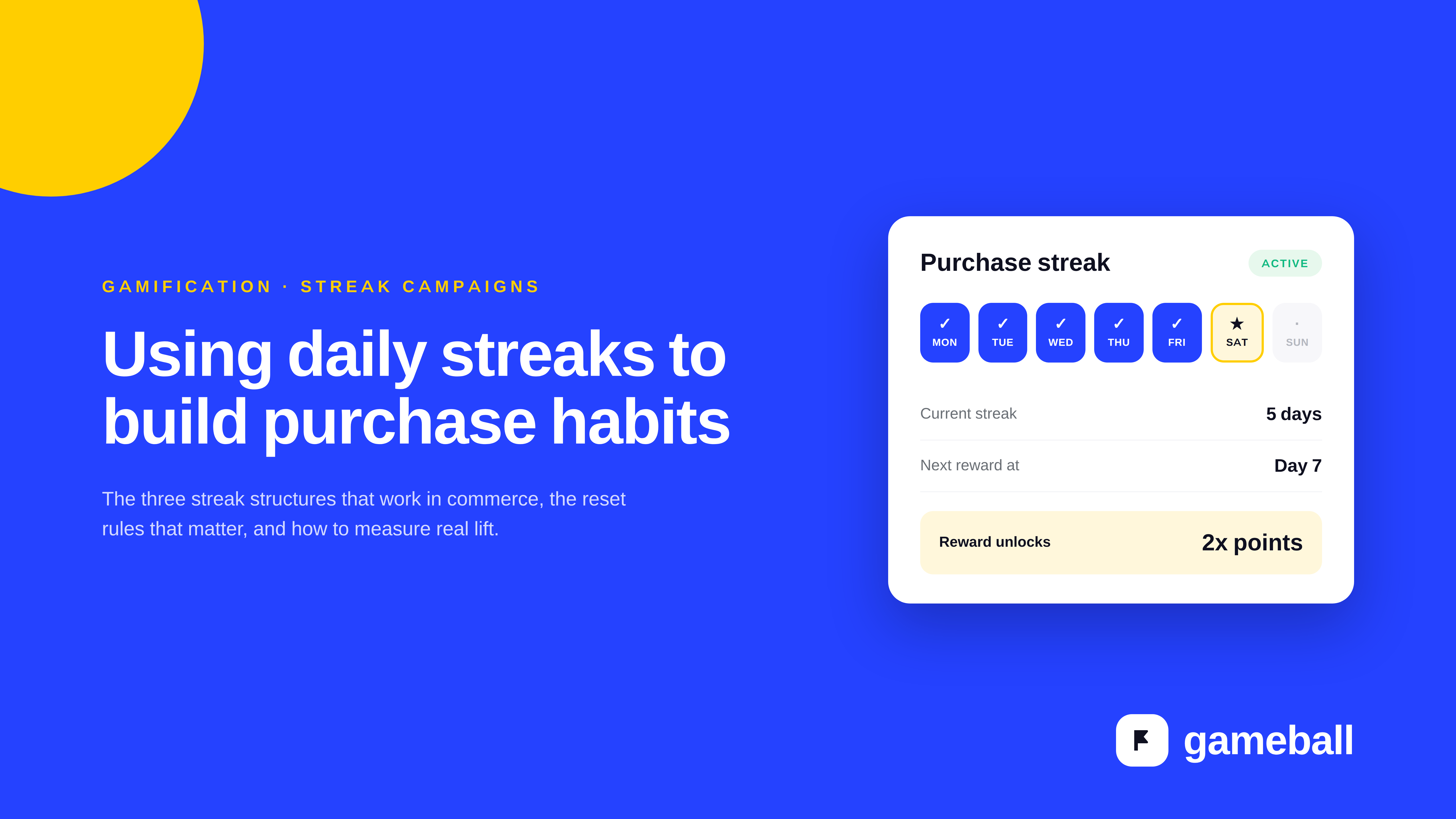
A streak campaign is a loyalty mechanic that rewards a customer for repeating an action across consecutive days, weeks or orders, and resets the count the moment they break the chain. The prize at the end matters less than the balance of effort the customer has built up and does not want to lose.
This guide covers the behavioural mechanic underneath streaks, the three streak structures that actually work in commerce, the reset rules that decide whether a streak motivates or frustrates, and how to tell whether your streak is producing incremental orders or simply paying people who were going to buy anyway.
What is a streak campaign?
A streak campaign is a rewarded sequence. You define one qualifying action, one interval, and one reset rule, and the customer earns something when they complete the sequence without a gap. Points programs reward volume. Streaks reward rhythm, which is why they change when people buy rather than only how much.
Every streak, whatever the industry, is built from the same four decisions.
A streak campaign sits inside the wider gamification toolkit alongside challenges, missions and tiers. To see where it fits against the traditional points and discount approach, read our companion guide on gamification versus traditional loyalty strategies, which compares the two on revenue impact rather than on novelty.
Why do streak campaigns work?
Streak campaigns work because effort that is visibly accumulating is hard to abandon. Two well documented effects do the work, and a third emerges once the streak is long enough to feel like an identity.
The first is the goal gradient effect. In the field study behind the goal gradient research by Kivetz, Urminsky and Zheng, café customers given a 12 stamp card with two stamps already filled reached their reward in a median of 10 days, against 15 days for customers given a plain 10 stamp card. Identical effort, faster behaviour, purely because the sequence felt already underway.
The second is loss aversion. Once a customer has five days banked, the cost of missing a day is no longer a missed reward, it is the deletion of five days of work. Duolingo, which has more than 6 million people on a streak of 7 days or longer, reports that learners who reach a 7 day streak are 3.6 times more likely to finish their course. Even a small change to the freeze mechanic moved its daily active learners by 0.38 percent.
The third effect is relevance. A streak only forms a habit if the action sits in a rhythm the customer already has, which is a targeting problem before it is a mechanics problem. McKinsey finds that personalization typically drives a 10 to 15 percent revenue lift, with 71 percent of consumers expecting personalized interactions. A daily streak pushed at someone who buys from you twice a year is not a habit, it is noise. Use behavioural analytics to pick the segment before you pick the reward.
The three streak structures that work in commerce
Three structures cover almost every viable streak in retail and services. The difference between them is what you are willing to count as a step.
Choosing between them is mostly a question of purchase frequency. A grocery or coffee brand can run a daily rhythm. A furniture brand cannot, and forcing one produces a streak nobody can hold.
| Structure | Qualifying step | Interval that works | Best for | Main risk |
|---|---|---|---|---|
| Daily check in | An app open, a game play, a poll answer | Daily | Apps, wallets, food delivery, media | High engagement that never converts to revenue |
| Consecutive purchase | A qualifying order above a minimum value | Weekly or monthly | Grocery, coffee, pharmacy, beauty replenishment | Rewarding customers who already bought that often |
| Cross category | An order from a category not yet used in the chain | Per order, no clock | Marketplaces, multi category retail, fashion | Forced purchases in categories with thin margin |
If you are still choosing a wider program shape rather than a single mechanic, our guide to the eight types of loyalty programs maps where streaks sit next to points, tiers and paid membership.
What reset rules actually do to behaviour
The reset rule is the highest leverage setting in a streak campaign, because it decides what a miss costs. Too harsh and a single bad week ends the relationship. Too soft and the chain stops meaning anything.
| Reset rule | What happens after a miss | Effect on behaviour | Use when |
|---|---|---|---|
| Hard reset | The count returns to zero immediately | Strongest urgency, highest churn among people who slip once | Short streaks of three to five steps where recovery is cheap |
| Grace period | The customer keeps the streak if they act within a set window | Protects casual buyers without removing the deadline | Weekly or monthly purchase streaks |
| Streak freeze | A limited token the customer earns or buys to cover one miss | Keeps long streaks alive and makes the streak feel owned | Long running daily streaks in apps and wallets |
| Partial decay | The count drops by one or two steps rather than to zero | Gentlest, lowest urgency, best for long horizons | Streaks of ten steps or more |
One more thing the goal gradient research flagged is worth designing around: after customers earned their first reward, engagement dipped before it climbed again toward the second. Plan for that dip. Open the next streak immediately, with a visible head start, rather than leaving the customer at zero the morning after they won something.
How to size a streak reward without eroding margin
Size the reward against the incremental order it is meant to create, not against the total value of the customer. A streak that pays 15 percent on every step turns your best customers into your cheapest, because the people most likely to complete a chain are the people who were already buying. The reward should sit at the end of the sequence, not on every step.
- ✓Put the value at the completion step, and keep interim steps to recognition such as progress, badges or status.
- ✓Set a minimum qualifying order value so the chain cannot be held with token purchases.
- ✓Cap how many streaks one customer can complete in a quarter.
- ✓Exclude already discounted lines, or the streak reward stacks on top of a promotion.
- ✓Prefer a reward that pulls the next visit, such as points or a category credit, over straight cash off.
The point of the exercise is a bigger basket and a shorter gap between orders, so the economics should be judged the same way you judge any retention spend. Our breakdown of average basket size and how to increase it is the right companion number to watch while a streak is live, and the calculation behind customer lifetime value tells you how much the habit is worth once it holds.
How to measure whether a streak drives incremental orders
Hold back a control group before launch. Without one, a streak campaign will always look successful, because the customers who complete streaks are your most engaged customers and would have shown up in the numbers regardless. Exclude a random 10 percent of the eligible segment from enrolment, then compare that group to the enrolled group on the same window.
| Metric | What it tells you | What a weak result looks like |
|---|---|---|
| Enrolment rate | Whether the mechanic is understood at all | Low take up means the rules or the entry point are unclear |
| Step 2 continuation | Whether the first step felt worth repeating | A steep drop after step one means the threshold is too far away |
| Completion rate | Whether the sequence length is realistic | Very high completion suggests you are paying for normal behaviour |
| Incremental orders versus holdout | The only number that proves the campaign caused anything | Enrolled and holdout groups order at the same rate |
| Margin per enrolled customer | Whether the lift survives the reward cost | Orders rise while contribution per customer falls |
| Post reward retention | Whether the habit outlived the prize | Activity collapses in the two weeks after completion |
Post reward retention is the one most teams skip, and it is the one that separates a habit from a promotion. If activity collapses the week after the reward lands, you did not build a habit, you ran a discount with extra steps. Instrument it before launch, the same way you would with any automated lifecycle campaign.
Common streak campaign mistakes
Most failed streaks fail for one of five reasons, and all five are design choices rather than execution problems.
- ✗The interval does not match how often people buy the category, so nobody can hold the chain.
- ✗The threshold is too long, so the first reward is too far away to pull anyone past step two.
- ✗Progress is invisible between sessions, so loss aversion never gets anything to work on.
- ✗The reminder arrives after the window closes, which converts a near miss into a grievance.
- ✗There is no holdout group, so nobody can say whether it worked.
Visibility is the cheapest of these to fix. A streak that lives only inside an email is a streak nobody is defending. Put the counter on the widget, the account page and the reminder, and make the number of days the largest thing on the screen.
How Gameball helps
Gameball runs streaks as a native mechanic through action streaks, alongside challenges, milestones and plug and play games, with rewards issued by the same loyalty engine that handles points and tiers, so a streak does not become a separate system to reconcile. Progress, reminders and reset rules are configured rather than built, campaigns are triggered through marketing automation, results are read against a holdout in analytics and intelligence, and the same mechanic ships for retail and ecommerce or fintech teams who want a daily rhythm rather than a quarterly campaign. Book a demo to see a streak configured against your own purchase frequency, or check pricing first.
Related reads
- The ROI of Gamification in Enterprise Customer Retention Strategies
- What Makes a Reward Feel Worth It? The Science of Effective Incentives
- 8 Secrets that Make the Starbucks Loyalty Program So Popular
Frequently asked questions
What is a streak campaign in a loyalty program?
A streak campaign rewards a customer for repeating a qualifying action across consecutive intervals, such as ordering in four straight weeks or opening the app seven days running. The count resets when the customer misses an interval. The mechanic works because accumulated progress becomes something the customer is unwilling to lose.
How long should a purchase streak be?
Between three and seven steps for a first streak. The threshold has to be close enough that the customer can picture reaching it after the first step, and the interval has to match how often people actually buy your category. Longer chains belong to apps with daily usage, not to stores people visit monthly.
Do streaks work for stores with low purchase frequency?
Yes, but not as daily purchase streaks. Use a non purchase action such as a check in, a review or a game play to build the visit habit, or count the chain per order with no clock at all, so a customer who buys every six weeks can still hold a streak across several months.
Should a streak reset to zero after a missed day?
Only for short streaks where recovery is cheap. For longer chains, a grace period or a limited streak freeze keeps the customer in the game after one bad week and protects the emotional investment you spent weeks building. A hard reset on a 30 day streak usually ends the relationship rather than restarting it.
How do I know if my streak campaign is actually working?
Hold out a random 10 percent of the eligible segment and compare order rate, basket size and margin per customer against the enrolled group over the same window. Then measure retention in the two weeks after the reward is paid. Without a holdout you are measuring who your best customers already were.
What is the difference between a streak and a challenge?
A challenge asks for a set of actions in any order, within a deadline. A streak asks for the same action repeatedly, in sequence, and punishes a gap. Challenges are better for broadening behaviour across categories. Streaks are better for tightening the gap between visits.
.svg)
.svg)
.svg)

Ready to level up your game?
Create your first campaign and start seeing results in 30 days.
Ready to grow?
Get in touch with our sales team today.
The loyalty vendor checklist your CTO
will thank you for
Discover engineering challenges, essentials, and more from global brands.

Gameball Staff
Stay ahead on retention
Subscribe to our newsletter and get all the latest updates as we post.

Ready to level up your game?
Create your first campaign and start seeing results in 30 days.
Read related articles

%2520(1)%2520(1)%2520(1)%2520(2)%2520(1).avif)


Ready to level up your customer loyalty?
Level up your customer loyalty!


.avif)
.avif)
.avif)
.avif)