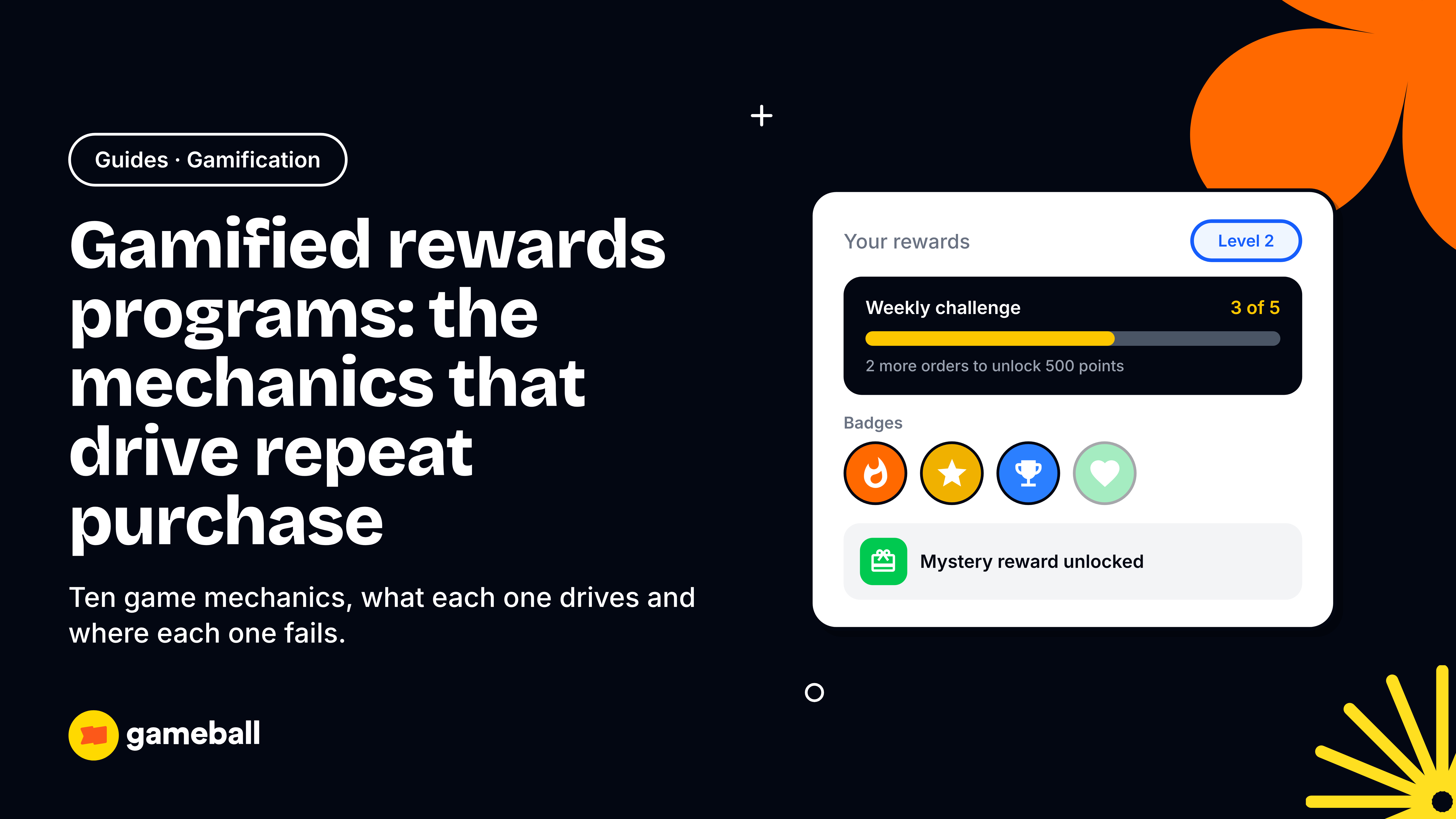
A gamified rewards program is a loyalty program that uses game mechanics such as streaks, challenges, badges and progress bars to reward the specific actions that lead to a repeat purchase, not just the money a customer spends. It turns the gap between two orders into something a member wants to close.
Most guides list the mechanics and stop there. This one goes a level deeper: for each of the ten mechanics brands actually use, it explains the behaviour the mechanic drives, the customer segment it works on and the way it usually fails. If you are still choosing a platform to run them, read our companion guide to gamification software, which compares ten platforms side by side.
What is a gamified rewards program?
A gamified rewards program is a loyalty program where members earn rewards by completing game-like goals, not only by spending. A classic points scheme pays out one currency for one behaviour. A gamified loyalty program adds goals with a visible finish line, an element of chance, and status that members can lose or keep. The loyalty engine still tracks points and tiers underneath; the game layer decides which actions earn them and how progress looks on screen.
The difference shows up in what members feel between purchases:
- Rewards one behaviour: spending
- Progress is a balance nobody checks
- Nothing pulls members back between orders
- Almost every reward is a discount
- Rewards the actions that lead to the next order
- Progress is visible after every action
- Gives members a reason to return this week
- Mixes discounts with status, surprise and goals
Game mechanics in loyalty are not a separate product category. They are a design layer you add to the points, tiers and rewards you already run, which is why most brands start with one or two mechanics and expand from there.
Why gamified rewards programs drive repeat purchase
Gamified rewards programs drive repeat purchase because they make progress visible, and visible progress changes how fast people act. In a well-known field study, Joseph Nunes and Xavier Drèze gave 300 car wash customers loyalty cards. Half needed eight stamps for a free wash. The other half needed ten but started with two already stamped. The effort required was identical, yet 34% of the head-start group redeemed against 19% of the others, and they came back sooner between washes. A related study by Ran Kivetz, Oleg Urminsky and Yuhuang Zheng found that customers speed up their purchases as they get closer to a reward.
The flip side is just as clear. In the Antavo Global Customer Loyalty Report 2026, 49.1% of US consumers said earning rewards takes too long, and 26.2% of loyalty points went unspent. A slow, invisible points balance is the problem game mechanics solve.
Consumers also say they want it. McKinsey’s Australian Consumer Loyalty Survey of more than 1,400 consumers found gamification ranked among the five most valued loyalty program features, and that top-quartile programs made members 14% more likely to increase purchase frequency than bottom-quartile ones. Frequency is where the money is: Bain's Fred Reichheld and Christine Detrick found that in financial services, a 5% increase in customer retention produces more than a 25% increase in profit.
The 10 game mechanics in loyalty programs and what each one drives
Every mechanic below is scored on three things: the behaviour it drives, the segment it works on and its failure mode. Pick by behaviour first, then check the segment.
1. Streaks
Streaks reward members for repeating an action on a schedule, such as ordering every week or opening the app every day. They shorten the gap between orders because breaking the run feels like a loss. Streaks work best on active regulars who already buy often. The failure mode is fragility: one missed day wipes out weeks of progress and the member quits. Add a grace period or a streak freeze. Our guide to daily streak campaigns covers the setup in detail.
2. Challenges
Challenges set a specific goal with a deadline, such as buying from a new category, leaving three reviews or referring a friend this month. They are the most flexible mechanic because you choose the behaviour. They suit new and active members. Challenges fail when the goal is set for your best customers and nobody else can finish it. See how brands use challenges to grow revenue without that trap.
3. Badges
Badges recognise milestones that spend alone does not capture: a first review, a tenth order, a visit to every branch. They drive exploration and give engaged members something to show. Badges fail when they carry no value, because a wall of meaningless icons becomes clutter. Tie each badge to a perk, a points bonus or a level.
4. Leaderboards
Leaderboards rank members on a metric such as points earned this month. They drive competition among VIPs and highly active members, and they work well in communities, fitness apps and B2B programs. Their failure mode is the long tail: most members see they cannot win and disengage. Use small cohorts, monthly resets or ranks relative to a member's own past.
5. Spin the wheel
Spin the wheel gives a member a chance at a prize, usually after a visit, a signup or a purchase. Uncertainty makes the next visit more appealing, which is why it suits lapsing and casual members. It fails when odds are loose and prizes are generous, because margin leaks fast. Gameball's promotions engine lets you set win probabilities and reward caps before launch.
6. Scratch cards
Scratch cards add a reveal moment after a purchase or signup. They work on first-time buyers and seasonal shoppers who need a reason to come back. They fail when every card shows the same small prize, so the excitement fades by the third scratch. Our guide to scratch and win campaigns shows how to keep the prize mix varied without killing margin.
7. Mystery rewards
Mystery rewards hide the prize until the member unlocks it with the next order. They build anticipation and work well on lapsing members and occasional buyers. They fail when the reward feels random rather than earned, so connect the unlock to a clear action. A small instant reward on unlock keeps the experience satisfying.
8. Progress bars
Progress bars show how close a member is to the next reward, level or challenge goal. They are the mechanic with the strongest evidence behind them, and they work best on new members who have not yet made a second order. They fail when the bar starts at zero or barely moves. Give a head start at signup and size steps so members see movement after every order.
9. Levels
Levels, often called tiers, give members a status they earn by spending and must keep by staying active. They drive higher spend among mid and high spenders. Levels fail when thresholds sit out of reach for most members. Our guide to tiered loyalty programs covers how to set thresholds members can reach.
10. Collections
Collections ask members to complete a set, such as one item from five categories or a visit to each location. They drive cross-category buying among active members. Collections fail when the set is too long or includes items members never buy. Keep sets to four or five pieces and run them for a season.
Here is the full comparison in one view:
| Mechanic | Behaviour it drives | Best segment | Failure mode |
|---|---|---|---|
| Streaks | Shorter gaps between orders or visits | Active regulars who already buy monthly | One missed day wipes progress and members quit |
| Challenges | A specific action: try a category, write a review, refer a friend | New and active members | Goals set too high, so few members ever finish |
| Badges | Exploration and milestones beyond spend | Engaged members who like collecting recognition | Badges with no value become clutter nobody notices |
| Leaderboards | Competition for top spots | VIPs and highly active members | Most members see they cannot win and disengage |
| Spin the wheel | A visit or an app open, often tied to a purchase | Lapsing and casual members | Loose odds and prizes that erode margin |
| Scratch cards | A reveal moment after a purchase or signup | First-time buyers and seasonal shoppers | Every card wins the same small prize, so the thrill fades |
| Mystery rewards | Anticipation before the next order | Lapsing members and occasional buyers | Rewards that feel random rather than earned |
| Progress bars | Completing the next step toward a reward | New members before the second order | Bars that start at zero or move too slowly |
| Levels | Spending more to reach or keep a status | Mid and high spenders | Thresholds out of reach for most members |
| Collections | Buying across categories or locations | Active members with broad catalogues to explore | Sets too long or impossible to complete |
How to match game mechanics to customer segments
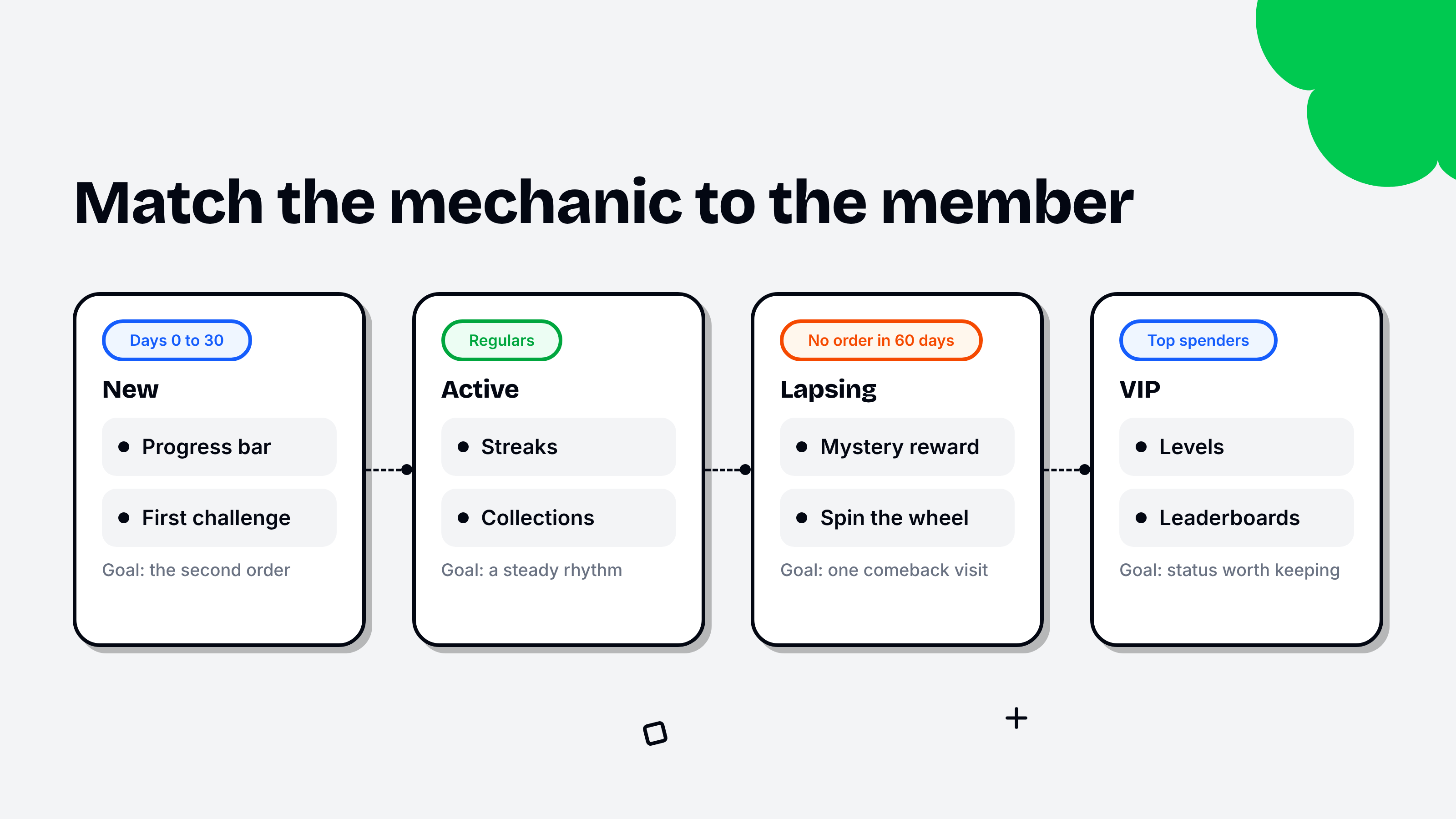
The right mechanic depends on where a member sits in their lifecycle, not on which mechanic is trending. A progress bar that gets a new member to the second order can bore a VIP, and a leaderboard that excites a VIP can discourage a newcomer. If you have not split your base yet, start with our guide to loyalty segmentation.
In the GCC, the same logic applies to the calendar. Ramadan countdowns, White Friday and national day campaigns suit challenges and calendar games that run for a set number of days, while US brands lean on Black Friday streaks and holiday collections. Gameball's gamification suite includes calendar challenges built for these windows.
How to launch a gamified loyalty program in five steps
Launch a gamified loyalty program by changing one behaviour at a time and measuring the lift against a control group. Use marketing automation to trigger each mechanic at the right moment instead of showing every game to every member.
The two numbers to watch are repeat purchase rate and redemption rate. If repeat purchase rises but redemption stays flat, members like the game but not the prize. If redemption rises and repeat purchase does not, you are paying for rewards that would have happened anyway.
Common mistakes with gamified loyalty programs
Most gamified loyalty programs that underperform make one of three mistakes, and each comes from a myth about how game mechanics work:
A fourth mistake is launching without a way to measure. Without a holdout group, a seasonal spike looks like a game working. Gameball's analytics compares redeemers with non-redeemers so you can see the real effect.
- A gamified rewards program rewards actions, not just spend, using mechanics such as streaks, challenges, badges and progress bars.
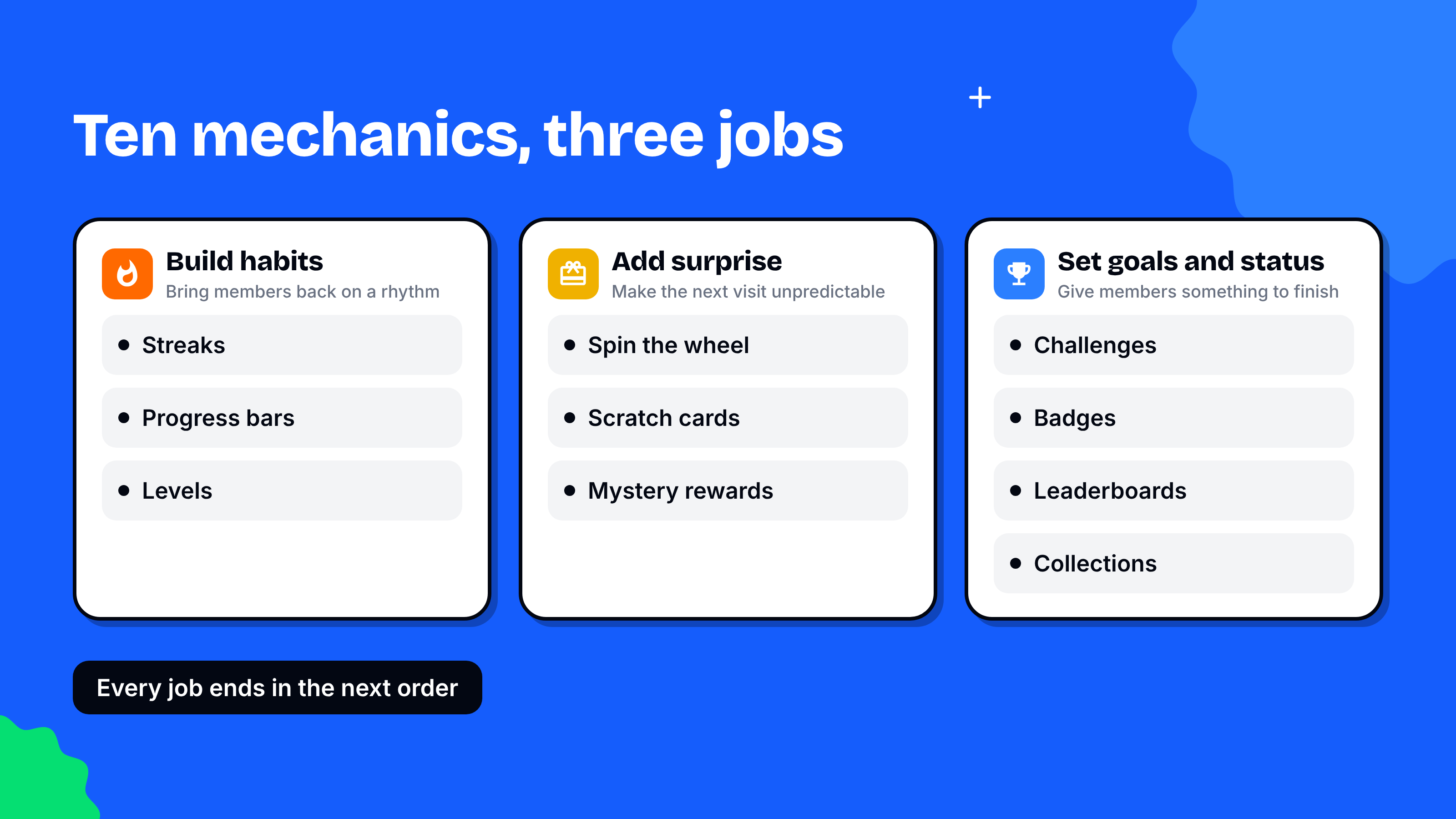
- Each mechanic does one of three jobs: build a habit, add surprise, or give members a goal and status to chase.
- Visible progress is the strongest lever: a head start lifted loyalty card redemption from 19% to 34% in one field study.
- Assign mechanics by segment. Progress for new members, streaks for regulars, surprise for lapsing members, status for VIPs.
- Set odds, caps and end dates before launch, and measure lift against a holdout group.
How Gameball helps
Gameball runs streaks, challenges, badges, leaderboards, progress bars and plug-and-play games such as spin the wheel on top of a full loyalty program, with reward caps and win odds set before launch. It serves retail and ecommerce brands and fintech apps across more than 57 million enrolled customers, and you can book a demo or compare plans to see which fits your program.
Related reads
- Gamification Software: 10 Platforms Compared for 2026
- Streak Campaigns: Using Daily Streaks to Build Purchase Habits
- Scratch and Win Campaigns: How to Run Them Without Killing Your Margin
Frequently asked questions
What is a gamified rewards program?
A gamified rewards program is a loyalty program that uses game mechanics such as streaks, challenges, badges, leaderboards and progress bars to reward specific customer actions, not only spend. Members see their progress toward a goal after every action, which gives them a reason to return sooner and buy again.
What is the difference between a gamified loyalty program and a points program?
A points program rewards one behaviour, spending, with one currency. A gamified loyalty program keeps the points but adds goals, chance and status on top, such as a weekly challenge, a spin after checkout or a badge for trying a new category. The game layer decides which actions earn rewards and how progress looks.
Which game mechanics work best for repeat purchase?
Progress bars have the strongest evidence. In a car wash study, cards with a two-stamp head start were redeemed 34% of the time against 19% for cards with none. Streaks work for regulars, challenges for new members, and mystery rewards or spins for lapsing members. Match the mechanic to the segment rather than picking one for everyone.
Do gamified rewards programs hurt margin?
They can if the odds and prizes are loose. Spin the wheel, scratch cards and mystery rewards cost whatever you let them cost, so set win probabilities, prize caps and a reward budget before launch. Price every reward against margin, and measure lift against a holdout group so you only pay for behaviour the game actually changed.
How do I measure a gamified loyalty program?
Measure repeat purchase rate, redemption rate and margin per member for the members who played, and compare them with a holdout group that did not see the mechanic. Track each mechanic separately. If repeat purchase rises but redemption stays flat, the prize is weak. If redemption rises alone, you may be rewarding orders that would have happened anyway.
Is gamification only for young shoppers?
No. Goal progress, surprise and status affect buying behaviour across age groups. The best-known evidence for progress mechanics comes from ordinary car wash customers, not gamers. What changes by audience is the format: a younger app audience may enjoy daily games, while older or B2B members respond better to levels, milestones and challenges.


Ready to level up your game?
Create your first campaign and start seeing results in 30 days.
Ready to grow?
Get in touch with our sales team today.
The loyalty vendor checklist your CTO
will thank you for
Discover engineering challenges, essentials, and more from global brands.

Gameball Staff
Stay ahead on retention
Subscribe to our newsletter and get all the latest updates as we post.

Ready to level up your game?
Create your first campaign and start seeing results in 30 days.
Read related articles


Ready to level up your customer loyalty?
Level up your customer loyalty!