%207.svg)

.svg)


Gamification software is a platform that adds game mechanics such as points, challenges, streaks, badges, leaderboards and mini games to a store, an app or a workplace, so that people repeat the behaviors a business cares about. The category is wider than most buyers expect, which is why so many shortlists end up comparing tools that were never built for the same job.
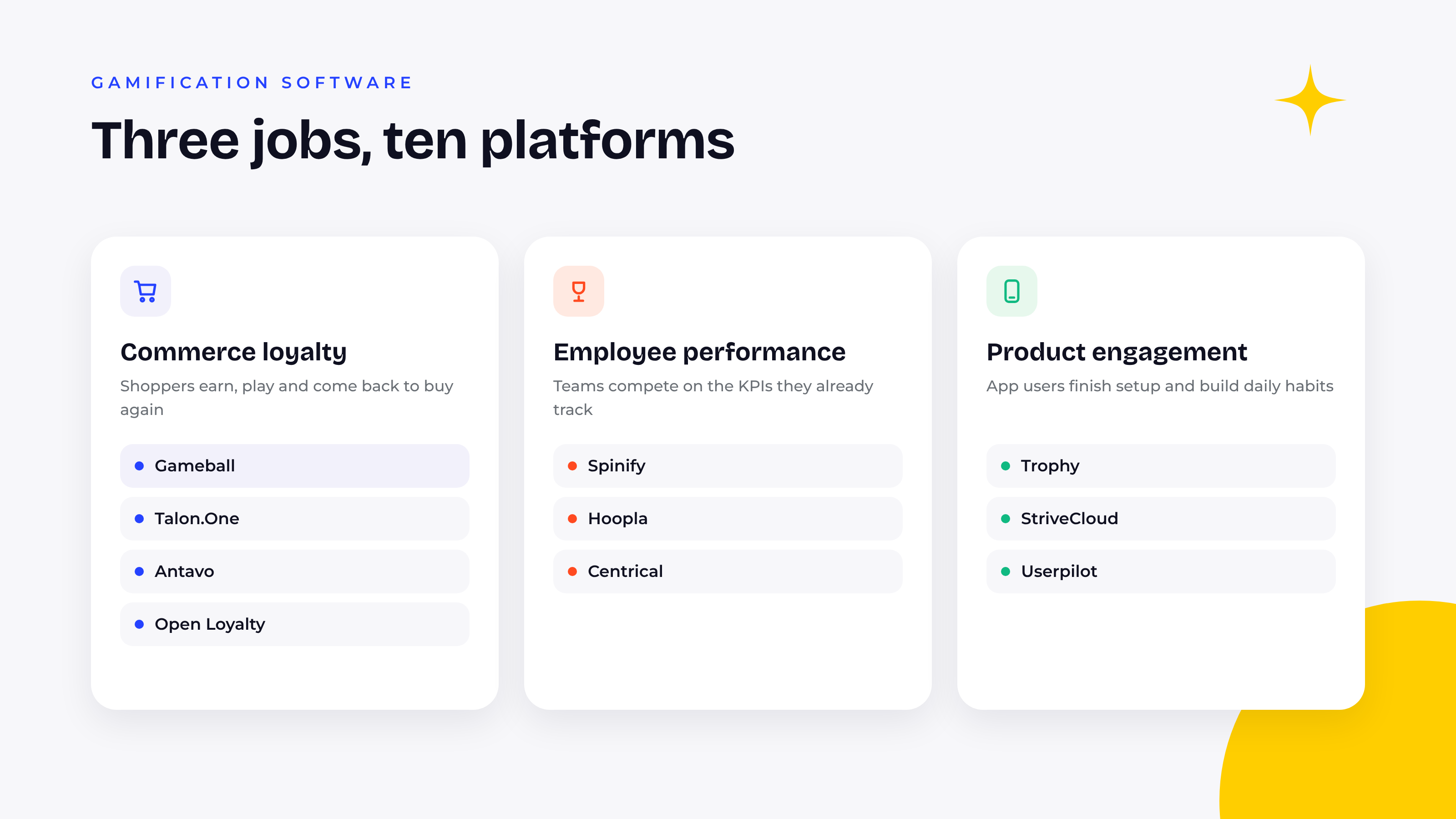
This guide compares ten gamification platforms across the three jobs the software actually does: commerce loyalty for shoppers, performance for employees, and engagement inside a digital product. For each one you get the mechanics it covers, how deep the integrations go and what the vendor publishes about pricing, so you can rule out two thirds of the market in a few minutes and spend your demo time on the right third.
What is gamification software?
Gamification software is the engine that tracks what a person does, checks it against rules you set, and responds with a game element: progress toward a goal, a badge, a place on a leaderboard, a reward or a chance to play. The person never sees the engine. They see a challenge card, a streak counter or a prize wheel, and they come back to finish what they started.
Most platforms are assembled from the same six building blocks. What separates them is who the player is, where the game appears and what system the rewards connect to.
A running score that turns everyday actions into visible progress and unlocks the next level.
Multi-step goals such as three orders in a month or a completed profile, with a reward at the end.
A counter for consecutive days or weeks of activity, so breaking the chain feels like a loss.
Collectible markers for milestones that make progress social and shareable.
Rankings that add friendly competition between customers, users or sales reps.
Spin the wheel, scratch and win, trivia and quick arcade games that pay out a reward.
If you want to see these mechanics in the wild before you shop, our companion guide to mobile loyalty gamification examples walks through how brands use each one inside their apps.
Why does gamification software matter in 2026?
Gamification software matters because retention is where the profit is, and game mechanics give people a reason to come back that is not another discount. Bain and Company has long argued that increasing retention by as little as 5 percent can boost profits by as much as 95 percent, and a well-designed challenge or streak is one of the cheapest ways to move that number.
Expectations have also moved. According to McKinsey research on personalization, 71 percent of consumers expect companies to deliver personalized interactions, and personalization most often drives a 10 to 15 percent revenue lift. Gamification software is one of the few tools that turns personal behavior data into a personal next step in real time.
Which type of gamification software do you need?
The right type of gamification software depends on who is playing, where the game lives and which system holds the reward. Answer the three questions below before you book a single demo, because the answers rule out most of the market.
Most retail, ecommerce and fintech brands land in the first group. That is where the business case is clearest, because every challenge or game ends in a measurable order, deposit or booking.
Gamification software compared: the 10 platforms at a glance
The table below summarizes all ten gamification platforms by use case, core mechanics, integration style and published pricing. Prices were checked on each vendor's public pricing page in October 2026; where a vendor does not publish a number, the table says so rather than guessing.
| Platform | Use case | Core game mechanics | Integration style | Published pricing |
|---|---|---|---|---|
| Gameball | Commerce loyalty | Challenges, missions, streaks, badges, leaderboards, spin the wheel and other plug-and-play games, VIP tiers | SDK and API, Shopify and Salla apps, CRM and CDP connections | Growth from $399/mo, Enterprise from $599/mo |
| Talon.One | Commerce promotions and loyalty | One-time, recurring and timed challenges, milestones, badges, leaderboards | API first engine with third party integrations and webhooks | Custom, based on data volume |
| Antavo | Enterprise loyalty | Challenges, tiers, gamification and referrals, clubs | API first, with Shopify, Klaviyo, Bloomreach and Braze among its integrations | Not published |
| Open Loyalty | Enterprise loyalty | Badges and achievements, challenges and missions, leaderboards, spin the wheel, scratch and win, lotteries | REST API engine with an admin UI | Platform fee plus a fee based on monthly active members |
| Spinify | Sales team performance | 20+ competition types, leaderboards on TV displays, badges, prize wheels, reward stores | Salesforce, HubSpot, Dynamics 365, Pipedrive, Slack, Teams | Per tracked user, by quote |
| Hoopla | Sales team motivation | Leaderboards, contests, recognition, deal celebrations on TV | Salesforce, HubSpot, Microsoft Dynamics, Pipedrive, Zapier | Not published, free trial |
| Centrical | Frontline and contact center performance | Gamified goals, KPI competitions, recognition, virtual rewards store, microlearning | Connects to the wider HR and data stack | By quote |
| Trophy | Consumer app engagement | Achievements, streaks, points and levels, leaderboards | API with SDKs for Node.js, Go, Java, .NET, PHP, Python and Ruby | Free to 1,000 MAU, Starter $25/mo, Pro $299/mo |
| StriveCloud | Consumer app engagement | Streaks, quests, leaderboards, raffles, XP and coins | No-code widgets plus SDKs and APIs | Starter listed at €999/mo |
| Userpilot | SaaS product onboarding | Onboarding checklists, flows and in-app prompts | Segment, Mixpanel, Amplitude, Heap, Intercom | Starter $299/mo, Growth from $849/mo |
Best gamification software for commerce loyalty
Commerce gamification platforms tie every game mechanic to a loyalty balance, so a finished challenge or a lucky spin turns into points, cashback or a tier upgrade that brings the customer back to buy. These four are built for retail, ecommerce, restaurants and financial apps.
1. Gameball
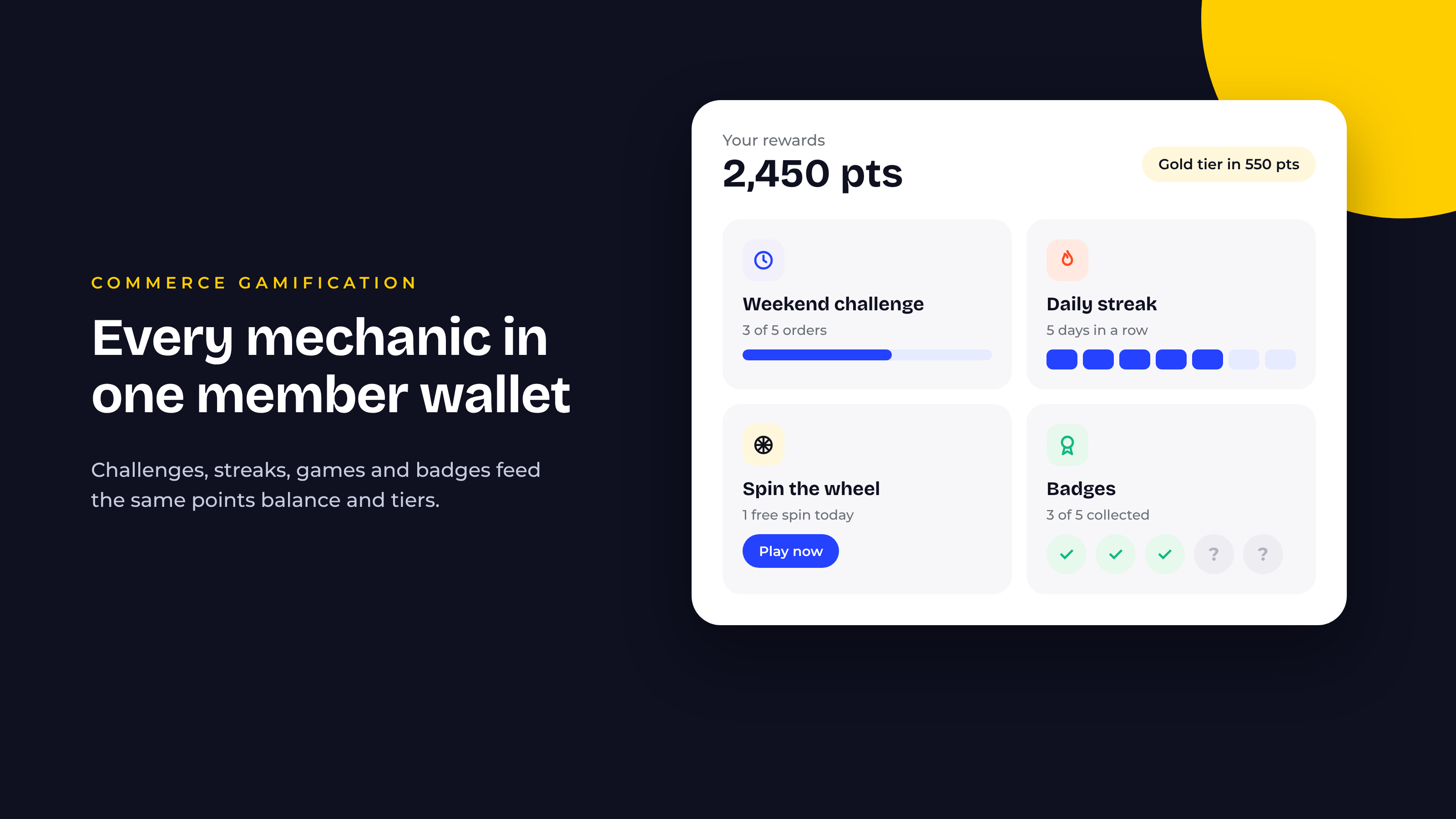
Gameball is a loyalty and gamification platform that puts challenges, streaks, games and tiers into one member wallet, which is why it suits brands that want gamified loyalty without stitching three vendors together. Its mechanics range from action streaks and multi-step challenges to plug-and-play games such as spin the wheel and trivia, plus gamified calendar campaigns built around moments like Ramadan or Christmas. It also covers referrals and VIP tiers, and serves retail and ecommerce brands as well as fintech apps across the US and the GCC.
- Best for: Retail, ecommerce and fintech brands in the US and the Gulf that want loyalty and gamification in one product, run by marketers.
- Mechanics: Challenges and missions, action streaks, milestones, badges, progress bars, leaderboards, spin the wheel and other in-app games, VIP tiers.
- Integrations: Shopify and Salla apps, SDK and API (the site quotes about two weeks for an SDK integration and one week via API), connections to CRM and CDP tools, 15M+ API calls handled daily with sub 300ms latency.
- Pricing: Growth from $399/mo, Enterprise from $599/mo.
2. Talon.One
Talon.One is a promotion and loyalty engine with a dedicated gamification module, aimed at large companies with engineering teams that want to configure complex rules. Its gamification engine supports one-time, recurring and timed challenges, milestones broken into smaller steps, progress trackers, leaderboards and custom badges, with rewards paid out as discounts, points or perks.
- Best for: Enterprise brands that already run complex promotions and have developers to own the integration.
- Mechanics: Challenges, timed challenges, milestones, progress trackers, leaderboards, badges.
- Integrations: API first, with third party integrations included and webhooks on higher plans.
- Pricing: Starter, Professional and Enterprise plans, priced individually on data volume. No public prices.
3. Antavo
Antavo is an enterprise loyalty platform that lists challenges, tier management, gamification and referrals and clubs among its products. Its strength is tier-led programs for retail, fashion, food and hospitality brands, with gamified engagement layered on top rather than at the center.
- Best for: Large retail, fashion and hospitality brands redesigning a tiered program.
- Mechanics: Challenges, tiers, gamification and referrals, rewards, clubs.
- Integrations: API first, with Shopify, Klaviyo, Bloomreach and Braze among the named integrations across marketing automation, CDP and ecommerce categories.
- Pricing: Not published. Pricing is discussed on a call.
4. Open Loyalty
Open Loyalty is an API first loyalty engine for enterprises that want to build their own front end. It has one of the broadest published mechanic lists in this comparison, from badges, achievements and leaderboards to spin the wheel, scratch and win, lotteries and raffles.
- Best for: Enterprise teams with developers who want full control over the member experience.
- Mechanics: Badges and achievements, challenges and missions, leaderboards, tiers, spin the wheel, scratch and win, lotteries.
- Integrations: REST API plus an admin UI for marketers. The vendor cites a 120ms average response time and a 99.99% uptime SLA.
- Pricing: A platform fee plus an allowance fee tied to monthly active members. No list prices.
Three of the four commerce platforms above price by quote, by data volume or by active members. Ask every vendor for a three year total cost at your expected member count, including implementation and support, so you compare like with like.
Best gamification platforms for employee engagement
Employee gamification platforms pull performance data from your CRM or contact center tools and turn it into competitions, leaderboards and recognition that teams can see in real time. They are built for managers, not marketers, and the reward is usually recognition or a bonus rather than a coupon.
5. Spinify
Spinify is a sales gamification tool that turns CRM activity into leaderboards and competitions displayed on office TVs, desktops and phones. It offers more than 20 competition types, badges, prize wheels and reward stores, and bills per tracked user.
- Best for: Sales teams that live in Salesforce, HubSpot, Dynamics 365 or Pipedrive.
- Mechanics: Leaderboards with TV displays, 20+ competition types, automatic and manual badges, prize wheels, reward stores.
- Integrations: Salesforce, HubSpot, Dynamics 365, Pipedrive, plus Slack and Microsoft Teams broadcasts and an API.
- Pricing: Per user per month, by quote. Plans are named Sardine, Goldfish, Shark and Whale.
6. Hoopla
Hoopla is a sales motivation platform built around leaderboards, contests and celebrations, such as a personalized video or song that plays when a rep closes a deal. It is designed to keep performance visible on the sales floor.
- Best for: Inside sales and contact center teams that want visible, celebratory competition.
- Mechanics: Leaderboards, contests, real-time recognition, deal celebrations on TV and mobile.
- Integrations: Salesforce, HubSpot, Microsoft Dynamics, Pipedrive, Slack, Microsoft Teams, Zapier and Talkdesk.
- Pricing: Not published. A free trial is available and the vendor says display hardware is included.
- ✓Rewards the actions that drive revenue: orders, deposits, reviews, referrals
- ✓Pays out in points, cashback, coupons or tier status
- ✓Lives on the storefront, in the app and in lifecycle messages
- ✓Run by marketing and CRM teams
- ✓Rewards the activities that drive targets: calls, deals, quality scores
- ✓Pays out in recognition, bonuses and reward store items
- ✓Lives on office TVs, manager dashboards and team chat
- ✓Run by sales, operations and HR leaders
7. Centrical
Centrical, formerly GamEffective, is a performance platform for frontline teams in contact centers, BPOs, financial services and other customer-facing roles. It combines gamified goals and KPI competitions with coaching, quality assurance and microlearning triggered by performance gaps.
- Best for: Large frontline and contact center operations that want gamification tied to coaching and learning.
- Mechanics: Gamified goals, KPI-linked competitions, peer and manager recognition, a virtual rewards store, microlearning paths.
- Integrations: Connects to the HR and data stack, with SAP, AWS and Workday among the logos it shows.
- Pricing: By quote.
Gameball has also used its own engine internally, and our story on gamifying the employee experience shows how the same mechanics translate to a team setting.
Best gamification tools for product onboarding and app engagement
Product gamification platforms sit inside your own app and reward usage itself: finishing setup, logging in on consecutive days or hitting a learning goal. They are built for product and engineering teams and usually price by monthly active users.
8. Trophy
Trophy describes itself as the gamification layer for consumer apps, with ready-made achievements, streaks, points, leaderboards and lifecycle messages that developers add through an API. Its streak logic handles time zones and streak freezes, a detail that matters more than it sounds once users travel.
- Best for: Consumer apps in education, fitness, finance and productivity that want habit loops without building them.
- Mechanics: Achievements, streaks with freezes, points with levels and boosts, daily, weekly and all-time leaderboards, push and email.
- Integrations: API with official SDKs for Node.js, Go, Java, .NET, PHP, Python and Ruby, plus webhooks on paid plans.
- Pricing: Free up to 1,000 MAU. Starter $25/mo and Pro $299/mo (10,000 MAU included), then $0.015 per extra MAU. Enterprise is custom.
Trophy and StriveCloud are fast for developers but still live in your codebase. If your marketing team needs to launch a Ramadan challenge or a weekend streak without a sprint, a commerce platform with a no-code campaign builder will ship faster.
9. StriveCloud
StriveCloud is an engagement platform for consumer apps with roughly 100,000 to 10 million monthly active users. It pairs a no-code builder for streaks, quests, leaderboards and raffles with APIs and SDKs, and adds experiments such as holdout groups and A/B tests.
- Best for: Larger consumer apps in mobility, media, fintech and sport that want to test engagement mechanics.
- Mechanics: Streaks, quests, leaderboards, raffles, XP and coins, a loyalty shop, segmentation and triggers.
- Integrations: No-code iframe widgets plus typed SDKs, webhooks and APIs. EU hosting by default.
- Pricing: The pricing page lists Starter at €999/mo for up to 25,000 MAU, with higher tiers and custom Enterprise pricing. Some figures on the page are inconsistent, so confirm with the vendor.
10. Userpilot
Userpilot is a product adoption tool rather than a pure gamification engine, but its onboarding checklists turn setup into a goal that users want to complete. It suits B2B SaaS teams whose main gamification need is getting new accounts to their first moment of value.
- Best for: B2B SaaS teams focused on onboarding and feature adoption.
- Mechanics: Onboarding checklists, flows, spotlights, banners and a resource center on higher plans.
- Integrations: Segment, Mixpanel, Amplitude, Heap, Intercom and Slack, with HubSpot and Salesforce as add-ons.
- Pricing: Starter $299/mo for up to 2,000 MAU, Growth from $849/mo, Enterprise custom.
How much does gamification software cost?
Gamification software pricing ranges from free developer tiers to enterprise contracts that are never published, and the pricing unit changes by category. Product tools charge by monthly active users, employee tools by tracked user, and commerce platforms by plan, data volume or active members.
The chart compares the published entry price for the four platforms in this list that show one. Treat it as the floor, not the bill: usage overages, implementation and support tiers are where totals diverge.
To judge whether a price is worth paying, model the return before you sign. Our guide to calculating gamification ROI walks through the inputs, and tracking repeat purchase rate gives you the number to measure the lift against.
How to choose gamification software
Choose gamification software by testing one mechanic on one behavior against a holdout group before you commit to a long contract. Demos all look good; a four to six week pilot shows whether the mechanic changes behavior for your customers.
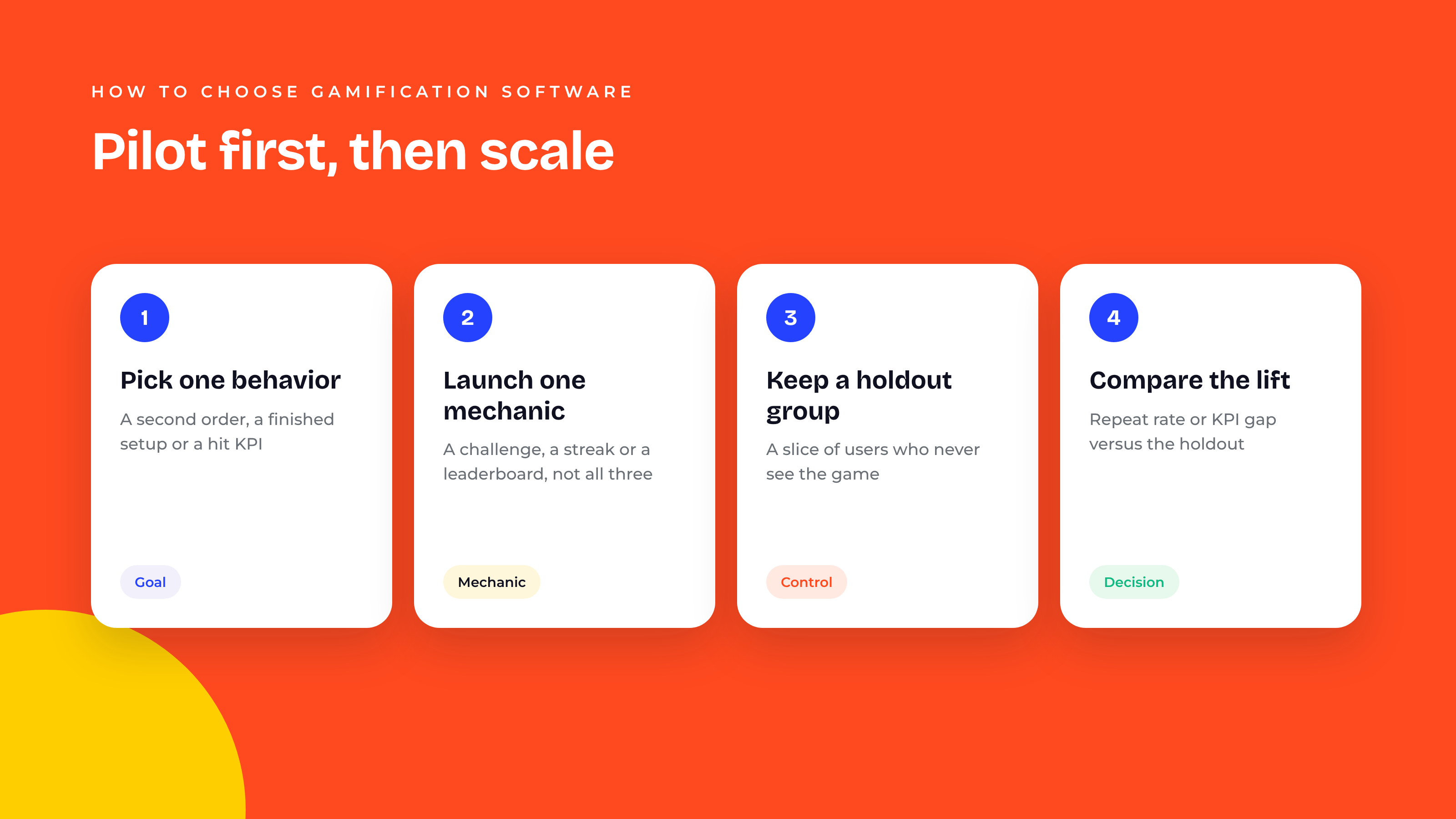
Use this checklist to score each vendor on your shortlist. For loyalty-led programs, our customer loyalty platform buyer's guide adds the questions to ask about points economics and tiers.
- ✓Covers the mechanics you need now and the next two you will want, such as daily streaks and multi-step challenges
- ✓Lets marketers launch, schedule and pause campaigns without engineering
- ✓Gives you control over game odds, reward budgets and caps so games do not erode margin
- ✓Connects natively to your commerce platform, CRM and messaging tools
- ✓Supports holdout groups and reports lift, not just participation
- ✓Handles Arabic, right to left layouts and local platforms such as Salla if you sell in the Gulf
- ✓Meets your security bar, for example SOC 2, ISO 27001 and local data rules such as Saudi PDPL
Personalization is the last test. Generic games feel like noise, while a challenge built around what a customer already does feels like a reason to come back.
71 percent of consumers expect companies to deliver personalized interactions, and 76 percent get frustrated when that does not happen.
Games of chance need the most care. Our playbook on scratch and win campaigns covers how to set odds and budgets so a game drives repeat purchase without killing your margin.
- Gamification software adds points, challenges, streaks, badges, leaderboards and games to a store, app or workplace to drive repeat behavior.
- The market splits into three jobs: commerce loyalty, employee performance and product engagement. Pick the category before the vendor.
- Commerce platforms such as Gameball, Talon.One, Antavo and Open Loyalty tie every game to a loyalty balance; employee tools such as Spinify, Hoopla and Centrical run on CRM data; product tools such as Trophy, StriveCloud and Userpilot live inside your app.
- Only four of the ten vendors publish an entry price, so ask for a total cost at your expected volume.
- Run a short pilot with a holdout group and judge the lift, not the demo.
How Gameball helps
Gameball brings gamification, loyalty, referrals and promotions into one platform, so every challenge, streak and game pays out into the same member wallet and tiers. Marketing automation triggers the right game at the right moment and analytics shows the lift against a holdout, so you can compare plans or book a demo to see it on your own data.
Related reads
- Streak Campaigns: Using Daily Streaks to Build Purchase Habits
- Scratch and Win Campaigns: How to Run Them Without Killing Your Margin
- Customer Rewards Platform: How to Evaluate One in 2026
Frequently asked questions
What is gamification software?
Gamification software is a platform that adds game mechanics such as points, challenges, streaks, badges, leaderboards and mini games to a store, app or workplace. It tracks what people do, checks those actions against rules you set and responds with progress or a reward, so customers, users or employees repeat the behaviors that matter to the business.
What is the best gamification software?
The best gamification software depends on the job. For commerce loyalty, look at Gameball, Talon.One, Antavo or Open Loyalty. For sales and frontline teams, look at Spinify, Hoopla or Centrical. For engagement inside a consumer or SaaS app, look at Trophy, StriveCloud or Userpilot. Choose the category first, then compare vendors inside it.
How much does gamification software cost?
Published entry prices in this comparison range from a free developer tier and $25 a month (Trophy) to $299 (Userpilot), $399 (Gameball Growth) and €999 a month (StriveCloud). Six of the ten vendors, including Talon.One, Antavo and Spinify, price by quote, data volume, active members or tracked users, so ask for a total cost at your volume.
What is the difference between a gamification platform and a loyalty program?
A loyalty program is the structure of points, rewards and tiers that keeps customers buying. A gamification platform adds the game layer on top, such as challenges, streaks and prize games, that makes earning those rewards engaging. Commerce platforms like Gameball combine both, so every game feeds the same points balance.
Can gamification software work for employees as well as customers?
Yes, but the tools are usually different. Employee gamification platforms such as Spinify, Hoopla and Centrical pull data from your CRM or contact center systems and reward hitting targets with recognition and bonuses. Customer gamification platforms reward orders, referrals and engagement with points, cashback and tier status.
How do you measure whether gamification is working?
Measure gamification against a holdout group that never sees the game. Compare the behavior you targeted, such as repeat purchase rate, time to second order, login frequency or KPI attainment, between the two groups over the same period. Participation and engagement counts alone can look strong even when the game does not change behavior.
.svg)
.svg)
.svg)

Ready to level up your game?
Create your first campaign and start seeing results in 30 days.
Ready to grow?
Get in touch with our sales team today.
The loyalty vendor checklist your CTO
will thank you for
Discover engineering challenges, essentials, and more from global brands.

Gameball Staff
Stay ahead on retention
Subscribe to our newsletter and get all the latest updates as we post.

Ready to level up your game?
Create your first campaign and start seeing results in 30 days.
Read related articles


Ready to level up your customer loyalty?
Level up your customer loyalty!


.avif)
.avif)
.avif)
.avif)