
%207.svg)

.svg)

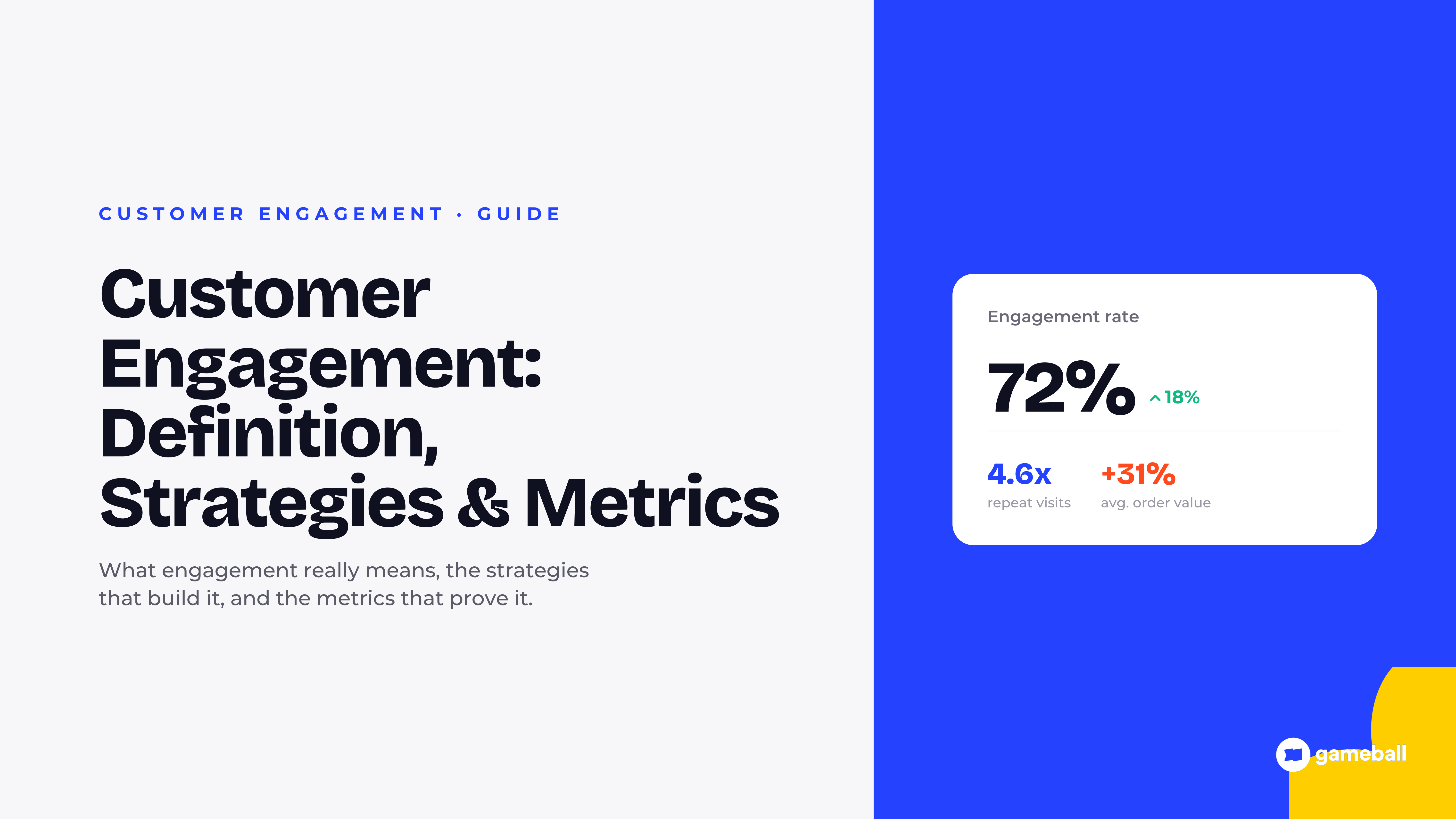
Customer engagement is the ongoing relationship between a brand and its customers, built through every interaction across every channel. Engaged customers buy more often, stay longer, and recommend you to others, which is why engagement has become one of the most important levers for sustainable growth. This guide explains what customer engagement is, the strategies that build it, and the metrics that prove it is working.
What is customer engagement?
Customer engagement is the depth of the relationship a customer has with your brand, measured by how often and how meaningfully they interact with you. It goes beyond a single purchase to include opening your emails, using your app, joining your loyalty program, leaving reviews, and recommending you to friends. Strong engagement means customers actively choose to spend time and attention with your brand, not just money.
Why customer engagement matters
Engagement is the bridge between a one-time buyer and a loyal customer. Engaged customers are far more valuable over their lifetime because they purchase more frequently, spend more per order, and are less likely to switch to a competitor. They also become advocates, bringing in new customers at little cost. As acquisition gets more expensive, the brands that win are the ones that turn attention into a lasting relationship rather than paying repeatedly to win the same customers back.
Customer engagement vs satisfaction vs loyalty
These three are related but distinct. Satisfaction measures how happy a customer is with a specific experience. Engagement measures how actively they interact with your brand over time. Loyalty is the outcome: a customer who keeps choosing you. A customer can be satisfied yet disengaged, or highly engaged and on their way to deep loyalty. Engagement is the day-to-day work that turns satisfaction into loyalty.
The main channels of customer engagement
- Email and lifecycle messaging: the workhorse channel for staying in touch. See our guide to ecommerce email flows.
- Mobile app and push: direct, high-visibility touchpoints for app-led brands.
- Loyalty and rewards: a loyalty program gives customers a reason to keep coming back and interacting.
- Social media and community: where customers discover, discuss, and advocate.
- On-site and in-app experiences: personalization, gamified elements, and helpful content.
8 customer engagement strategies that work
- Launch a loyalty program. Rewarding repeat behavior is one of the most reliable ways to drive ongoing engagement. Start with how to start a loyalty program.
- Add gamification. Challenges, streaks, and points turn routine interactions into something customers look forward to. Explore gamification.
- Personalize everything. Use customer segmentation to tailor messages and offers to each group.
- Go omnichannel. Make the experience consistent across web, app, email, and in-store.
- Automate lifecycle journeys. Welcome, post-purchase, and win-back flows keep customers engaged at the right moments with automated journeys.
- Reward behaviors, not just purchases. Points for reviews, referrals, and sign-ups deepen the relationship, as covered in our behavioral loyalty guide.
- Build community. Give customers a reason to belong through groups, events, and shared identity.
- Act on feedback. Ask for input and show customers you used it, which turns passive buyers into invested participants.
Customer engagement metrics to track
You cannot improve what you do not measure. These are the metrics that reveal whether your engagement work is paying off:
| Metric | What it tells you |
|---|---|
| Repeat purchase rate | How many customers come back to buy again |
| Active users (DAU/MAU) | How many customers use your app or site regularly |
| Email and push engagement | Open, click, and conversion rates on your messages |
| Loyalty participation rate | Share of customers active in your program |
| Net Promoter Score (NPS) | How likely customers are to recommend you |
| Customer lifetime value (CLV) | Total value an engaged customer delivers over time |
Watch these together rather than in isolation. Rising loyalty participation and repeat purchase rate, paired with growing customer lifetime value, is the clearest sign your engagement strategy is working.
Common customer engagement mistakes
- Confusing activity with value. More emails are not more engagement if they annoy people. Relevance beats volume.
- Rewarding only purchases. Engagement grows when you recognize reviews, referrals, and participation too.
- Treating every customer the same. Without segmentation, your messages fit no one well.
- Measuring vanity metrics. Followers and impressions matter less than repeat purchases and retention.
How to build a customer engagement strategy
A strong engagement strategy is a connected plan, not a pile of disconnected tactics. Build it in six steps:
- Set clear goals. Decide what engagement should achieve, such as higher repeat purchase rate or lower churn.
- Understand your customers. Use customer segmentation to learn what each group values.
- Choose your channels. Focus on the two or three channels where your customers actually spend time.
- Create a value exchange. Give customers a reason to engage, most reliably through a loyalty program that rewards their participation.
- Automate the moments that matter. Trigger the right message at the right time so engagement scales without manual effort.
- Measure and iterate. Track the metrics above, learn what works, and refine each month.
Treated as an ongoing system rather than a one-off campaign, this approach compounds: engaged customers generate better data, which powers more relevant experiences, which deepen engagement further.
Customer engagement across the funnel
Engagement is not only for existing customers. At the awareness stage, helpful content and social presence draw people in. During consideration, reviews, personalized recommendations, and responsive service build trust. At purchase, a smooth experience and a warm welcome set the tone. After purchase is where the biggest opportunity lives: loyalty rewards, gamified challenges, and lifecycle messaging turn a single sale into a lasting relationship. The brands that engage well at every stage, not just after the sale, build momentum that competitors find hard to match.
How loyalty and gamification power engagement
Of all the levers available, loyalty and gamification do the most to sustain engagement, because they give customers a reason to keep interacting between purchases. A loyalty program rewards the behaviors you want more of, buying, reviewing, referring, and turns them into a habit. Gamification adds momentum: streaks encourage repeat visits, challenges create clear goals, and progress bars pull customers toward the next reward. Together they turn engagement from something you chase into something customers choose to opt into.
Just as importantly, every rewarded interaction generates data about what each customer values, which sharpens your segmentation and makes every other channel more relevant. For example, a store that rewards customers for completing their profile, following on social, and leaving a review after purchase keeps them connected at several points in the journey, not only at checkout. Over months, those small, rewarded interactions add up to a relationship that a competitor's discount cannot easily break. This is why loyalty and gamification sit at the center of most successful engagement strategies rather than off to the side. If you only have the resources to start one initiative, a rewards program that recognizes participation as well as spending is usually the highest-return place to begin.
How Gameball helps
Gameball brings the tools that drive engagement into one platform: loyalty, gamification, referrals, and promotions, all connected to segments and analytics so you can engage the right customer with the right action. Book a demo to see it on your own data.
Related reads
- Customer Retention Programs: How Top Brands Keep Customers Loyal
- Cracking the Code of Customer Behavior: A Guide to Behavioral Loyalty
- Building Gamification for Gen-Z: How Gamified Experiences Captivate Gen-Z Consumers
Frequently asked questions
What is customer engagement?
Customer engagement is the ongoing relationship between a brand and its customers, measured by how often and how meaningfully they interact across channels such as email, app, social, and loyalty programs. Strong engagement leads to higher retention and lifetime value.
What are the best customer engagement strategies?
Effective strategies include launching a loyalty program, adding gamification, personalizing with segmentation, going omnichannel, automating lifecycle journeys, rewarding behaviors beyond purchases, building community, and acting on feedback.
How do you measure customer engagement?
Track repeat purchase rate, active users, email and push engagement, loyalty participation rate, Net Promoter Score, and customer lifetime value. Look at these together to see whether engagement is translating into revenue.
What is the difference between customer engagement and customer satisfaction?
Satisfaction measures how happy a customer is with a specific experience, while engagement measures how actively they interact with your brand over time. Engagement is the ongoing work that turns satisfaction into loyalty.
.svg)
.svg)
.svg)

Ready to level up your game?
Create your first campaign and start seeing results in 30 days.
Ready to grow?
Get in touch with our sales team today.
The loyalty vendor checklist your CTO
will thank you for
Discover engineering challenges, essentials, and more from global brands.

Gameball Staff
Stay ahead on retention
Subscribe to our newsletter and get all the latest updates as we post.

Ready to level up your game?
Create your first campaign and start seeing results in 30 days.
Read related articles

_compressed%2520(1)%2520(1).avif)
%2520(1)%2520(1)%2520(1)%2520(2)%2520(1).avif)
.avif)
Ready to level up your customer loyalty?
Level up your customer loyalty!


.avif)
.avif)
.avif)
.avif)