%207.svg)

.svg)

Most brands pour money into acquiring new customers while their existing ones quietly slip away. The math rarely works in their favor; acquiring a new customer costs five to seven times more than keeping one you already have.
Customer lifetime value (CLV) measures the total revenue a customer generates across their entire relationship with your brand. This article breaks down how to calculate CLV, which metrics influence it most, and the specific loyalty and retention tactics that move the needle.
What is customer lifetime value?
Customer lifetime value (CLV) is the total revenue a business can expect from a single customer across the entire relationship. You'll also see it called CLTV or LTV, same thing, different abbreviations.
CLV works as a north-star metric for retention-focused brands. It tells you what a customer is actually worth over time, not just on their first purchase. When you know this number, you can make smarter decisions about where to spend your marketing budget and which customers deserve the most attention.
Why customer lifetime value matters for retention and growth
Acquiring a new customer costs five to seven times more than keeping an existing one. That's why CLV matters so much; it shifts your focus from constantly chasing new buyers to getting more value from customers you already have.
Here's what CLV helps you do:
- Lower acquisition pressure: When existing customers spend more over time, you don't have to rely as heavily on expensive acquisition channels.
- Set smarter budgets: CLV tells you how much you can afford to spend acquiring a customer while staying profitable.
- Spot problems early: Tracking CLV by segment reveals which customer groups are thriving and which are declining.
- Prioritize retention: CLV connects directly to loyalty programs, referrals, and personalization efforts.
How to calculate customer lifetime value
The basic formula is straightforward:
CLV = Average Order Value x Purchase Frequency x Customer Lifespan
More sophisticated predictive models exist, but this formula gives you a solid starting point. Once you know these three numbers, you can figure out which lever to pull first.
Key metrics and factors that impact customer lifetime value
Five core metrics directly influence CLV. Each one represents a lever you can pull to increase lifetime value.
Average order value
Average order value (AOV) is the average revenue per transaction. Increasing AOV raises CLV without requiring customers to buy more often; they simply spend more each time.
Purchase frequency
Purchase frequency measures how many times a customer buys within a given period. Higher frequency compounds CLV over the customer lifespan, which is why brands focus so heavily on getting customers to come back.
Customer retention rate
Retention rate is the percentage of customers who continue buying over time. According to research from Bain & Company, even a 5% improvement in retention can increase profits by 25% to 95%.
Customer churn rate
Churn is the flip side of retention: the percentage of customers who stop buying. Left unchecked, churn erodes CLV faster than most teams realize.
Customer acquisition cost
CAC is what you spend to acquire a new customer. The LTV: CAC ratio, ideally 3:1 or higher, tells you whether your unit economics support sustainable growth.
How to improve customer lifetime value with loyalty and retention
The most effective ways to boost CLV focus on increasing average order value, purchase frequency, and customer lifespan. Loyalty and retention programs are the primary levers for all three.
1. Segment customers by behavior and value
RFM segmentation groups customers based on three factors: how recently they bought (Recency), how often they buy (Frequency), and how much they spend (Monetary). This approach helps you identify high-value customers who deserve VIP treatment and at-risk customers who need re-engagement.
You wouldn't send the same offer to a first-time buyer and a loyal customer who's purchased ten times. A strong segmentation strategy makes that kind of personalized treatment possible.
2. Launch a tier-based loyalty program
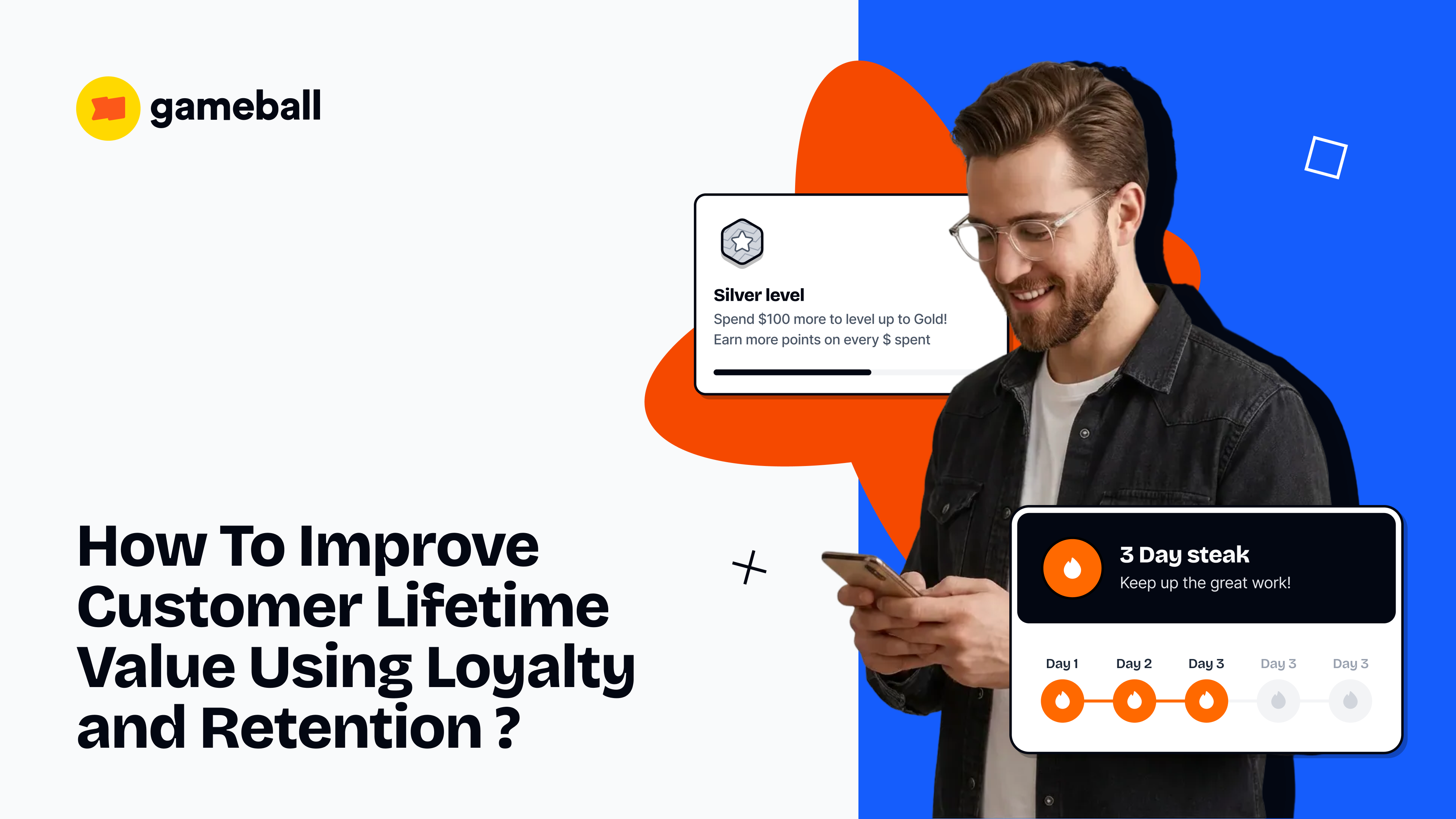
Tiered loyalty programs with escalating rewards motivate customers to spend more to unlock better benefits. Think Bronze, Silver, Gold, each tier offering progressively better perks.
Points, cashback, and VIP perks all work here. The key is giving customers a clear reason to keep climbing. You can learn more about how tiered loyalty programs work in practice.
3. Reward behaviors beyond purchases
This is what separates modern behavioral loyalty from transactional programs. Rewarding engagement actions, reviews, referrals, app logins, and social shares builds habit and emotional connection.
When customers earn points for leaving a review or referring a friend, they're investing in your brand beyond just buying products.
4. Personalize offers and promotions
Personalization based on purchase history and behavior increases relevance and conversion. Segment-based promotions and targeted discounts feel less like spam and more like genuine value.
According to McKinsey, 71% of consumers expect personalization, and 76% get frustrated when they don't find it.
5. Automate lifecycle and re-engagement campaigns
Automated flows keep customers engaged without manual effort. Welcome sequences, post-purchase follow-ups, win-back campaigns for dormant customers, and expiring-points reminders all fall into this category.
Proactive engagement beats reactive outreach. When you reach out before a customer churns, you have a much better chance of keeping them.
6. Add gamification to build habit loops
Gamification makes loyalty engaging through streaks, challenges, badges, and progress bars. These mechanics tap into the same psychology that makes games addictive; customers feel like they're making progress toward something, so they keep coming back.
7. Turn customers into referrers
Referred customers often have higher CLV than customers acquired through paid channels. Referral programs let you acquire high-quality customers while rewarding your existing ones.
How loyalty programs increase customer lifetime value
Loyalty programs aren't one-time campaigns. Their infrastructure drives repeat behavior and protects margins over time.
Points and cashback rewards
Earning points or cashback on purchases incentivizes repeat transactions. Configurable earn rates, by spend, category, or tier, let you control margins while still rewarding customers.
VIP tiers and status benefits
Tier progression creates aspirational goals. Status benefits like early access, exclusive discounts, or priority support increase emotional loyalty beyond just transactional rewards.
Family and household wallets
Aggregating loyalty across household members increases engagement by allowing families to pool points toward shared rewards. It's a simple way to make your program more valuable without increasing costs.
How gamification drives higher customer lifetime value
Gamification is the engagement layer on top of loyalty. Game mechanics create habit loops that increase how often customers interact with your brand.
Streaks and daily challenges
Consecutive-day incentives, daily login rewards, streak bonuses, and build habitual engagement. Customers who check in daily are far more likely to buy.
Missions and milestone rewards
Objective-based campaigns where customers complete a set number of actions to earn a reward give them clear goals. Milestones make the journey feel achievable and keep customers moving forward.
Badges and leaderboards
Achievement badges and competitive leaderboards add social proof and intrinsic motivation. They also reward non-purchase behaviors, which deepens engagement beyond transactions.
How referrals contribute to customer lifetime value
Referral programs turn satisfied customers into an acquisition channel. Referred customers tend to be higher-value because they come with built-in trust from the person who referred them.
Dual-sided rewards
Rewarding both the referrer and the referee increases participation. It creates a win-win dynamic that feels fair to everyone involved.
Milestone bonuses for top referrers
Bonus rewards for high-volume referrers, after 5 or 10 successful referrals, incentivize advocacy at scale. Your best customers become your best marketers.
Multi-step referral flows
Event-based referral logic, rewarding on signup and again on first purchase, ensures quality referrals that actually convert, not just signups that never buy.
How to reduce churn and protect customer lifetime value
Reducing churn is just as important as increasing spend. Churn prevention is a proactive, data-driven practice.
Identify at-risk customers early
Signals of churn risk include declining purchase frequency, decreased engagement, and support complaints. Early identification enables intervention before it's too late.
Use predictive segmentation
Behavioral data and RFM analysis can predict which customers are likely to churn. Segment-based targeting lets you reach them with the right message at the right time.
Trigger win-back automations
Automated win-back campaigns, personalized offers, "we miss you" emails, expiring-reward reminders, and re-engage dormant customers before they're gone for good.
How to track and measure customer lifetime value over time
CLV isn't a one-time calculation. It's a living metric that you track over time through cohort analysis and segment-level reporting.
Here's what to measure:
- CLV by customer segment: Compare high-value vs. at-risk cohorts to see where to focus.
- CLV by acquisition channel: Understand which channels bring customers with higher lifetime value.
- CLV before and after loyalty enrollment: Measure program impact directly.
- Redemption rates and program engagement: Tie loyalty activity to revenue outcomes.
Dashboard reporting and data unification across channels make this possible at scale.
Turning loyalty into a customer lifetime value engine with Gameball
Gameball unifies loyalty, gamification, referrals, and promotions in one platform. Instead of stitching together five different tools, you get one system that works across web, app, and POS.
The platform rewards behavior, not just transactions. Customers earn points for reviews, referrals, app logins, and social shares, not just purchases. And because everything connects to your customer data, you can see exactly how your loyalty efforts translate to CLV.
Book a demo to see how Gameball can help you turn loyalty into a growth engine.
FAQs about improving customer lifetime value
What is a good customer lifetime value?
A "good" CLV depends on your industry and business model. Generally, CLV works best when it's at least three times your customer acquisition cost (CAC) to support profitable growth.
What is the ideal LTV to CAC ratio?
A healthy LTV: CAC ratio is typically 3:1 or higher. This means the lifetime value of a customer is at least three times what it costs to acquire them.
How long does it take to see CLV improvements from a loyalty program?
Most brands begin seeing measurable CLV improvements within three to six months of launching a loyalty program. Results depend on program design and customer engagement levels.
How is customer lifetime value different from customer value?
Customer value typically refers to the worth a customer perceives in a product or service. Customer lifetime value is a financial metric measuring the total revenue a customer generates over the full relationship with the brand.
What are the 3 C's of value in customer relationships?
The 3 C's of value commonly refer to Customer, Company, and Competitor. It's a framework for evaluating how an offering creates value relative to customer needs and competitive alternatives.
.svg)
.svg)
.svg)

Ready to level up your game?
Create your first campaign and start seeing results in 30 days.
Ready to grow?
Get in touch with our sales team today.
The loyalty vendor checklist your CTO
will thank you for
Discover engineering challenges, essentials, and more from global brands.

Gameball Staff
Stay ahead on retention
Subscribe to our newsletter and get all the latest updates as we post.

Ready to level up your game?
Create your first campaign and start seeing results in 30 days.
Read related articles
.avif)

Ready to level up your customer loyalty?
Level up your customer loyalty!


.avif)
.avif)
.avif)
.avif)