
%207.svg)

.svg)

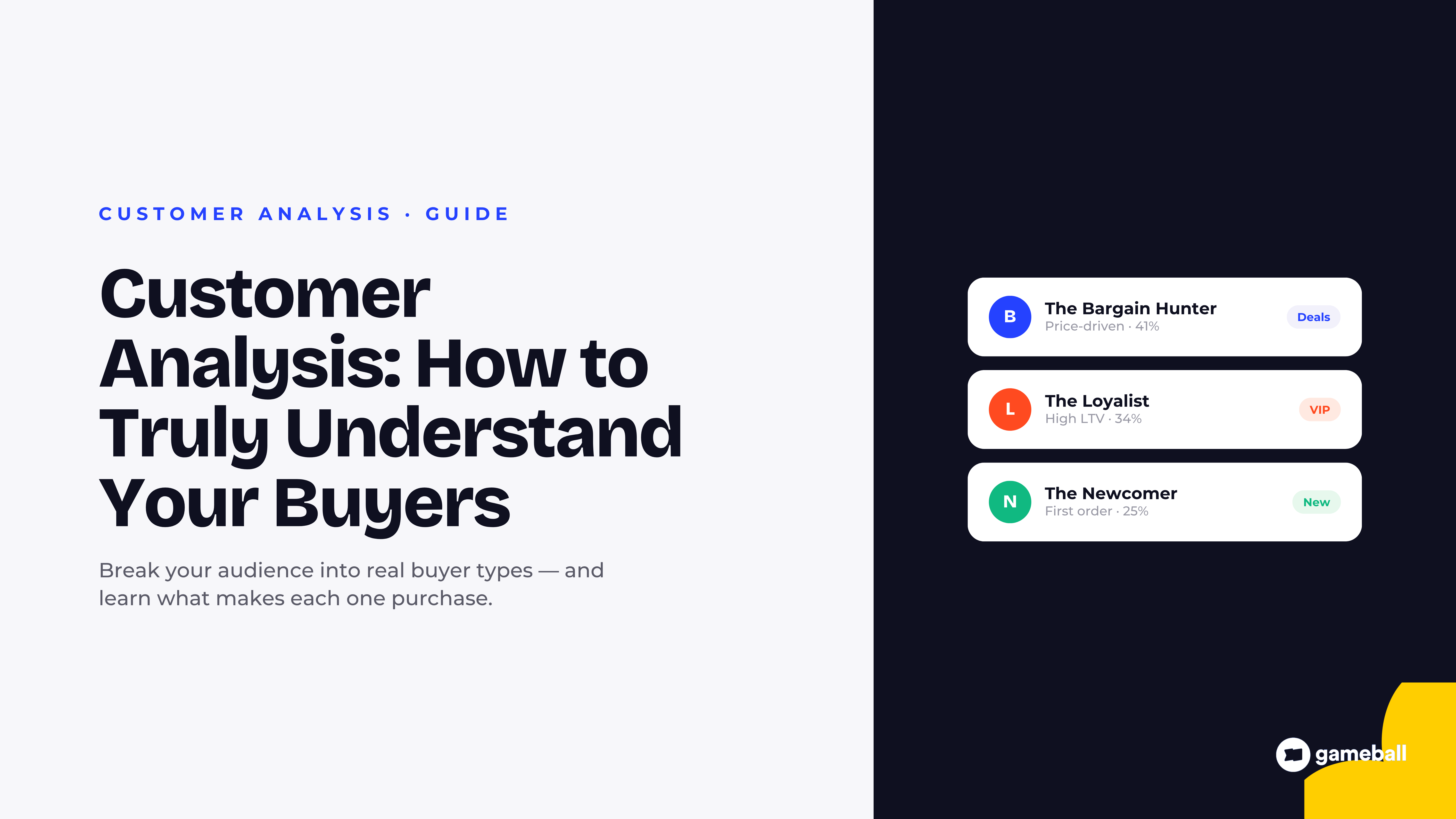
Customer analysis is the process of studying your customers to understand who they are, what they need, and how they behave, so you can serve them better. Done well, it sharpens your marketing, guides product decisions, improves retention, and reduces wasted spend by focusing effort where it counts. This guide covers the types of customer analysis, a simple step-by-step process, and the frameworks that make it practical, so you can start understanding your buyers this week.
What is customer analysis?
Customer analysis is the systematic study of your customer base to uncover patterns in who buys, why, how often, and how much. It combines quantitative data, like purchase history, with qualitative input, like reviews and surveys, to build a clear picture of your buyers. That picture then informs every decision, from which products to stock to which customers to prioritize.
Why customer analysis matters
Without analysis, you are guessing. With it, you know which customers drive the most value, which are at risk, and what motivates each group. That knowledge lets you spend marketing budget where it works, personalize experiences, and reduce churn. Brands that understand their customers deeply consistently outperform those that treat their audience as one undifferentiated mass. In practice, that means every marketing dollar works harder, fewer customers slip away unnoticed, and your best customers get the attention that keeps them loyal.
Types of customer analysis
- Behavioral analysis: how customers act, including browsing, buying, and engaging. Closely linked to behavioral loyalty.
- Value analysis: which customers contribute the most revenue over time, measured through customer lifetime value.
- Needs analysis: the core jobs customers hire your product to do.
- Segmentation analysis: grouping customers by shared traits, as covered in our customer segmentation guide.
How to do a customer analysis, step by step
1. Set your goal. Decide what you want to learn, such as who your best customers are or why customers churn.
2. Gather your data. Pull together transaction, engagement, profile, and feedback data in one place.
3. Segment your customers. Group them by value, behavior, or needs so patterns become visible.
4. Analyze the patterns. Look for what your best customers have in common, where drop-off happens, and which segments are growing.
5. Act on the findings. Adjust marketing, products, and rewards based on what you learn.
6. Review regularly. Customer behavior changes, so repeat the analysis to stay current.
Useful customer analysis frameworks
RFM analysis
RFM scores customers on recency, frequency, and monetary value, a fast way to find your best and most at-risk customers using data you already have. See our guide to RFM customer segmentation.
Cohort analysis
Cohort analysis groups customers by when they joined and tracks how each group behaves over time, which reveals whether retention is improving.
Customer personas
Personas turn data into memorable, representative profiles that keep teams focused on real customer needs when making decisions.
Turning analysis into action
- Personalize marketing so each segment gets relevant messages and offers.
- Reward your best customers with a loyalty program and VIP perks.
- Re-engage at-risk customers before they churn, using automated journeys.
- Guide product and inventory decisions with what the data shows customers want.
Common mistakes to avoid
- Analysis without a goal. Study your customers to answer a specific question, not for its own sake.
- Ignoring qualitative data. Numbers show what happens; reviews and surveys explain why.
- One-and-done analysis. Customers change, so make it an ongoing habit.
- Not acting on findings. Insight only matters if it changes what you do.
A customer analysis example
Imagine an online store that wants to grow repeat purchases. It runs an RFM analysis and finds that a small group of customers, around 15 percent, drives more than half of revenue. Digging deeper, it sees these customers buy across multiple categories and almost always redeem their rewards. Meanwhile, a large group of one-time buyers never returns after their first order. The analysis points to two clear actions: give the high-value group a VIP tier with early access to protect and grow their spend, and build a welcome journey with a first-reward milestone to earn a second purchase from one-time buyers. Within two quarters, repeat purchase rate rises because each group finally receives treatment built for its behavior, rather than the same generic newsletter.
Benefits of customer analysis
Done consistently, customer analysis improves almost every metric that matters:
- Higher revenue from marketing that speaks to what customers actually want.
- Better retention because you spot and re-engage at-risk customers early.
- Lower wasted spend as budget flows to the highest-value segments and channels.
- Smarter product decisions guided by real customer needs rather than guesswork.
- Clearer priorities because you can see which customers and segments drive growth.
How often should you run customer analysis?
Customer analysis is not a one-time project but an ongoing practice. Customer behavior shifts with seasons, trends, and your own changes, so an analysis that was accurate six months ago can quietly go stale. A practical rhythm is a light review every month to watch key segments and metrics, and a deeper analysis each quarter to reassess who your best customers are, where drop-off is happening, and which segments are growing or shrinking.
It also helps to run a focused analysis whenever you are about to make a significant decision, such as launching a product, entering a new market, or reworking your loyalty program. In those moments, a quick look at what your data says about customer needs and behavior can prevent an expensive mistake. The goal is to keep your understanding of customers current, so your marketing, product, and retention decisions are always grounded in what is true today rather than what was true a year ago. Brands that build this cadence into how they operate consistently make sharper decisions than those that analyze their customers once and assume nothing has changed.
How Gameball helps
Gameball's segments and analytics analyze customer behavior automatically and let you act on it with loyalty, gamification, and personalized journeys. Book a demo to understand your buyers better.
Related reads
- Customer Segmentation: Strategy, Process & Growth Tips
- What Is RFM Customer Segmentation in E-commerce?
- Cracking the Code of Customer Behavior: A Guide to Behavioral Loyalty
Frequently asked questions
What is customer analysis?
Customer analysis is the process of studying your customers to understand who they are, what they need, and how they behave. It combines quantitative data like purchases with qualitative input like reviews to guide better decisions.
How do you do a customer analysis?
Set a clear goal, gather transaction and feedback data, segment your customers, analyze the patterns, act on the findings, and review regularly. Frameworks like RFM and cohort analysis make the process practical.
What is the difference between customer analysis and customer segmentation?
Customer analysis is the broader study of your buyers, while segmentation is one part of it: grouping customers by shared traits. Segmentation is often a key output of a customer analysis.
What data do you need for customer analysis?
You need transaction data, engagement data, profile information, and customer feedback. Most brands already collect this through their store, app, loyalty program, and support channels.
What is the difference between customer analysis and market research?
Customer analysis studies your existing customers and their behavior, using data you already have. Market research looks more broadly at a market, including people who are not yet your customers, often through surveys and external studies. The two are complementary, but customer analysis is usually faster and cheaper because the data is already yours.
What frameworks are used in customer analysis?
Common frameworks include RFM analysis for scoring customers by recency, frequency, and monetary value, cohort analysis for tracking groups over time, and customer personas for turning data into representative profiles. Most brands combine two or three depending on the question they are answering.
What are the benefits of customer analysis?
Customer analysis drives higher revenue through better-targeted marketing, stronger retention by spotting at-risk customers early, lower wasted spend, smarter product decisions, and clearer priorities based on which customers drive growth.
Who should own customer analysis in a company?
Ownership usually sits with marketing, growth, or a dedicated analytics function, but the insights should be shared across product, service, and leadership. The most customer-centric companies make customer data easy for everyone to access, so decisions everywhere are grounded in real customer behavior rather than assumptions.
.svg)
.svg)
.svg)

Ready to level up your game?
Create your first campaign and start seeing results in 30 days.
Ready to grow?
Get in touch with our sales team today.
The loyalty vendor checklist your CTO
will thank you for
Discover engineering challenges, essentials, and more from global brands.


Gameball Staff
Stay ahead on retention
Subscribe to our newsletter and get all the latest updates as we post.

Ready to level up your game?
Create your first campaign and start seeing results in 30 days.
Read related articles



_compressed%2520(1)%2520(1).avif)
Ready to level up your customer loyalty?
Level up your customer loyalty!


.avif)
.avif)
.avif)
.avif)