A win back campaign is a sequence of messages and offers that brings lapsed customers, people who bought from you before but have stopped, back to their next purchase before they are gone for good. Done well, it is the cheapest revenue in your retention program, because these customers already know your brand, your products and your checkout.
This guide covers how to define a lapsed customer by the purchase cycle of your category rather than a flat 90 days, the four-message win-back sequence, how to ladder incentives so you stop handing discounts to people who would have come back anyway, and when to stop spending on a customer who is genuinely gone. It is written for ecommerce and retail teams that already run a loyalty or email program and want a customer reactivation flow that pays for itself.
What is a win back campaign?
A win back campaign, also called a lapsed customer campaign or customer reactivation flow, targets customers who have stopped buying and works to earn their next order. It usually runs as three to five automated messages across email, SMS, app push and your loyalty widget, triggered when a customer passes the point at which they would normally have bought again.
It is easy to confuse with two neighbouring flows, and the difference matters because each one starts from a different signal and is judged by a different number. To see where win-back sits in the bigger retention picture, read our companion guide on customer churn rate, which covers how to calculate churn and twelve ways to reduce it.
Triggered when a customer passes their expected reorder point. Success is the next order.
Triggered by no opens or clicks. Success is attention and a healthy email list.
Triggered by a cancellation or downgrade request on a subscription. Success is a kept plan.
Bloomreach draws the same line in its guide to win-back emails: re-engagement is for people who stopped opening, win-back is for people who stopped buying, and the two should be tracked separately so one does not hide the other.
Why win-back campaigns matter
Win-back campaigns matter because a lapsed customer is cheaper to bring back than a new one is to find, and returning customers carry a disproportionate share of revenue. Harvard Business Review notes that acquiring a new customer is anywhere from five to 25 times more expensive than retaining an existing one, depending on the study and the industry.
The last number is why win-back belongs in automation rather than a quarterly blast. In Omnisend's analysis of close to 24 billion emails sent in 2024, one in three people who clicked an automated message bought, against one in 18 for scheduled campaigns. A lapse-triggered winback email is exactly that kind of message: it reaches one customer at the moment they become overdue. The Gorgias repeat customer data explains the stakes, and it is also why a falling repeat purchase rate is usually the first sign a win-back flow is missing.
How do you define a lapsed customer?
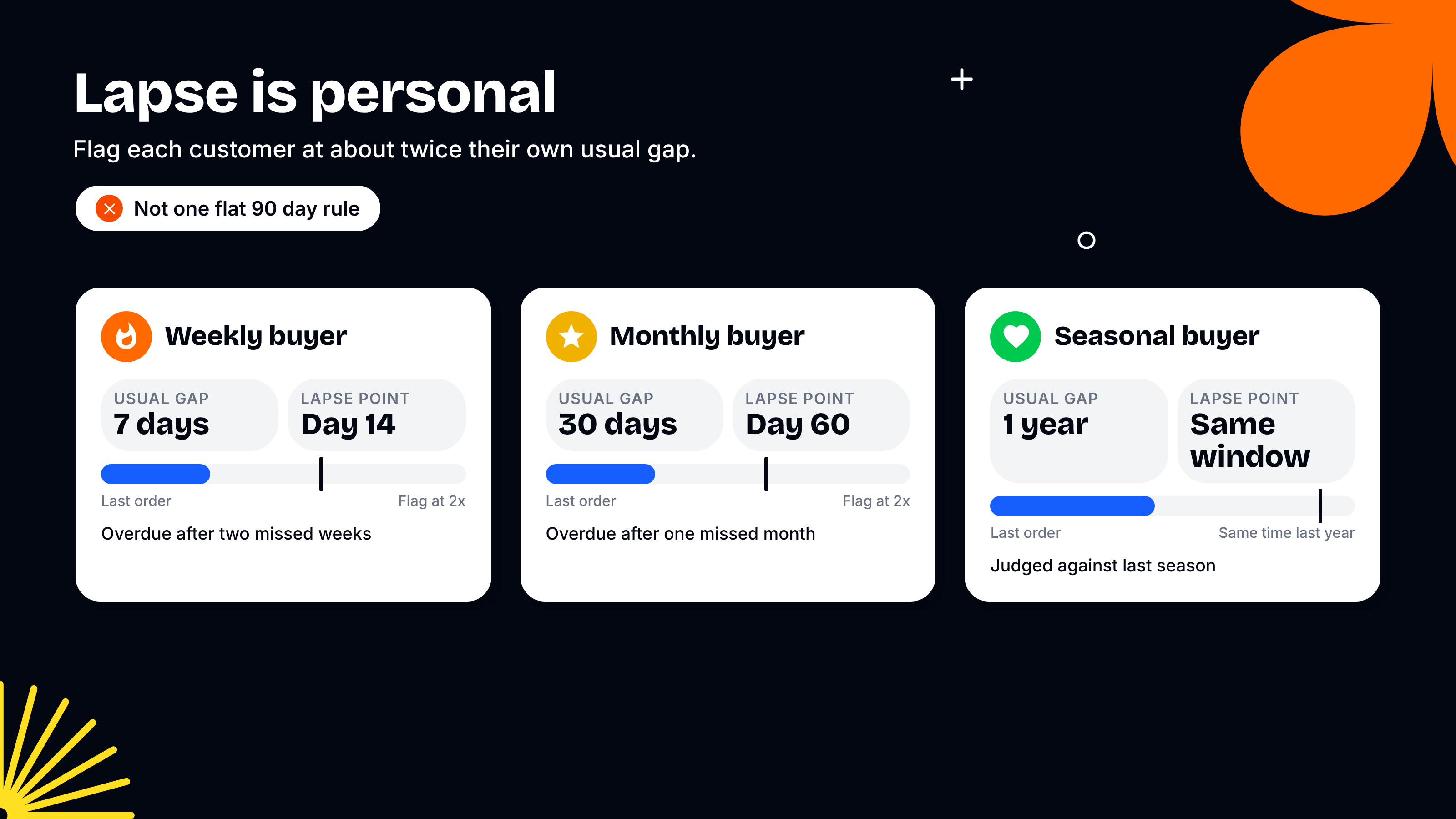
Define a lapsed customer as someone who has gone noticeably longer than their normal gap between orders, not someone who has crossed an arbitrary date. A flat 90-day rule treats a coffee subscriber and a sofa buyer the same way: it is far too late for the first and far too early for the second.
The practical method is to measure the median number of days between orders for each category or segment, then flag customers at roughly twice that gap, as Bloomreach suggests. Judge seasonal buyers against their own previous year, and for one-time buyers use the median time to second purchase in their category.
| Purchase pattern | How to set the lapse point | Illustrative example |
|---|---|---|
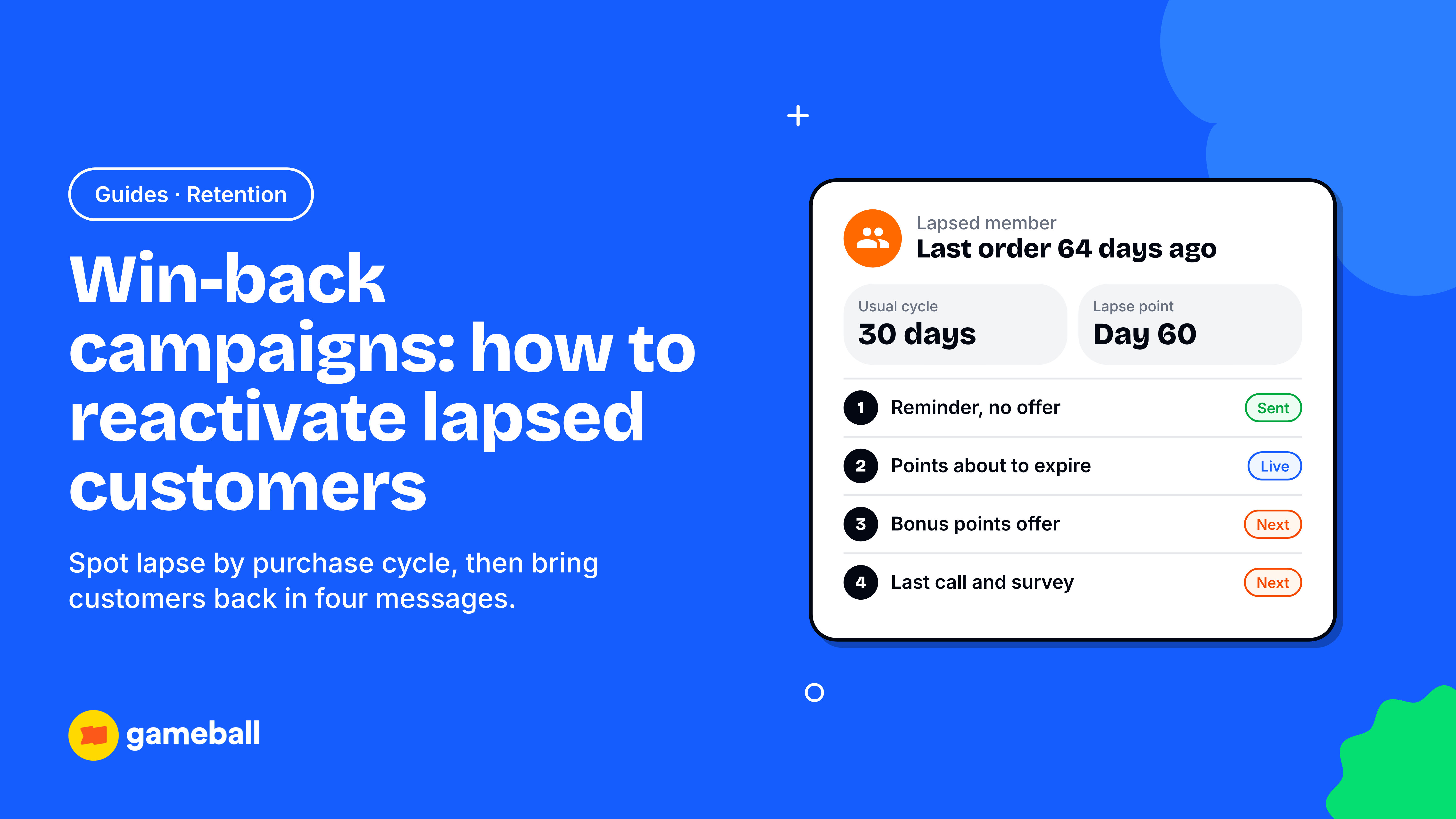
| Frequent replenishment (coffee, pet food, supplements) | About twice the customer's own median gap | Orders every 30 days, flag at about day 60 |
| Regular top-ups (beauty, grocery) | About twice the segment median gap | Median gap of 45 days, flag at about day 90 |
| Considered purchases (fashion, home) | Twice the category median gap, checked against the season | Median gap of 120 days, flag at about day 240 |
| Seasonal (gifting, back to school) | Compare with the same window last year | Bought last November, flag if no order by mid December |
| One-time buyers | Category median time to second purchase | Most second orders land by day 50, flag at day 50 |
| Long replacement cycle (electronics, furniture) | Expected replacement cycle, with service content in between | Shopify advises not waiting more than 12 months before getting in touch |
A single cut-off is a population average. It fires on your best weekly buyers weeks after they have already switched, and it nags seasonal buyers who are not late at all. Set the lapse point per segment from your own order data, then revisit it every quarter.
If you already score customers on recency, frequency and monetary value, the lapse point slots straight in: recency measured in purchase cycles rather than days. Our guide to RFM customer segmentation in ecommerce walks through the scoring.
The four-message win-back sequence
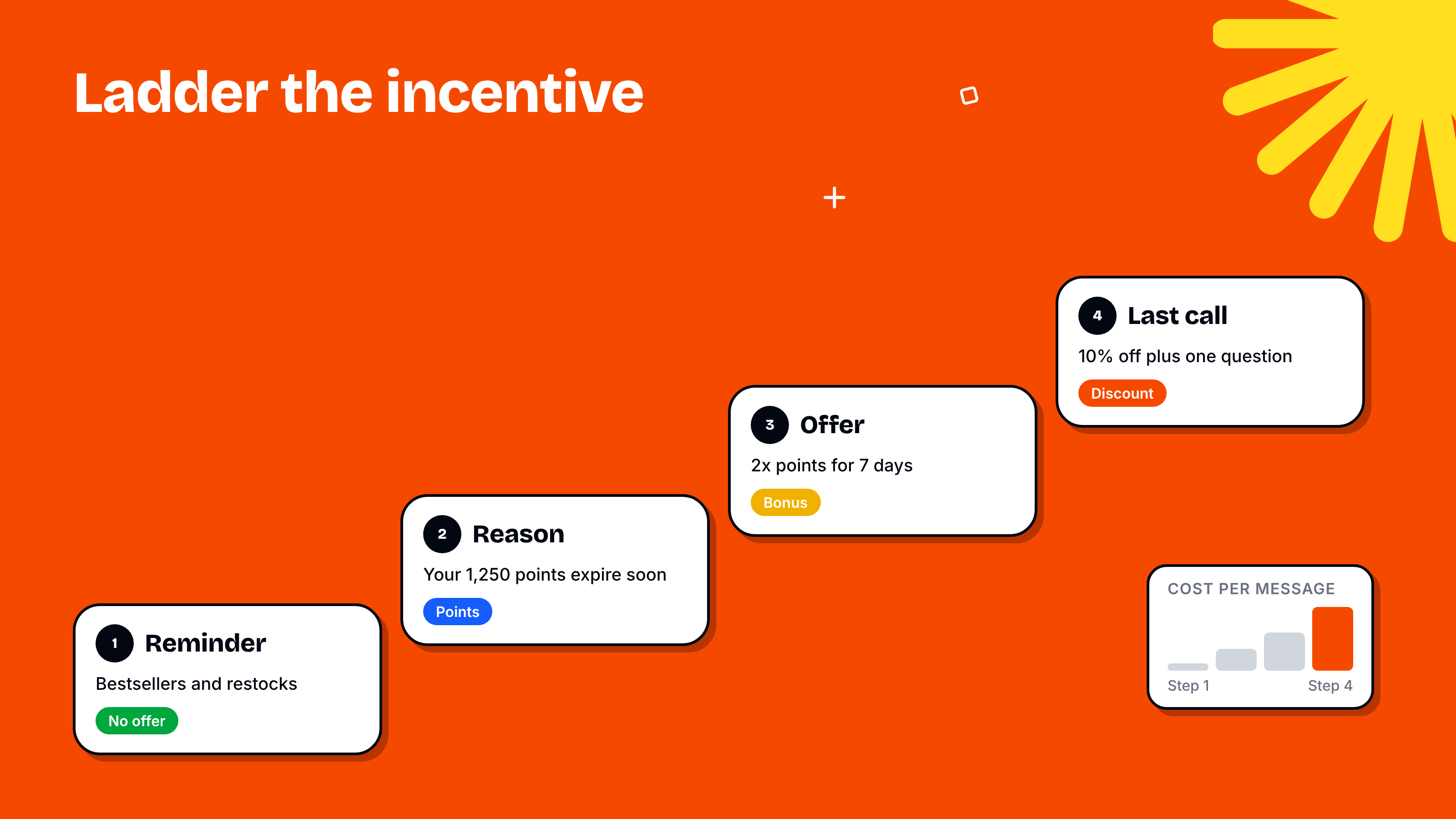
A win-back sequence that works is four messages over three to four weeks, each with a different job: remind, give a reason, make an offer and close the loop. Shopify's guide to running winback campaigns describes the same arc of re-engagement, incentive, feedback and a final goodbye, and recommends leading with bestsellers or restocks while holding incentives for later in the series.
No discount. Show what is new, restocked or best-selling in the category they bought, plus their loyalty points balance. A subject line such as "Your usual is back in stock" beats "We miss you".
Give personal value: points about to expire, a tier they are close to losing, or a product that pairs with their last order. Switch to SMS or push if the first email went unopened.
The first real incentive, sized to the customer's value. Try bonus points or free shipping before a percentage discount.
Your strongest offer, a one-question survey asking why they stopped buying, and a clear note that you will email less from now on.
Keep every winback email short and specific to the customer. McKinsey found that 71% of consumers expect personalized interactions and 76% get frustrated when they do not get them, and a lapsed customer is the least forgiving audience you have. Stop the sequence the moment the customer buys, and send a thank-you instead of the next message.
Channel matters too. Use your loyalty widget and app push for customers who still visit but no longer buy, and email or SMS for those who have gone quiet everywhere. For retail and ecommerce brands with stores and an app, a marketing automation workflow triggered by each customer's lapse point, not by a calendar, keeps the timing personal across every channel.
How to ladder win-back incentives
Incentive laddering means starting with no offer and only raising the value of the incentive for customers who ignored the cheaper step. It protects margin, because some lapsed customers come back with a reminder alone, and a 20% code sent to them on day one is money given away.
- The discount reaches everyone, including people who were about to reorder anyway
- Customers learn to wait for the lapse email before buying
- Margin is lowest exactly where reactivation volume is highest
- There is no way to tell which part of the offer worked
- Day one costs nothing: a reminder, bestsellers and the points balance
- Loyalty currency comes before cash discounts
- The biggest offer only reaches customers who ignored three cheaper steps
- Each rung can be tested against a holdout group
Loyalty currency is the natural middle rung. Bonus points, a points multiplier for a week or a reminder that points are about to expire usually cost less than a discount of the same perceived value, and they pull the customer back into your loyalty program instead of training them on coupons. For why some rewards feel bigger than they cost, see the science of effective incentives. Size the final rung to customer value: a high-value lapsed customer can justify a stronger promotion than a one-time bargain hunter, a point our guide on raising lifetime value without more discounts develops further.
Which lapsed customers should you win back first?
Win back high-value customers who lapsed recently first, because they are the most likely to return and the most valuable when they do. Plot lapsed customers on two axes, historical value and how many purchase cycles overdue they are, and give each quadrant its own treatment.
Run the full sequence early, lead with tier status and points, and allow the strongest final offer.
One personal outreach with a meaningful offer and a survey. If nothing comes back, sunset.
Reminder and points steps only. No cash discount unless the margin allows it.
Stop spending. Move them to a low-frequency list or suppress them.
Value here should be lifetime value, not last order size. If you have not modelled it yet, our guide on how to calculate customer lifetime value covers the formula, and analytics that segment customers by RFM turn the quadrant into a saved audience rather than a spreadsheet.
When should you stop trying to win a customer back?
Stop when a customer has received the full sequence without opening, clicking or buying, or when they are several purchase cycles past their lapse point. Continuing to mail them hurts deliverability, inflates list costs and drags down the numbers you use to judge the campaign. Shopify recommends sunsetting contacts who have not opened or clicked in 90 to 180 days, or after three to four win-back attempts.
- No opens, clicks or site visits across all four messages
- Three or more purchase cycles past their lapse point
- Bounced, unsubscribed or marked your email as spam
- Survey answer says they moved, switched category or no longer need the product
- Their last order ended in an unresolved complaint, which needs service recovery rather than another offer
Sunsetting is not deleting. Move gone customers to a suppression or low-frequency list, keep their points and purchase history, and let a future purchase or visit put them back into the active flows. A customer who returns on their own a year later should find their tier and balance waiting. Better still, prevent the drift: the small micro-loyalty moments between purchases cost far less than any win-back offer.
How to measure a win-back campaign
Measure a win-back campaign by reactivation rate and incremental revenue against a holdout group, not by opens. Opens tell you the subject line worked; only a control group of lapsed customers who receive nothing tells you how many orders would have happened anyway.
| Metric | What it tells you | How to calculate it |
|---|---|---|
| Reactivation rate | Share of lapsed customers who ordered again | Customers who ordered within the window divided by customers who entered the flow |
| Incremental reactivation | Lift caused by the campaign itself | Reactivation rate of the flow minus the holdout group's rate |
| Revenue per lapsed customer | Value of the flow, counting people who did not buy | Attributed revenue divided by everyone who entered the flow |
| Incentive cost per reactivation | What each returning customer cost you | Discount and points cost divided by reactivated customers |
| Second-order retention | Whether reactivated customers stay | Share who order again within one more purchase cycle |
| Unsubscribe and complaint rate | Whether you are burning the list | Unsubscribes and spam complaints divided by delivered messages |
Second-order retention is the number most teams skip. A win-back that brings customers back for one discounted order and then loses them again has moved revenue forward, not created it. Bain's original work on the economics of retention found that in financial services a 5% increase in retention produced more than a 25% increase in profit, and that gain comes from customers who stay, not from one-off returns. Track reactivated customers as their own cohort and compare their loyalty redemption rate and repeat behaviour with customers who never lapsed.
- A win back campaign targets customers who stopped buying, not people who stopped opening, and it is measured by the next order.
- Define lapse per segment at about twice the usual gap between orders, and judge seasonal buyers against their own previous year.
- Run four messages over three to four weeks: reminder, reason, offer and last call with a survey.
- Ladder incentives from no offer to points to a discount, so the biggest offer only reaches customers who ignored the cheaper steps.
- Prioritise high-value customers who lapsed recently, sunset the long gone, and measure everything against a holdout group.
How Gameball helps
Gameball gives you the pieces of a win-back program in one place: a points and tiers program whose balances give lapsed customers a reason to return, automated workflows that fire on inactivity, RFM segmentation and analytics to decide who to win back first, and promotions and gamified rewards for the offer rung. To see how a lapse-triggered flow would work for your store, book a demo or compare plans.
Related reads
- Customer Churn Rate: How to Calculate It and 12 Ways to Reduce It
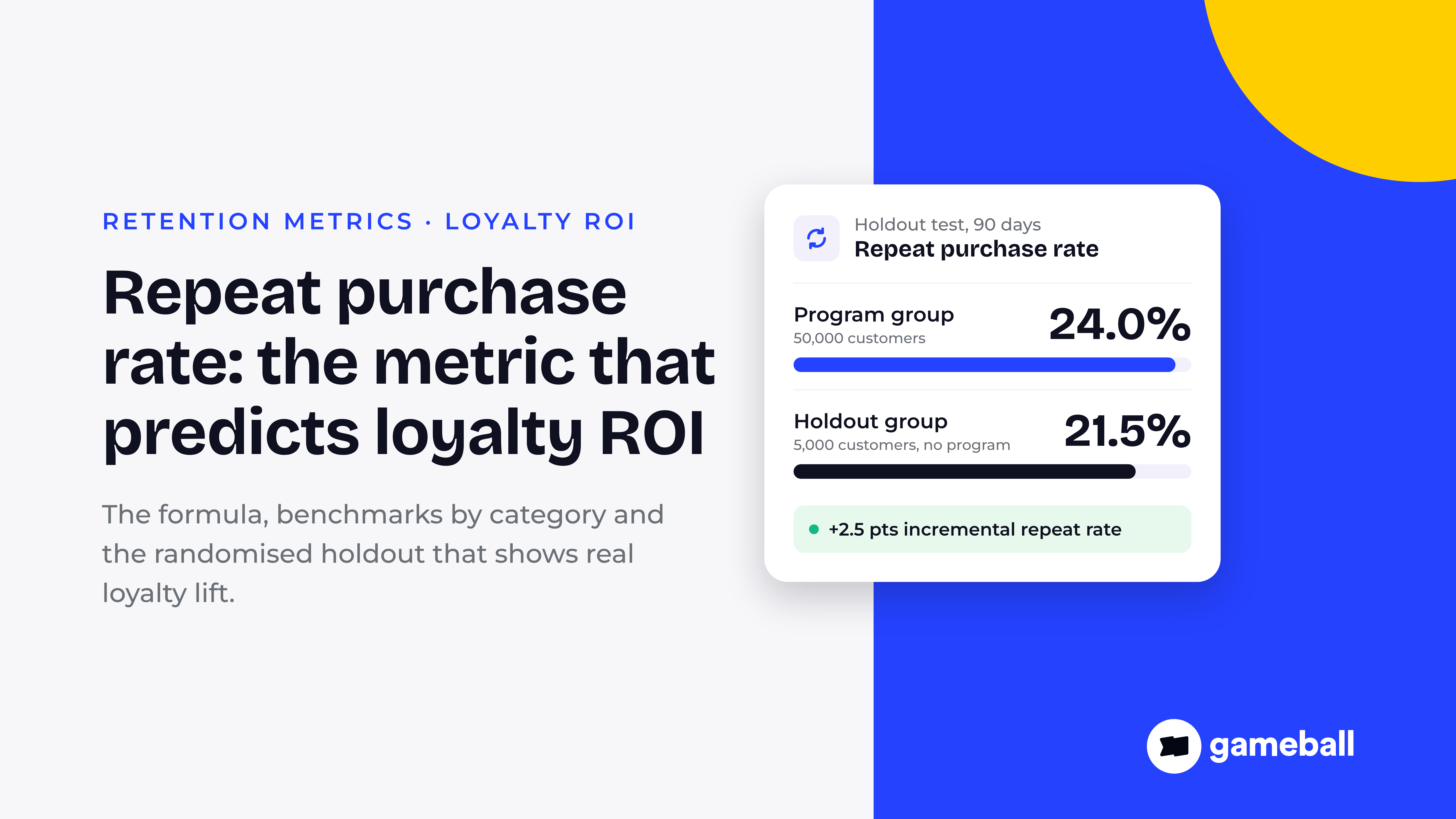
- Repeat Purchase Rate: The Metric That Predicts Loyalty ROI
- Retention Marketing: How to Build a Retention-First Growth Engine
Frequently asked questions
What is a win back campaign?
A win back campaign is an automated series of messages and offers aimed at customers who bought before but have stopped. It is triggered when a customer passes their normal reorder point and usually runs three to five messages across email, SMS, push and the loyalty widget, with the goal of earning the next purchase.
When is a customer considered lapsed?
A customer is lapsed when they have gone noticeably longer than their usual gap between orders. A practical rule is to flag them at about twice the median gap for their segment, judge seasonal buyers against the same window last year, and use the category median time to second purchase for one-time buyers.
How many emails should a win-back sequence have?
Most win-back sequences work best with four messages over three to four weeks: a reminder with no offer, a reason such as expiring points, a first incentive, and a last call with a survey. Stop the sequence as soon as the customer buys, and sunset anyone who ignores all four.
Should a win-back campaign include a discount?
Not at the start. Lead with a reminder, bestsellers and the customer's points balance, then move to bonus points, and only offer a cash discount in the final message. Laddering this way protects margin because the biggest incentive only reaches customers who ignored every cheaper step.
What is a good win-back reactivation rate?
There is no reliable universal benchmark, because rates depend on category, purchase cycle and how lapse is defined. Most published figures come from vendors' own customers. The number that matters is incremental reactivation: your flow's reactivation rate minus that of a holdout group that received no messages.
What is the difference between win-back and re-engagement?
Win-back targets customers who stopped buying and is measured by the next order. Re-engagement targets subscribers who stopped opening or clicking and is measured by attention and list health. A customer can still open every email and be lapsed, so track the two flows separately.


Ready to level up your game?
Create your first campaign and start seeing results in 30 days.
Ready to grow?
Get in touch with our sales team today.
The loyalty vendor checklist your CTO
will thank you for
Discover engineering challenges, essentials, and more from global brands.

Gameball Staff
Stay ahead on retention
Subscribe to our newsletter and get all the latest updates as we post.

Ready to level up your game?
Create your first campaign and start seeing results in 30 days.
Read related articles


Ready to level up your customer loyalty?
Level up your customer loyalty!