
%207.svg)

.svg)

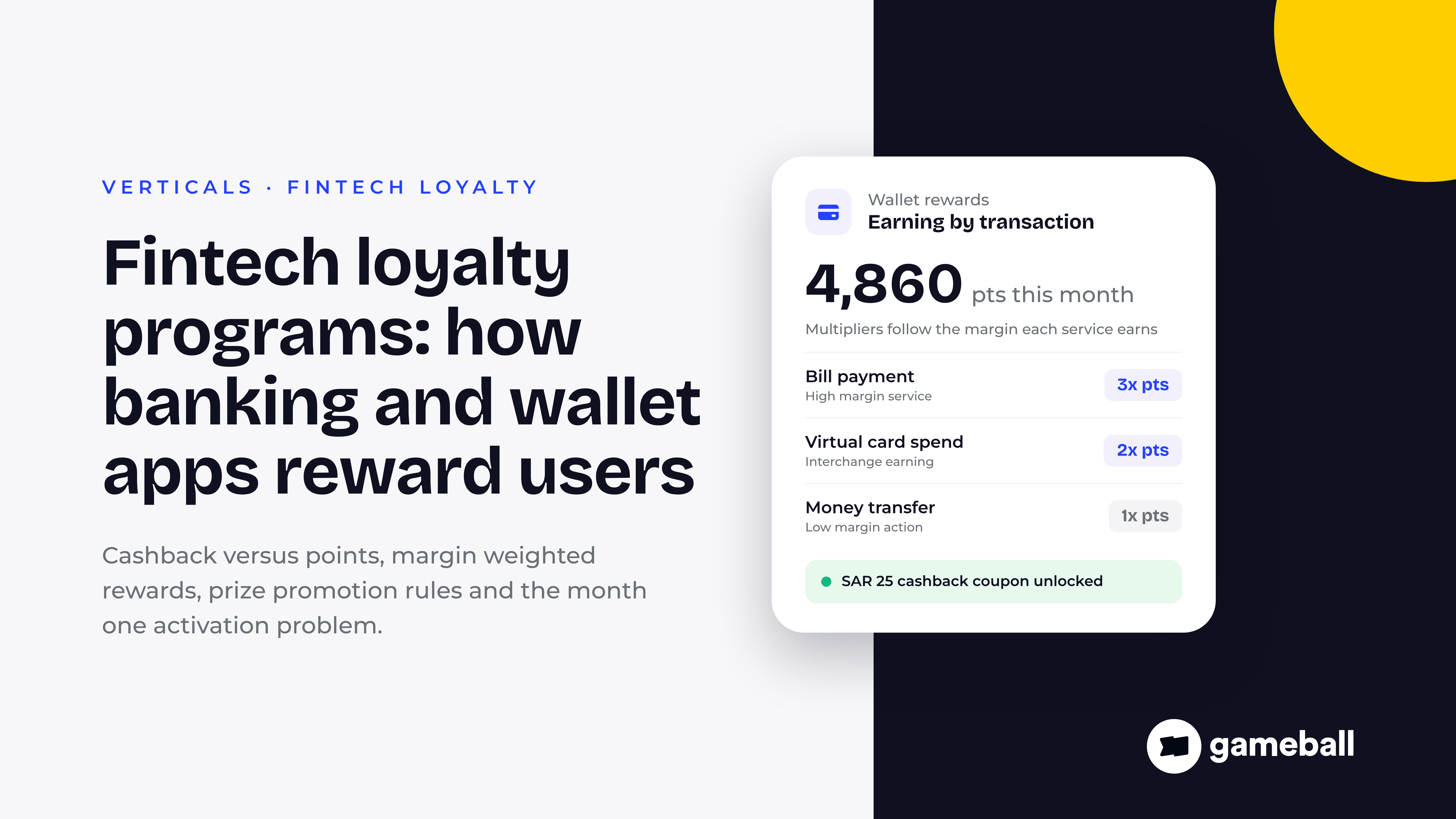
A fintech loyalty program is a rewards system built into a banking, payments or wallet app that pays users in cashback, points or perks for the financial behaviours the business wants more of, such as funding the wallet, paying bills or using a card. It looks like a retail loyalty program on the surface. Underneath, the economics and the rules are different, because the product being rewarded is money itself.
This guide covers what changes when you reward financial behaviour: when to pay in cashback and when to pay in points, how to tie rewards to the transactions that actually make you money, the regulatory limits on prize promotions in the US, Saudi Arabia and the UAE, and how to solve the activation problem most fintechs face in the first month. It uses AxisPay, a regional digital wallet, as the worked case throughout.
What is a fintech loyalty program?
A fintech loyalty program is a rewards layer inside a financial app that turns transactions into earned value. Instead of rewarding a basket of products, it rewards actions such as a first deposit, a bill payment, a card top up or a referral, and pays users back in a currency they understand: cash, points, fee waivers or partner perks.
Most banking loyalty programs started as card rewards. Wallet and neobank programs go further, because they can see every transaction in real time and reward it instantly. To see how financial services compare with the other sectors where loyalty works best, read our companion guide to the best industries for loyalty programs, which maps retail, F&B, travel and fintech side by side.
Why fintech loyalty is different from retail loyalty
Fintech loyalty is different because the margin sits in specific transaction types, not in the average order. A retailer can earn the same few points of margin on almost every product. A wallet may earn nothing on a peer to peer transfer, a fee on a bill payment and interchange on a card swipe. A reward that treats every transaction the same pays users to do the things that cost you money.
The second difference is trust. Users judge a financial brand by whether it keeps its promises with their money, so a reward that is devalued or quietly withdrawn does more damage than a missed coupon in retail. The upside is just as large: Bain research found that increasing retention by as little as 5% can boost profits by as much as 95%, and in a category where users rarely hold more than a few financial apps, staying the default app is the whole game.
| Dimension | Retail loyalty | Fintech loyalty |
|---|---|---|
| What is rewarded | Purchases of products | Financial actions: deposits, bill payments, card spend, transfers, referrals |
| Where margin sits | Spread fairly evenly across the basket | Concentrated in a few transaction types, with some running at zero or negative margin |
| Preferred reward currency | Points, discounts, free products | Cashback, fee waivers, points, partner perks |
| Speed users expect | Rewards after the order ships | Rewards at the moment the transaction settles |
| Main regulatory exposure | Consumer protection and promotion rules | Consumer protection, prize promotion rules and financial regulator scrutiny |
| Biggest early risk | Low repeat purchase | Users who sign up and never fund the account |
Cashback vs points: which reward currency fits a fintech app?
Cashback fits when you need a simple, immediate incentive that users trust, and points fit when you want to steer behaviour and control cost over time. Most mature fintech rewards programs use both: cashback for the moment of truth, points for the long game.
Cashback is easy to understand and feels like real money, which makes it strong for activation and for converting a first transaction. The trade off is cost: every unit of cashback is a direct expense, nearly all of it gets used, and it trains users to compare your rate against competitors. Points cost less per unit of perceived value, because not every point is redeemed and you control what points buy. They also let you weight rewards by transaction type, which is the key lever in fintech. The cost is complexity: users need to understand the value of a point, and you need a ledger that can carry the liability. Our guide to how a points engine handles accrual, expiry and liability goes deeper on that side.
| Factor | Cashback | Points |
|---|---|---|
| Clarity for users | Very high: the value is obvious | Medium: users need to learn what a point is worth |
| Cost control | Low: close to every unit is redeemed | Higher: redemption thresholds, expiry and reward choice shape cost |
| Behaviour steering | Possible with different rates, but rate wars follow | Strong: multipliers can favour high margin transactions |
| Best moment to use | First deposit, first card spend, win back | Ongoing engagement, tiers, challenges and streaks |
| Accounting | A direct expense when paid | A deferred liability until redeemed or expired |
A practical pattern is to pay cashback as a coupon or wallet credit that can be used on the services you want to grow. That keeps the clarity of cash while pointing the value back into your own product. For more structures, see our list of cashback reward campaign ideas.
Transaction triggered rewards: tie earning to margin
Transaction triggered rewards are rules that issue a reward automatically when a specific financial event settles, such as a bill payment, a card purchase or a recurring transfer. The design principle is simple: weight the reward by the margin each transaction type earns, so the program pays users more for the actions that pay you more.
Gamified mechanics work well on top of these rules. A streak campaign can reward a user for paying bills through the app three months in a row, and challenges can push users to try a second and third service. The gamification engine handles the mechanics, while the earning rules keep the cost aligned with margin.
Regulatory constraints on prize promotions
The main regulatory constraint is that any reward decided by chance, such as a spin to win, a scratch card or a prize draw, is usually treated as a prize promotion, and those are licensed or restricted in many markets. Rewards that every eligible user earns by a fixed rule, such as cashback or points, are generally treated differently, but they still fall under consumer protection law.
| Market | What applies | What it means for a fintech |
|---|---|---|
| United States | In December 2024 the CFPB warned that deflating the value of accrued rewards, or revoking them based on buried or vague conditions, may be an unfair or deceptive practice | Publish clear earning and redemption terms, avoid retroactive devaluation, and make sure rewards can actually be redeemed |
| Saudi Arabia | The Ministry of Commerce requires an electronic license from the Chamber of Commerce before a competition, prohibits requiring a purchase to enter a prize draw, and caps the period from announcement to prize delivery at 60 days | A spin or draw that only paying users can enter needs careful structuring; violations can bring fines of up to SAR 1 million |
| UAE | Dubai and Abu Dhabi have long required a permit from the economic department before running a sales promotion, with an official present at prize draws | Plan permit lead time into the campaign calendar and confirm current rules with the relevant emirate |
Two design choices reduce exposure across all three markets. First, offer a free route to enter any chance based game, or give every participant a guaranteed minimum reward. Second, write terms that never let you change the value of rewards a user has already earned. Our guide to running scratch and win campaigns covers prize pool math and disclosure in more detail. This section is general information, not legal advice, so review any prize promotion with counsel in each market before launch.
The month one activation problem
The month one activation problem is the gap between users who download and register a fintech app and users who actually fund it and transact. A sign up without a funded account produces no revenue, and a user who does nothing in the first weeks rarely comes back. The loyalty program should be designed to close that gap, not just to reward users who are already active.
Timing matters as much as the reward itself, so connect each step to automated journeys that trigger on the user's actual behaviour rather than on a fixed calendar. Our guide on getting customers to sign up for rewards covers enrolment tactics, and referral rewards paid only after the invited user funds their account keep acquisition costs honest. For the wider view of why early drop off matters, see our breakdown of customer churn rate.
Worked case: how AxisPay rewards wallet users
AxisPay is a regional fintech and digital wallet provider in the EMEA region, offering money transfers, bill payments and pay to merchant services. Its challenge was a familiar one: users were active, but mostly on basic money transfers, while the profitable services were bill payments and virtual cards. Its in house points and referral system also lacked the scalability and customisation needed to change that.
According to the AxisPay case study, the team rebuilt the program around four moves that map directly onto the principles above.
The lesson for other fintechs is that the reward currency mattered less than where the rewards pointed. Weighting earning by margin turned the program from a cost centre into a way to shift usage toward the services that fund it.
How to build a fintech rewards program: a launch checklist
A fintech rewards program launches well when finance, compliance and product agree on the rules before marketing announces anything. Use this checklist to get there.
For more inspiration on mechanics that suit financial apps, read our deep dive on fintech gamification, and our post on retention insights for fintechs and grocery apps. Track results with loyalty analytics that separate activated users from registered ones.
How Gameball helps
Gameball powers loyalty for fintech and wallet apps with a points and cashback engine that can weight earning by transaction type, cashback coupons and promotions and gamified challenges, streaks and spin campaigns, handling more than 15 million API calls a day at under 300ms latency, and it is SOC 2, ISO 27001, GDPR and Saudi PDPL compliant. Book a demo to see how it would work on your own transaction data, or compare plans and pricing.
Related reads
- The Winning Combo: Fintech Gamification - Level Up Your Financial Experience
- 17 Best Industries for Loyalty Programs in 2026 [With Examples]
- Cashback Reward Campaign Ideas to Boost Customer Loyalty & Sales
Frequently asked questions
What is a fintech loyalty program?
A fintech loyalty program is a rewards system inside a banking, payments or wallet app that pays users cashback, points or perks for financial actions such as deposits, bill payments, card spend and referrals. Unlike retail programs, it rewards transactions rather than products, so the best programs weight rewards by the margin each transaction type earns.
Is cashback or points better for a fintech rewards program?
Cashback is better for activation because users understand it instantly, while points are better for steering behaviour and controlling cost over time. Many fintech apps use both: cashback for the first deposit or first card spend, and points with multipliers, tiers and challenges to build lasting habits around high margin services.
How do banking loyalty programs make money?
Banking loyalty programs make money by shifting users toward profitable behaviour, such as card spend that earns interchange, bill payments that carry fees, or higher balances. When rewards are weighted by margin, the extra activity on those services covers the cost of the rewards and lifts customer lifetime value and retention.
Do wallet rewards need a license?
Rewards that every eligible user earns by a fixed rule, like cashback or points, generally do not need a promotion license, though consumer protection law still applies. Chance based rewards such as prize draws or spin to win often do. Saudi Arabia and the UAE both require permits for prize promotions, so check with counsel before launch.
How do fintechs improve activation in the first month?
Fintechs improve first month activation by rewarding the first funded transaction rather than registration, running a short onboarding challenge, using a first time bonus to introduce a second service, and starting a monthly streak on a recurring action such as bill payments. Automated journeys should trigger each step from real user behaviour.
What results can a fintech loyalty program deliver?
Results depend on design, but AxisPay, a regional digital wallet, reported a 36% increase in customer lifetime value, a 49% active engagement rate, a redemption rate three times the market benchmark and 20% month over month growth in retention rate after moving to margin weighted rewards with Gameball.
.svg)
.svg)
.svg)

Ready to level up your game?
Create your first campaign and start seeing results in 30 days.
Ready to grow?
Get in touch with our sales team today.
The loyalty vendor checklist your CTO
will thank you for
Discover engineering challenges, essentials, and more from global brands.

Gameball Staff
Stay ahead on retention
Subscribe to our newsletter and get all the latest updates as we post.

Ready to level up your game?
Create your first campaign and start seeing results in 30 days.
Read related articles
_compressed%2520(1)%2520(1).avif)


%2520(1)%2520(1)%2520(1)%2520(2)%2520(1).avif)
Ready to level up your customer loyalty?
Level up your customer loyalty!


.avif)
.avif)
.avif)
.avif)