%207.svg)

.svg)

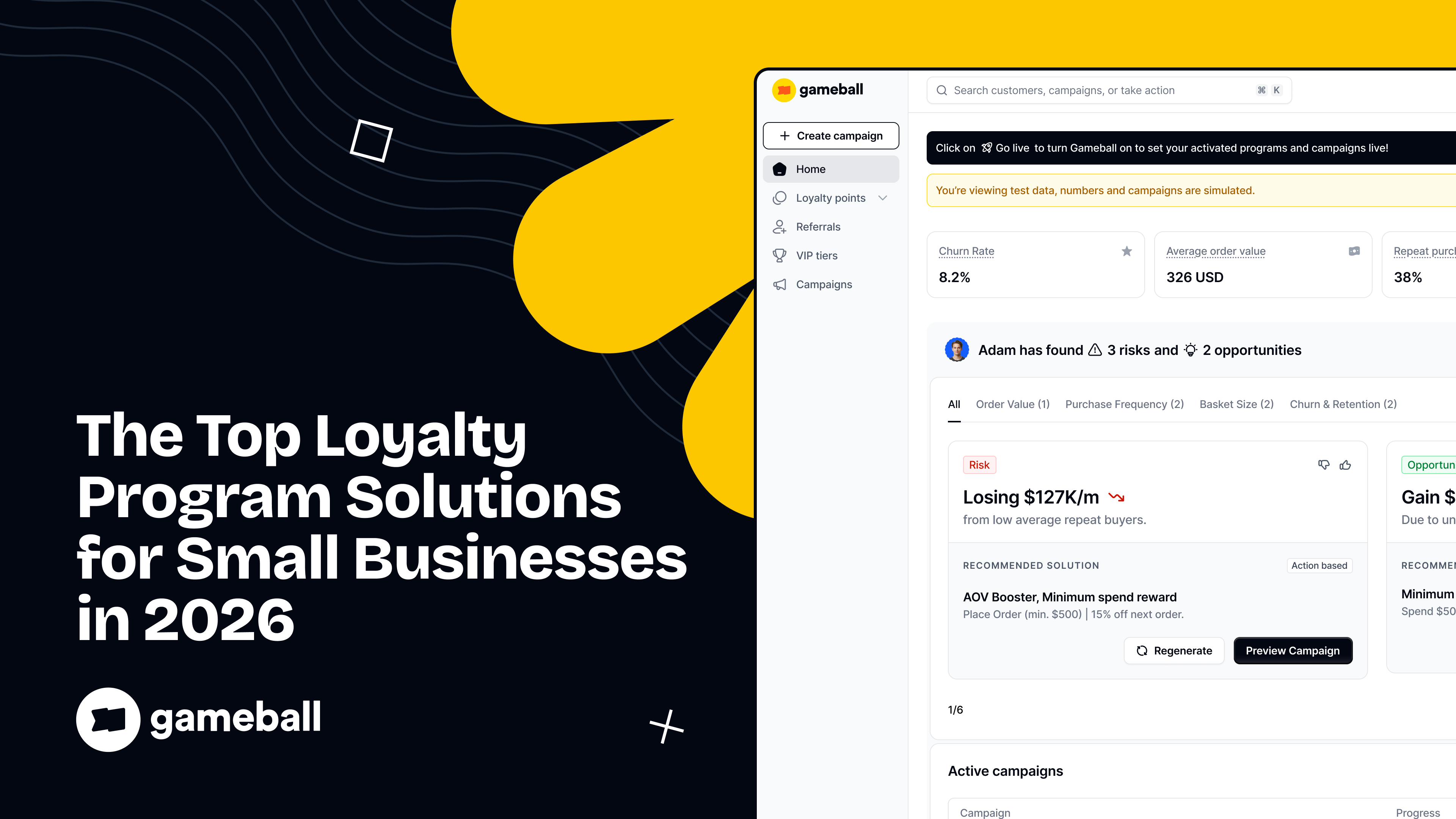
Repeat customers spend 67% more than new ones, yet most small businesses still rely on hope rather than systems to bring people back. A loyalty program changes that equation by giving customers a tangible reason to return.
This guide covers the types of loyalty programs that work for small businesses, the software platforms worth considering, and how to launch and measure a program that actually drives results.
What is a small business loyalty program?
The best loyalty programs for small businesses boost repeat visits and revenue by 15-20%, according to industry benchmarks. Popular software tools like Square Loyalty and Loopy Loyalty make it easy to deploy digital punch cards or point systems that integrate directly with your point-of-sale (POS) and payment systems.
A small business loyalty program is a marketing strategy that rewards repeat customers to encourage continued purchases. Rather than hoping customers come back on their own, you give them a reason, points, discounts, or exclusive perks, which makes returning feel worthwhile.
Benefits of a loyalty program for small businesses
Why bother with a loyalty program in the first place? The short answer: repeat customers are more valuable than new ones, and a loyalty program gives them a reason to keep choosing you.
Here's what a well-run program can do:
- Increased repeat purchases: Customers who earn rewards have a tangible reason to come back, even when competitors are nearby.
- Higher customer lifetime value: When customers stay longer and buy more often, their total value to your business compounds over time.
- Reduced acquisition costs: Retaining an existing customer costs far less than acquiring a new one.
- Better customer data: Every transaction in your loyalty program captures purchase behavior and preferences, giving you data to personalize future offers.
- Competitive differentiation: Many small businesses still don't offer loyalty programs. Having one can set you apart.
Types of loyalty programs for small businesses
Not every loyalty program works the same way. The structure you choose depends on your business model, how often customers buy, and what margins you're working with.
Points-based programs
Points-based programs are the most common format. Customers earn a set number of points per dollar spent, then redeem those points for discounts, free products, or other rewards.
This structure is flexible and easy for customers to understand. A coffee shop might offer 1 point per dollar, with 50 points earning a free drink.
Tiered and VIP programs
Tiered programs unlock escalating benefits as customers reach spending milestones. A customer might start at a "Bronze" level and work toward "Gold" or "Platinum" status with better perks at each tier.
This approach encourages higher frequency and spending. Customers feel recognized for their commitment, which builds emotional loyalty beyond just transactions.
Cashback programs
Cashback programs give customers a percentage of their purchase back as store credit. For example, a 5% cashback rate means a $100 purchase earns $5 toward a future order.
The simplicity of cashback makes it highly appealing. Customers immediately understand the value without doing mental math.
Punch card and digital stamp programs
The classic "buy 10, get 1 free" model has gone digital. Instead of paper cards that get lost, customers now save digital stamp cards to their Apple Wallet or Google Wallet.
This format works especially well for high-frequency purchases like coffee, quick-service restaurants, or salon visits.
Paid and subscription programs
Some businesses charge a fee for premium loyalty benefits. Amazon Prime is the most famous example, but small businesses can offer similar models with perks like free shipping, early access, or exclusive discounts.
Paid programs create committed, high-value customers who have already invested in the relationship.
Referral and advocacy programs
Referral programs reward existing customers for bringing in new buyers. Both the referrer and the new customer typically receive a discount or bonus.
This turns your loyal customers into an acquisition channel, reducing your reliance on paid advertising.
Gamified loyalty programs
Gamified loyalty goes beyond simple points. Challenges, badges, streaks, and missions make earning rewards more engaging and habit-forming.
This approach creates emotional investment and keeps customers coming back even when they're not actively shopping.
Key features to look for in small business loyalty software
Not all loyalty platforms offer the same capabilities. When evaluating your options, here's what matters most.
POS and eCommerce integrations
Your loyalty software needs to sync with your payment processor or eCommerce platform. This allows purchases to be tracked automatically without manual entry at checkout.
Look for native integrations with systems like Square, Shopify, WooCommerce, or your existing POS.
Flexible earn and redeem rules
You want the ability to configure points-per-dollar rates, redemption thresholds, and reward types without calling a developer every time you make a change.
The best platforms let business teams adjust rules on the fly as promotions or margins shift.
Omnichannel customer experience
If you sell both online and in-store, your customers expect a single points balance that works everywhere. Omnichannel loyalty means the program feels seamless regardless of where the transaction happens.
Segmentation and personalization
Customer data becomes powerful when you can act on it. Look for platforms that let you send targeted promotions, like birthday rewards or win-back offers for lapsed customers, based on purchase history and behavior.
Analytics and customer insights
You can't improve what you don't measure. Your loyalty platform needs to track enrollment rates, redemption rates, and program ROI so you can optimize over time.
Built-in referrals and gamification
Advanced platforms often include referral programs and gamified engagement in one system. This consolidates multiple tools into a single dashboard, reducing complexity and cost.
Top loyalty program solutions for small businesses
Here's a comparison of the leading loyalty platforms for small businesses, each with different strengths depending on your sales channels and goals.
Gameball
Gameball offers gamification-powered loyalty with points, tiers, referrals, and promotions in one platform. It works across web, app, and POS without requiring customers to download a separate app.
For small businesses planning to scale, Gameball provides enterprise-grade features, like behavioral segmentation and automated campaigns, without enterprise complexity.
Smile.io
Smile.io is a leading Shopify loyalty app with points, referrals, and VIP tiers. Its generous free tier makes it accessible for new stores, though it's primarily designed for eCommerce-only businesses.
Square Loyalty
Square Loyalty is ideal for brick-and-mortar businesses already using Square POS. Customers enroll with just their phone number at checkout, and the program runs seamlessly within the Square ecosystem.
Loopy Loyalty
Loopy Loyalty creates digital stamp cards that customers save directly to Apple Wallet or Google Wallet. No app download required, making it frictionless for local businesses with high-frequency purchases.
LoyaltyLion
LoyaltyLion focuses on mid-market eCommerce and offers more customization than simpler alternatives. It integrates with Shopify, BigCommerce, and Magento.
Yotpo Loyalty
Yotpo Loyalty is part of a broader suite that includes reviews, SMS, and subscriptions. It's a good choice for brands that want unified retention tools from one vendor.
Kangaroo Rewards
Kangaroo Rewards offers a branded mobile app option, multi-location support, and marketing automation features.
TapMango
TapMango provides a custom-branded app, flexible points system, and integrated eCommerce.
Marsello
Marsello combines loyalty with email and SMS marketing and integrates with POS systems for retail.
How to choose the right loyalty program for your small business
With so many options, narrowing down the right platform comes down to a few key decisions.
Match the platform to your sales channels
Brick-and-mortar businesses benefit most from POS integration. E-commerce businesses look for platform integrations like Shopify or WooCommerce. Omnichannel businesses require a unified solution that works everywhere.
Align rewards with your margins
Your reward structure directly impacts profitability. Configurable earning rates and redemption rules let you protect margins while still offering compelling value to customers.
Evaluate ease of use for non-technical teams
Small teams rarely have dedicated developers. Look for a no-code configuration that lets marketing or operations staff run the program independently.
Check scalability and roadmap
Choose a platform that can grow with you. If you might later add gamification, referrals, or multi-location support, it's easier to start with a platform that already offers those capabilities.
How to set up a loyalty program for your small business
Launching a loyalty program doesn't have to be complicated. Here's a step-by-step approach.
Step 1: Define your loyalty goals and KPIs
Decide what success looks like before choosing a platform. Are you trying to increase repeat purchases, raise average order value, or drive referrals?
Step 2: Choose your program type and reward structure
Select from points-based, tiered, punch card, or other models based on your business model and how often customers typically buy.
Step 3: Configure earn and redeem rules
Set your points-per-dollar rate, redemption thresholds, and reward catalog. Keep the math simple, customers shouldn't need a calculator to understand their rewards.
Step 4: Integrate with your POS and online store
Connect your payment systems and storefronts for automatic tracking. Manual entry creates friction and errors.
Step 5: Launch and promote to customers
Announce your program through email, signage, and checkout prompts. Train staff to mention the program and enroll customers.
Step 6: Monitor, iterate, and optimize
Track enrollment, redemption rates, and ROI. Adjust rewards and rules based on what the data tells you.
Best practices to promote and grow your loyalty program
A great program only works if customers know about it and use it. Here's how to drive enrollment and engagement:
- Enroll at checkout: Make signup seamless with just a phone number or email.
- Train staff to mention the program: In-store promotion increases awareness significantly.
- Promote across channels: Use email, social media, website banners, and receipts.
- Send personalized rewards: Birthday offers, and win-back campaigns for lapsed customers drive re-engagement.
- Keep rewards attainable: Make the first reward easy to reach to build a habit.
- Use automation: Trigger messages for points expiry, tier upgrades, and milestones.
Measuring the ROI of your small business loyalty program
How do you know if your program is working? Track these key metrics.
Repeat purchase rate
Repeat purchase rate measures the percentage of customers who make multiple purchases. This is your primary indicator of loyalty success.
Customer lifetime value
Customer lifetime value (CLV) represents the total revenue a customer generates over their entire relationship with your business.
Redemption rate
Redemption rate shows the percentage of earned rewards that customers actually use. A rate that's too low may indicate disengagement, while one that's too high could pressure margins.
Average order value
Compare the average order value between loyalty members and non-members. Members typically spend more per transaction.
When to upgrade from a basic loyalty app to an advanced platform
Simple tools work well for getting started, but you may outgrow them. Here are signs it's time to upgrade:
- You want omnichannel support across online and in-store experiences
- You're ready to add gamification, challenges, or referral programs
- You're expanding to multiple locations or markets
- You want advanced segmentation and personalization
- Your current tool requires developer help for every change
- You want to unify loyalty, promotions, and marketing automation
Platforms like Gameball are designed to scale from startup to enterprise, so you don't have to migrate again as your business grows.
Build a loyalty program that grows with your business
The best loyalty programs start simple and evolve with your customers. Choose a program type that fits your business model, select software that integrates with your existing systems, keep the experience simple for customers, and measure results consistently.
The right platform scales with you, from your first hundred customers to your first million.
Frequently asked questions about small business loyalty programs
How much does small business loyalty software cost?
Pricing varies widely. Many platforms offer free tiers with limited features, while paid plans typically start around $50-200 per month. Enterprise solutions are priced based on customer volume and feature requirements.
Can I run a loyalty program without a mobile app?
Yes. Many platforms offer digital wallet passes or web-based experiences that don't require customers to download a separate app.
How long does it take to launch a small business loyalty program?
Most modern loyalty platforms can be set up and launched within a few days to two weeks, depending on integration complexity and program design.
Are loyalty programs worth it for businesses with fewer than 100 customers?
Yes. Starting early helps you build customer data and loyalty habits from the beginning. Smaller businesses typically benefit from free or low-cost solutions while they grow.
Can a loyalty program work for service-based small businesses?
Absolutely. Service businesses like salons, fitness studios, and professional services can use visit-based rewards, referral programs, and tiered memberships effectively.
How do small businesses prevent loyalty program abuse and fraud?
Look for platforms with built-in fraud controls such as purchase validation, points holds until transactions clear, and automatic refund adjustments.
.svg)
.svg)
.svg)

Ready to level up your game?
Create your first campaign and start seeing results in 30 days.
Ready to grow?
Get in touch with our sales team today.
The loyalty vendor checklist your CTO
will thank you for
Discover engineering challenges, essentials, and more from global brands.

Gameball Staff
Stay ahead on retention
Subscribe to our newsletter and get all the latest updates as we post.

Ready to level up your game?
Create your first campaign and start seeing results in 30 days.
Read related articles
_compressed%2520(1)%2520(1).avif)

.avif)
Ready to level up your customer loyalty?
Level up your customer loyalty!


.avif)
.avif)
.avif)
.avif)