
%207.svg)

.svg)

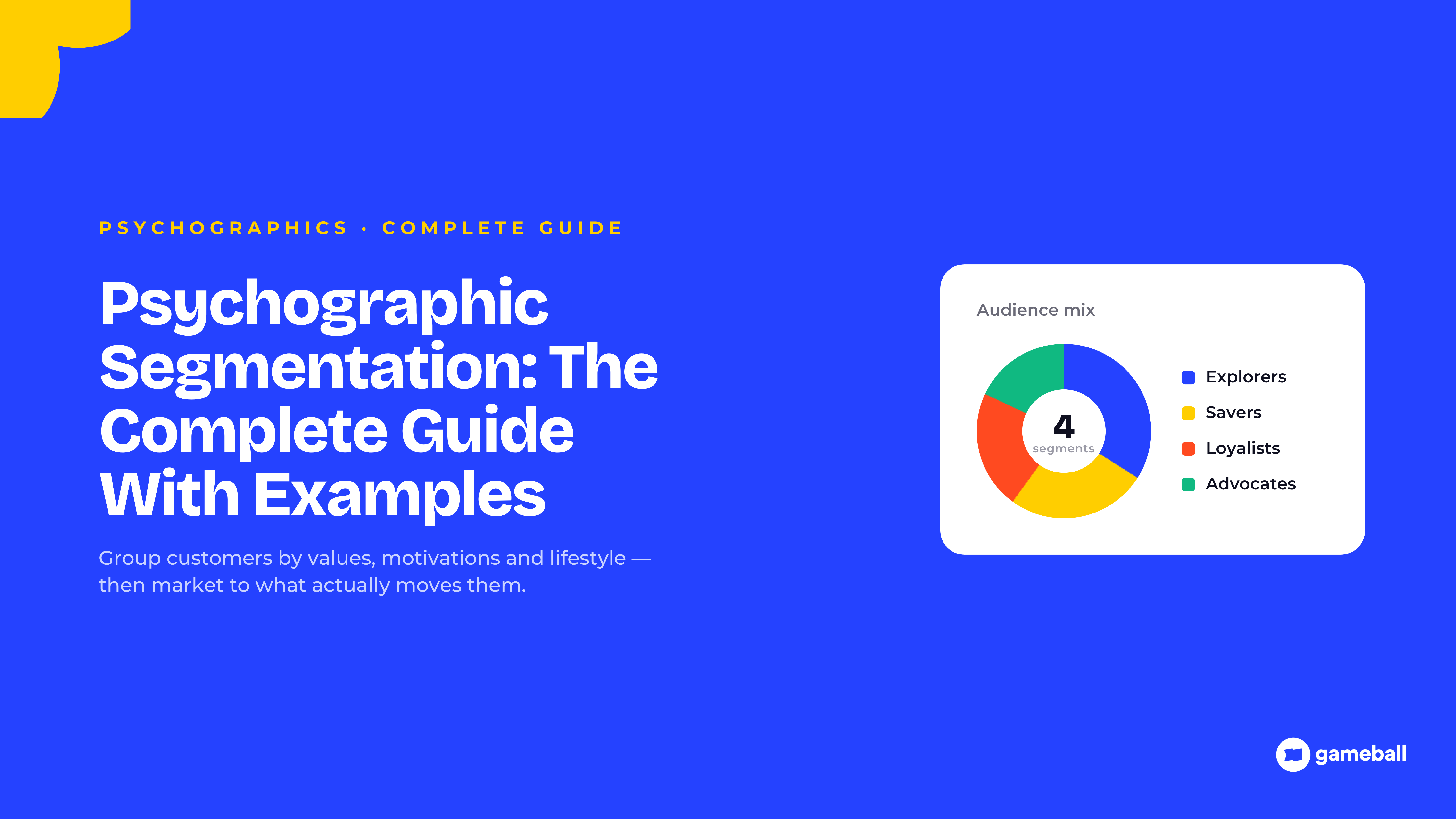
Psychographic segmentation is the practice of grouping customers by their psychological traits: their lifestyles, values, personalities, interests, and attitudes. Unlike demographics, which describe who a customer is, psychographics explain why they buy. That 'why' is what lets you write messages, design rewards, and build products people actually care about.
This guide covers the definition, the five core psychographic variables, how to collect the data without a huge research budget, and four real examples you can copy. If you run marketing for an ecommerce, retail, or subscription brand, this is one of the highest-leverage skills you can build.
What is psychographic segmentation?
Psychographic segmentation divides a market into groups based on shared psychological and lifestyle characteristics rather than surface-level facts like age or location. A demographic profile might tell you a shopper is a 32-year-old woman in Dubai. A psychographic profile tells you she values sustainability, follows fitness influencers, shops in short focused bursts, and is willing to pay more for brands that share her values. The second profile is the one that helps you sell.
The concept sits alongside three other classic approaches. To see how they fit together, read our companion guide on customer segmentation, which maps all four models side by side.
Psychographic vs demographic vs behavioral segmentation
These three are easy to confuse because they overlap. Here is the simplest way to keep them straight:
| Type | Question it answers | Example |
|---|---|---|
| Demographic | Who is the customer? | Age 25-34, female, urban, mid-income |
| Psychographic | Why do they buy? | Health-conscious, ambitious, values convenience |
| Behavioral | What do they do? | Buys monthly, redeems points, opens every email |
The strongest segments combine all three. Demographics and behavior are easier to measure, so most teams start there. Adding psychographics is what turns a generic campaign into one that feels personal. For the behavioral side, see our detailed guide on behavioral segmentation.
The 5 psychographic variables (the AIVLP model)
Most psychographic data falls into five buckets. A useful memory aid is AIVLP:
- Activities and interests: hobbies, sports, causes, and how people spend their free time. A customer who follows marathons responds to different imagery than one who collects sneakers.
- Values and beliefs: what matters to them, such as sustainability, family, status, health, or value for money. Values drive brand preference more than almost anything else.
- Lifestyle: the rhythm of daily life, including budget habits, family stage, and how much time they have. A busy parent and a student both want convenience for very different reasons.
- Personality: traits like adventurous, cautious, social, or analytical. Personality shapes tone: some shoppers want bold and playful, others want calm and factual.
- Attitudes and opinions: how customers feel about your category, price, and competitors. Attitudes predict who will try something new versus who needs social proof first.
How to collect psychographic data (without a big budget)
You do not need an expensive market research firm. Most brands already sit on the raw material:
- Surveys and quizzes: a short 'help us personalize your experience' quiz at signup is the fastest way to capture values and interests. Keep it to three or four questions.
- Product reviews and support chats: the language customers use reveals what they care about. Tag recurring themes like 'gift', 'sensitive skin', or 'eco'.
- Social and community signals: which posts they engage with, which hashtags they follow, and which of your campaigns they share.
- Loyalty program data: the rewards customers choose say a lot about their motivations. Someone who always redeems for early access values status and novelty; someone who redeems for discounts values savings. A loyalty program turns everyday activity into a steady psychographic signal.
- On-site behavior: the categories people browse, the content they read, and the filters they use all hint at lifestyle and values.
According to McKinsey, personalization done well can lift revenue by 5 to 15 percent and cut acquisition costs meaningfully. Psychographics are the fuel that makes that personalization feel human instead of creepy.
Psychographic segmentation examples
1. Activewear brand: the 'aspirational athlete'
A fitness apparel brand notices a segment that follows athletes, buys around New Year and the start of summer, and engages with goal-setting content. The brand builds a 'training streak' challenge that rewards consistency, not just spending. Messaging leans on achievement and identity rather than discounts.
2. Beauty retailer: the 'clean-beauty believer'
A beauty retailer identifies shoppers who filter for cruelty-free and sustainable products and who read ingredient content. This segment gets early access to clean launches and a rewards tier that donates to environmental causes. Values, not price, drive their loyalty.
3. Coffee chain: the 'ritual seeker'
A coffee chain finds a group that visits at the same time every morning and values routine and convenience. A punch-card style streak reward and a fast reorder flow fit their psychology perfectly. For how habit-based rewards work, see our guide to instant rewards.
4. Fintech app: the 'ambitious optimizer'
A fintech app spots users who track spending closely and value progress and control. Gamified savings goals and status badges speak to that mindset far better than a generic cashback offer.
How to use psychographic segments in marketing and loyalty
Segmentation only pays off when it changes what you do. Put your segments to work like this:
- Tailor messaging: match tone and imagery to each segment's values and personality.
- Personalize rewards: offer status perks to novelty seekers and savings to value seekers. A flexible loyalty engine lets you run different reward logic per segment.
- Design better journeys: trigger the right message at the right moment with automated journeys.
- Prioritize products and content: build more of what your most valuable psychographic segments love.
Benefits of psychographic segmentation
Investing in psychographics pays off in several concrete ways:
- Higher relevance: messages that speak to values and identity get opened, clicked, and remembered more than generic promotions.
- Stronger loyalty: when customers feel a brand shares their values, they stay longer and forgive the occasional misstep. This emotional connection is far harder for competitors to copy than a price cut.
- Better product decisions: knowing the mindset of your best segments tells you what to build, stock, and promote next.
- More efficient spend: you stop wasting budget on messages that do not fit and concentrate it where it resonates, which lowers acquisition and retention costs.
- Premium positioning: shoppers who buy on values are often less price-sensitive, which protects your margins.
Common mistakes to avoid
Psychographic segmentation goes wrong when it is treated as a one-off exercise or a stereotype. Watch out for these traps:
- Guessing instead of measuring. Do not invent personas from the boardroom. Ground every segment in real survey, review, or behavioral data.
- Too many segments. Five rich segments you act on beat twenty you cannot. Start small and expand only when each is being used.
- Set and forget. Values and lifestyles shift. Refresh your segments at least once or twice a year, or let them update automatically from live data.
- Ignoring behavior. Psychographics are strongest when paired with what customers actually do. On their own, they can flatter to deceive.
- Being creepy. Use insight to be helpful, not to show off how much you know. Personalization should feel like good service, not surveillance.
How to get started this week
You can take a first step without a big project. Add one or two lifestyle or values questions to your signup or account flow. Read your last fifty reviews and tag the themes that come up most. Then group your customers into three rough psychographic buckets and write one tailored message for each. Small, fast experiments teach you more than a perfect plan that never ships, and they give you real data to refine your segments over time.
How Gameball helps
Gameball's segments and analytics turn everyday customer activity into living segments, then let you attach different loyalty, gamification, and messaging logic to each one. Instead of guessing at psychographics from a one-off survey, you build them continuously from how customers actually engage. Ready to see it on your own data? Book a demo.
Related reads
- Customer Segmentation: Strategy, Process & Growth Tips
- Cracking the Code of Customer Behavior: A Guide to Behavioral Loyalty
Frequently asked questions
What is psychographic segmentation?
Psychographic segmentation is a way of grouping customers by psychological traits such as lifestyle, values, interests, personality, and attitudes. It explains why people buy, which makes marketing and rewards more relevant than demographics alone.
What are examples of psychographic segmentation?
Common examples include grouping shoppers as health-conscious, status-driven, budget-focused, eco-minded, or convenience-seeking. A brand might build a 'clean-beauty believer' segment and reward it with early access to sustainable products.
What is the difference between psychographic and demographic segmentation?
Demographic segmentation describes who a customer is, such as age or location. Psychographic segmentation explains why they buy, based on values and lifestyle. Used together, they create richer, more actionable customer profiles.
How do you collect psychographic data?
You can collect it from short signup quizzes, product reviews, support conversations, social engagement, on-site behavior, and the rewards customers choose inside a loyalty program.
.svg)
.svg)
.svg)

Ready to level up your game?
Create your first campaign and start seeing results in 30 days.
Ready to grow?
Get in touch with our sales team today.
The loyalty vendor checklist your CTO
will thank you for
Discover engineering challenges, essentials, and more from global brands.

Gameball Staff
Stay ahead on retention
Subscribe to our newsletter and get all the latest updates as we post.

Ready to level up your game?
Create your first campaign and start seeing results in 30 days.
Read related articles

_compressed%2520(1)%2520(1).avif)
Ready to level up your customer loyalty?
Level up your customer loyalty!


.avif)
.avif)
.avif)
.avif)