
%207.svg)

.svg)

![Types of Loyal Customers in E-commerce: A Complete Guide [2026]](https://cdn.prod.website-files.com/6909c94feb8ec80110e2e8bb/69efd971b8e49b75bb3c6f2d_69efd94af2a8eea4dbb0d2b2_types-of-loyal-customers-in-e-commerce-a-complete-guide-2026--main-image.webp)
You've probably heard people—us included—talk A LOT about loyal customers. How they're amazing and a must-have for any business. And they truly are.
Let's not forget the commonly referenced statistic about how selling to a loyal customer can be 20 times more successful than selling to a new one. (Harvard Business Review)
Or the stat that shows that a mere 5% increase in customer retention can push up your profits by 25% to 95%. (Harvard Business Review)
But did you know that there are different types of loyal customers?
It's true.
Customer loyalty is important. But it's equally important to consider the different types of loyal customers and how these levels of customer loyalty affect your business.
In this article, we'll be tackling many aspects of customer loyalty, specifically the different types of loyal customers. We'll also explain what a customer loyalty ladder is and how to reward loyal customers to make them even more loyal to your brand.
Who is a loyal customer?
A loyal customer is someone who not only likes a brand and their products, but also buys from them regularly. Whenever they need a certain product, their mind automatically goes to their favorite brand.
The simplest definition of a loyal customer is one who keeps coming back.
Research by Annex Cloud from 2020 found loyal customers willing to "pay more" by an average of 33% per transaction or order compared to regular or not-loyal customers.
It's because of this that brands spend lots of time to create and build what's known as customer retention or customer loyalty.
Why is customer loyalty important?
Having loyal customers is important. Great. What does that mean? And why are they so coveted?
Here are several clearer reasons why you should increase customer loyalty:
- Entices customers to buy more and therefore boosts revenues and sales
- Reduces customer acquisition costs (CAC)
- Increases customer retention
- Offers better opportunities to ask for and get referrals.
- Increases customer lifetime value
- Boosts average order value (AOV)
According to Fundera, 43% of customers who are brand loyal are willing to pay more for that brand's products.
A survey by Annex Cloud found that 46% of customers were more likely to buy from a brand that offers a customer loyalty program. In addition, 54% said they "would consider doing more business" with a brand if it offered rewards.
The research also found 87% of consumers wanting more brands to offer loyalty and rewards programs. At the same time, brands with loyalty programs reported 'an increase in loyalty memberships' in the past year.
What are the 5 stages of customer loyalty?
As you can see, with loyalty, the data is positive. Having loyal customers can grow your business significantly and sustain it in the long-term.
But to understand loyalty, we'll need to look at the five stages of the customer and loyalty journey. After that, we'll examine the six types of loyal customers.
Here are the five stages of loyalty, according to Tycoon Story.
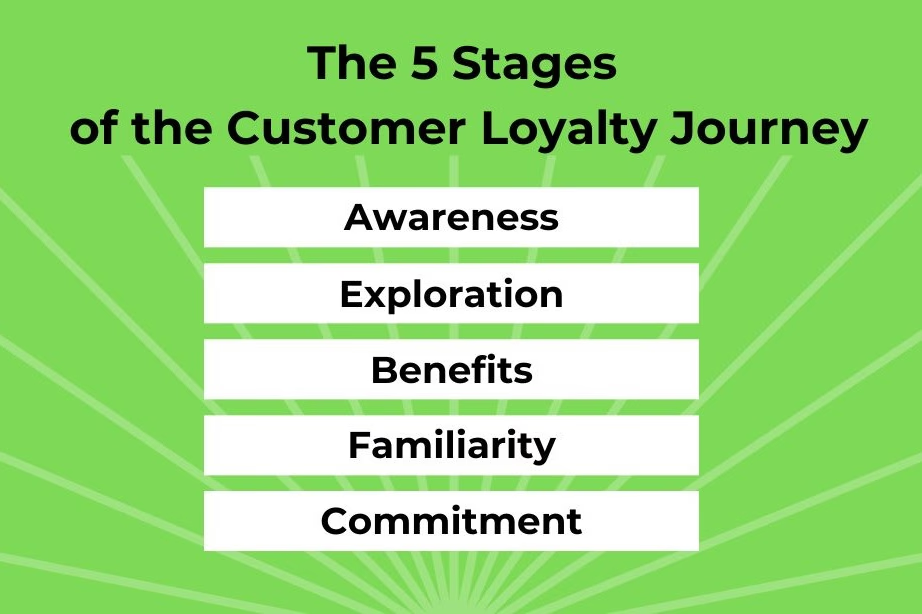
Let's explore each in brief.
Customer loyalty stage 1: Awareness
Every brand and marketing effort starts with awareness. To get people to buy from you, they must first become aware of who you are and what you're selling.
This is also known as brand awareness. Creating pages on social media, publishing enticing posts, and having an e-commerce website are the first steps in creating awareness.
Customer loyalty stage 2: Exploration
Once a customer comes across your ads, your pages, or your website, they begin exploring. They explore your website, your products, whether or not you have positive reviews, and so on.
Using search engine optimization (SEO) for products means you can appear organically—without paying for ads—when customers search for products similar to yours.
This should not deter you from running a few ads on social media platforms where your target audience is.
Customer loyalty stage 3: Benefits
Your products should not only come with a description but also offer value for customers.
Let's say you have an e-commerce beauty store. You sell multiple brands along with a few local ones. It's imperative you clarify the details for each product and the benefits they get from using this product.
You can go a step further and mention who this product isn't for. While this may reduce your sales, customers will thank you for saving them time and money spent on products that don't help them.
For example, mentioning that a certain type of lotion for dry or normal skin will create a sticky feel if people with greasy skin use it, will save these people time in trying a product that's not for them.
With benefits, you want to stand out from the competition, but you should always put the customer first.
Customer loyalty stage 4: Familiarity
This is the next stage in both the buyer's journey and loyal customers' journey.
First impressions are important. But once you've nailed the first impression, you've already started a relationship with your customer.
Now it's time to entice that customer into being a regular and a devotee. Now, they need to become familiar with your brand and products.
Customer loyalty stage 5: Commitment
Customer satisfaction and loyalty go hand-in-hand. Satisfied customers become loyal customers. And loyal customers become committed customers and brand ambassadors and advocates (whom we'll talk about in the next section).
Commitment is the last stage of the customer loyalty journey. At this stage, it's easier to build more connections and trust with your customers.
As a business, you want to offer these committed and loyal customers the best level of service and the best return on their experience.
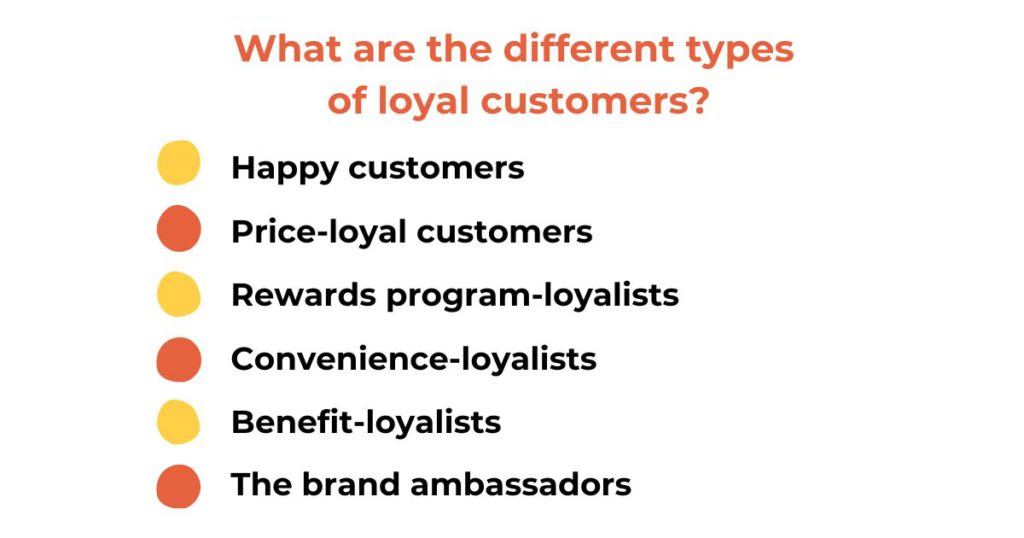
Different types of loyal customers
We've clarified why customer retention is important and how the customer loyalty journey works. Now, it's time to identify who those loyal customers are, what or who they're loyal to, and how they affect your business.
Loyalty comes in several forms as you'll see with the following types of loyal customers. You'll notice that some customers are loyal to 'things' other than your brand.
1) Happy customers
The first group is simply the happy customers. They are satisfied with the products or services you offer. They like you and they regularly buy from you.

They are loyal but not 100% loyal. They can be buying from you and your competitors or may easily turn to your competitors if they make a better offering than yours.
2) Price-loyal customers
This group is loyal to price. They're also known as 'discount seekers' or 'bargain seekers.' If you offer a lower price than your competitor, they'll come to you.
It's often not worth the hassle to retain this type of customer because for them it's all about price.
Quality often doesn't factor in their calculations. At the same time, constant discounts will either eat into your revenues and profits (a LOT!) or tell customers you're overpricing your products (so you're not trustworthy).
3) Reward program loyals or loyalists
These are customers who are loyal because you have a rewards program. And it's not a bad thing. They're enticed by the rewards and benefits you're offering. However, they may not be 100% brand loyal.
The problem with this group of rewards-program-loyalists is that they'll take the utmost you have to offer via your rewards program. They'll max it out if they can.
That said, you can use a variety of customer rewards to engage them even when they're not buying from you. You can use their rewards-program-loyalty to get them to leave reviews in exchange for points. In other words, you'd be playing the long game.
4) Loyal-to-convenience customers
This group of 'fairly' loyal customers is loyal to you when it's convenient for them to buy from you. Convenience customers don't necessarily look at price. In fact, some customers may pay more for the convenience.
Convenience may come in the form of being located closer to them or having stores in multiple locations.
It's possible to turn convenience-lovers into a loyal following if you figure out how you're a better option for them.
Enhancing your customer service response time or service in general can turn them into brand-loyal customers. Being friendly in your offline locations and asking for their feedback are ways to build a stronger relationship between your business and these customers.
4.5) The meh loyals
Another type of convenience customer is the 'meh customer' or the 'just-because' loyals. These are a negative type of convenience customer.
They are people who may not like your brand but buy your products or visit your restaurant for convenience. It's the closest to their job or something along those lines.
5) Benefit-loyalists
Similar to the loyalty-program-loyalists, this group is loyal to the benefits you offer them, not to you.
It's very hard to retain this group, and it's often recommended that you don't even try.
An example of a benefit-loyalist is a customer who enters your store for the restroom. To justify their using of the restroom, they decide to buy the smallest or cheapest thing you have.
6) The brand ambassadors
These are the customers you're looking for and want to retain. The truly loyal customers are those who are not only satisfied with your products but also think of you first when their needs arise.
These loyal customers make regular purchases from your online or physical stores. They contribute to your monthly revenue.
These loyal customers are where customer satisfaction meets loyalty. They're customers who will eagerly try your new products and offer feedback, which means if you want to test a new product or offering, these are the customers to reach out to.
They're your brand ambassadors because they'll eagerly refer you to friends, family, and colleagues. They're probably the most active in your referral program.
What is a customer loyalty ladder?
Loyal customers are the bread-and-butter of any business, online, in-store, mobile app, or all combined.
Businesses dream of getting customers who buy from them the moment they enter their store for the first time. Or of making that first purchase and instantly becoming a loyal customer.
But customer loyalty doesn't happen overnight. You need time to nurture customers, whether it's after they see your ads or after they make the first purchase.
This nurturing process takes time. And while building customer loyalty is a fruitful process, it's also a long and not-so-simple one.
Factor in the increase in the number of home-grown brands and products, the ease of cross-border e-commerce, and rising inflation, building loyalty is, unfortunately, becoming harder.
This nurturing process is sometimes called the customer loyalty ladder. Like a ladder, customers pass through stages—or rungs—rising higher as they engage more frequently with your brand and begin trusting you more.
According to HubSpot, there are four levels within the customer loyalty ladder. These are lead, customer, client, and advocate.
“The hope is that [customers] will progress up each step of the ladder to eventually become staunch supporters of your business.” (HubSpot)
How to identify your loyal customers
Now that you know the different types of loyal customers, it's time to find out which customers fall under which category. You should, then, create a customer retention strategy and explore ways to retain your top customers.
You can also help customers rise up in the loyalty ladder.
To identify which category of loyalty your customers are in, we recommend you engage with your customers.
A customer engagement strategy will not only help you build loyalty, but also generate interest and excitement around your products.
It will help you build more relationships with customers who may not be your brand ambassadors but who can contribute greatly to your revenues.
We also recommend using a loyalty and rewards program and avoiding the common loyalty program mistakes. Having a rewards program helps you identify your loyal and semi-loyal customers and increase engagement and awareness.
How to reward your loyal customers
Knowing how to reward your loyal customers is important. Traditional loyalty programs relied on a points-for-purchases equation. Modern and successful loyalty programs, however, use this as one of several tactics.
Instead of tying points to purchases, e-commerce brands like you can offer more ways to gain points, such as:
- leaving product reviews
- sharing social media posts
Afterwards, customers can use these points to get special coupons or discounts or freebies like free shipping, or even gifts.
Many brands start with the most common type of loyalty program, which is the points-based program. As they grow, gaining thousands of customers, many switch to tier-based rewards programs, which drive more loyalty by creating a community.
Some of the world's most popular brands using tiered loyalty programs include Ulta, Sephora, and most recently Gap.
Regardless of the type of program you choose, you should create a desire to use and rise within your program. That way, customers won't get bored and instead will remain invested and interested.
Increase customer loyalty with Gameball
The good thing about loyalty programs today is that you don't have to struggle and pay lots of money to create them in-house.
Using loyalty and rewards programs like Gameball saves you tons of time and money. You also get tons of benefits, features, and analytics to help you examine your customers' behavior.
Gameball's newest segmentation feature takes your loyalty program to a whole new level. It lets you to divide customers into groups based on
- Interests
- Behavior
- Location
- Buying preferences and patterns
- Demographics
And much more.
The Gameball team launches new features on a monthly basis. And you can even propose features and see them added to the program.
As a customer engagement and retention platform, Gameball offers various unique ways to engage with and reward customers. Here are a few of those tactics:
- Challenges and missions, where customers perform certain actions to win badges, points, and/or rewards
- Cashback rewards
- Instant rewards
- Gamified levels
We highly recommend you pair your rewards program with your referral program to grow your customer base and loyal following.
Final words
Building long-term relationships with customers is essential for any business that wants to succeed today.
You need to be present for your customers and engage with them.
The days where brands were islands unable to connect with customers, just hoping people will come into their store and buy their products, are gone!
Like any relationship, it takes two to build that relationship. Customer loyalty isn't any different.
As a business, you'll have to exert some effort to attract and retain your customers. A loyalty and rewards program helps you achieve many retention and growth goals. It also comes with metrics that you can track to ensure a successful loyalty program.
Even some of the world's leading luxury brands have loyalty programs, so why shouldn't you?
If you want to see how loyalty programs help you retain customers and turn them into brand-loyal followers, sign up for Gameball today and give customers an experience they'll never forget.
If your store is on Shopify, you can get Gameball directly from the Shopify app store.
.svg)
.svg)
.svg)

Ready to level up your game?
Create your first campaign and start seeing results in 30 days.
Ready to grow?
Get in touch with our sales team today.
The loyalty vendor checklist your CTO
will thank you for
Discover engineering challenges, essentials, and more from global brands.
.avif)
Nada Sobhi
Content Writer
Stay ahead on retention
Subscribe to our newsletter and get all the latest updates as we post.

Ready to level up your game?
Create your first campaign and start seeing results in 30 days.
Read related articles


_compressed%2520(1)%2520(1).avif)
Ready to level up your customer loyalty?
Level up your customer loyalty!


.avif)
.avif)
.avif)
.avif)